3 April 2024: Out with Basil and friends: We found a male and a female plains-wanderer.
27 March 2024: Robert reported ten blue-winged parrots seen along the Delta Creek north of Wanganella.
26 March 2024: Nick from the States and I went out for the day and evening. Five plains-wanderers located — four males and a female, all in close proximity.
19 March 2024: Out with Dan and Harry from the UK and another Dan, from Ireland, for the day and evening, Two female and two male plains-wanderers were found.
15 & 16 March 2024: Eric, an ornithologist from Hawaii, had birded Australia quite a bit back in the 1990s, so he only had a fairly short list of potential life birds to be seen around Deniliquin. However, he didn’t have a camera back in the nineties so was keen to photograph as many species as possible. On the first morning, we headed out to the boree country north of town to search for superb parrot and painted honeyeater. There’s been a lot of superbs feeding along the Hay Road of late, from the town right out to the boree, feeding in both the black box and boree on the TSR. However, not a single bird was to be seen today as we drove north! I wasn’t too worried as I thought we would run into them somewhere. We had good luck with the painted honeyeaters out in the boree, seeing both an adult and several juvenile birds. It’s getting to the time now when they are starting to head back north, so you can never be certain of finding them. Also, it has barely rained here for two months so it’s getting dry which increases the uncertainty. Historically they use to often hang around until at least April and I think on at least one occasion I had one still present out there in June in the 1990s. But what happened back then and what happens now are two completely different things. There are still plenty of berries on the grey mistletoe so hopefully they will be around for a while yet. A few other non-target species were photographed here including bluebonnets, striped, spiny-cheeked and singing honeyeaters, grey-crowned babblers, southern whiteface and a cracking male red-capped robin but still no superb parrots.
A couple of wedge-tailed eagles as well as brown falcons and nankeen kestrel were added to the list. We moved on to some black box country as western gerygone was on the hit list. We did see them but they would not cooperate for a photo. Also at this locality we encountered chestnut-rumped and yellow-rumped thornbills and five black-faced woodswallows which surprised me as I had never seen them here previously and which are generally a scarce bird in the district nowadays. A big flock of white-fronted chats were present here feeding in a nearby paddock of lucerne.
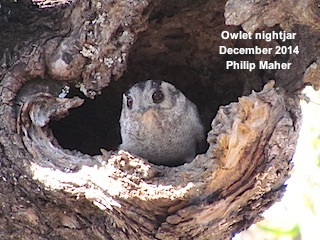
We called in up the road at my revegetation area at Monimail and Eric photographed an owlet nightjar in one of my nest hollows. Plenty of mistletoebirds here as well. I have five species of mistletoe established here now with a couple in fruit and the rest ripening in coming weeks and months. It will be a smorgasbord for mistletoebirds and honeyeaters for months to come.
Still no superb parrots and I was getting a little uneasy now. Given we hadn’t run into them I thought we better make a concerted effort and seek them out. We tried a patch of large mature boree nearby and luck was with us with several birds seen including a cracking adult male resting up in the heat of the day.
We headed out on the plains north of Wanganella mid-afternoon. Eric had spotted crake on his hit list, so we paid a visit to Black Swamp. Both Cooper’s and Black Swamps are drying out fast now after filling up over twelve months ago. They both had a bit of a top up this past summer, particularly Cooper’s. Another month or so will probably see both of them dry up completely. Both swamps are a seething mass of European carp and the great egrets are making the most of the easy pickings now. There are scores of great egrets present, mainly immature birds that I presume have come down from the breeding colonies on the Murrumbidgee and Lachlan Rivers. There were fewer white-faced and white-necked herons and a some plumed egrets as well as scores of royal and yellow-billed spoonbills and a few great and little pied cormorants and dozens of pelicans. It was quite the spectacle. There will be a stench out there in coming weeks or months when the swamps finally dry out and millions of carp perish. Nutrients will be recycled into the ground when the swamps dry out, making for an explosion of life when they flood again.
It didn’t look great for spotted crake but I was pleasantly surprised when a couple appeared from nowhere. No sign of black-tailed native hen which was also on Eric’s list. I doubt the spotted crakes will be there much longer either.
We headed across to the plains-wanderer property now and were greeted near the entrance by a superb adult spotted harrier on the ground less than a hundred metres off the road. We both snapped some decent shots.
Banded lapwings (and plains-wanderers) have become scarce of late due to all the rain in November/ December making the ground cover a little too dense for them. Luckily, I had a tip off from John as to where there were still a few lapwings hanging on. We managed to locate about seventeen banded lapwings on a dam where John had seen them. We continued north heading up towards the pine ridge at Booroorban where chestnut-crowned babblers were our quarry. On route, scores of red kangaroos were seen and a good few emus. Up near the pine ridge, a lovely immature Australian hobby was perched up on a fence posing nicely for photographs. The hobbies have done well this season and there have been quite a few immatures about. (One took a singing honeyeater at Wanganella SH area only a week ago). I had not been up here looking for the chestnut-crowned babblers for a few years, so I had a little trouble locating the spot but eventually I got my bearings and in a short time we encountered a large group. They can be quite wary at times but eventually Eric had some decent photos.
The sun was sinking fast now so we made haste back south to the plains-wanderer country. A few stubble quail were seen on the verge of the track in the late afternoon. There had been hundreds around of late but they have started to thin out a bit in recent weeks.
We waited for nightfall. We walked less than a hundred metres from the vehicle before three plains-wanderers were spotted with the thermal. Two females and a male, all immature, but one of the females was quite well-coloured. Most of the birds we have been seeing lately have been immatures and I think that many of adults have probably moved on as the vegetation has become thicker in the last few months. The three birds were fairly close together which I thought a bit unusual at this time of year and it being a bit dry at present. I’m guessing one or the other of the females was perhaps trying to establish a pair bond with the male for when it does eventually decide to rain. They will breed at almost any time of year, particularly if they have not bred well in the previous spring/summer. The plains-wanderers did not breed very well this past season due to September and most of October being outrageously dry and conversely, November and December and some of January being wet and eventually rendering the vegetation too dense for them. They just couldn’t win. However, they bred so well the previous year that it didn’t really matter. I am guessing that most of the immature birds we are seeing now are between eight and twelve months old.
We went spotlighting from the vehicle looking for buttonquail after our success with the wanderers, eventually finding two immature red-chested buttonquail and a couple more stubble quail. Surprisingly another three plains-wanderers were seen when we were driving around, two flushed up and one seen on the ground. It had become a little windy and the immature birds can often be a little flighty on a windy night. Six birds for the night is our best tally for quite a while and amazing given that only a month ago we had completely missed them on two occasions. Eric was more than pleased now so we headed for home.
Next morning we headed out west of Pretty Pine in search of diamond firetail, a scarce bird in the district nowadays. West of the Pine some raptor activity was noticed and we pulled up and had little eagle, whistling kite and brown goshawk as well as ravens. They all soon dispersed so I’m not sure what was going on. One was probably trying to take a kill off another perhaps. It is always good to have a sighting of little eagle nowadays as it is a scarce bird.
There was small bird activity near some native willow trees a bit further out and we had rainbow bee-eaters, yellow-rumped thornbills and Eric finally had good looks and photos of western gerygone. We searched in vain at the locality where I had previously seen diamond firetails. It was quite windy so not good conditions to be looking for them. Eventually I sighted a juvenile firetail with almost no colour, but it got away before Eric could get onto it. No more could be found so we gave up on that and headed back towards town.
On the way back a commotion was noticed with a raptor and a large flock of long-billed corellas and sulpher-crested cockatoos. I thought it may have been black falcon but when we got out it turned out to be a big female peregrine. Always a notable sighting and the first I have seen in the district for some time. We were having quite a good raptor day.
We called in to some black and grey box country on the TSR near The Pine and were pleased to see a couple of diamond doves still present. The resident pair of hooded robins was also seen well. Eric glimpsed a couple of what was almost certainly painted buttonquail but they soon vanished under the thorny saltbushes. A nice flock of tree martins was present, and a sacred kingfisher was seen briefly.
We headed out southeast of town now in a last ditch effort to see diamond firetail. We searched an area of black box woodland with a scattering of boree trees that has been one of the last refuges for diamond firetail through the long years of drought. It was the middle of the day now, although not overly hot, but still not an ideal time to be searching for them. We found a few other birds — another pair of hooded robins was seen and yellow-rumped thornbills and southern whitefaces. The firetails often feed with other small ground birds so I thought they might be nearby. Eric thought he could hear them calling and with some perseverance we eventually tracked them down, a cracking pair of adults. Eric got some decent photos as well. On the way back into town we stopped for a small flock of zebra finches on the roadside near a rice crop, completing the finch list for the district and a scarce bird now as well. We were both pleased with our morning’s work and Eric set off for the mallee a happy man.
12 March 2024 The revegetation plots: As many of you know, my great labour of love has been the three revegetation plots I have around the district. For want of something better to do I went back through my notebooks and did the maths on how many plants have gone in the ground in the last twenty-eight years. The first revegetation plot, the old Forestry house site at Gulpa, which was started in 1995, has had 6,850 trees and shrubs planted, the Monimail on the Hay Road, started in 2002, has had 7,150 plants and from 2001, at the Wanganella Sandhill, 30,100 plants have been planted, making a total of 44,100 plants. At a guess, I'd say I've lost, due to drought, 4000 at Gulpa, 3000 at the Monimail and 20,000 at the Wanganella Sandhill. All plants but a few thousand in the first year or two were grown by me. These sites are now paying dividends in the number of species they attract and are a fantastic resource for our birding tours in this district.
4 March 2024: Out with Mark and Linda from the UK for the day and evening. In the morning we had about fifteen superb parrots, one immature painted honeyeater, rainbow bee-eaters, grey-crowned babblers, western gerygone, bluebonnets, white-winged and purple-backed fairywrens, two southern boobooks and around four hundred plumed whistle-ducks. In the afternoon and evening we saw Australian pipits, brown songlarks, a Horsfield's bushlark, emus and red kangaroos. After dark, one red-chested buttonquail, one little buttonquail, one barn owl, three fat-tailed dunnarts and two plains-wanderers — an immature female and an immature male.
28 February 2024: Out with Simon Star and his client: Three male plains-wanderers sighted and another that got away.
25 February 2024: Out with Trevor from Queensland – NO plains-wanderers!
5 February 2024: Out with my mate Steve Davidson and his client - NO plains-wanderers!
3 February 2024: Out with Arco from Taiwan for the evening. In a more timely fashion than my outing with George and Jens, Arco and I found a female plains-wanderer and two males.
1 February 2024: George from Massachusetts and Jens from Denmark joined forces for the day and evening. We eventually found a male plains-wanderer with two large chicks. This was the first time I had been out since 23 December, after which Trisha and I headed to Cairns and on to Iron Range for two Wet Season tours and then to the opposite end of the country for a private Tasmania tour. George was on the second Wet Season tour and Tasmania. I don't know whether George was losing faith in me during the night but it took four long hours to find a plains-wanderer.
5 January 2024: Robert took out South Australians, Pieter, his wife and five-year old son for the evening. They had a highly successful time, not only getting a female plains-wanderer and a red-chested buttonquail but earlier finding painted and striped honeyeaters, budgies, superb parrot, Baillon's and spotted crakes and grey-crowned babbler.
2 January 2024: Robert kicked off a wet and stormy first outing of the New Year with Dale and Helen from the UK and Trevor and Margaret from South Africa. They found a pair of drenched plains-wanderers, a red-chested buttonquail, stubble quail, barn owl and a boobook. Not a bad effort for what seemed like impossible conditions. Good work Robert!
23 December 2023: Nathan from Canada and Sebastian from Australia joined forces for an evening excursion on the plains. We found a pair of plains-wanderers.
19 December 2023: Out with Diane and Georgina from Victoria for the evening. Diane has been out with me a few times but plains-wanderer was new for Georgina. We found two female plains-wanderers and also located Diane's other 'wanted' species — red-chested buttonquail — of which we saw two, an adult female and a juvenile. We also saw little buttonquail and stubble quail and many banded lapwings. Earlier in the evening, we had painted honeyeater, budgies, white-browed woodswallow and red-backed kingfisher, among other species. Weatherwise, it was a particularly windy evening.
16 December 2023: Out with Andrew and Kelly from the States for an evening's plains-wandering excursion. We located two females and one male plains-wanderer and a red-chested buttonquail.
15 December 2023: Robert and I had a look for painted snipe today — to no avail, but we did see three Australasian bitterns and one Latham's snipe.
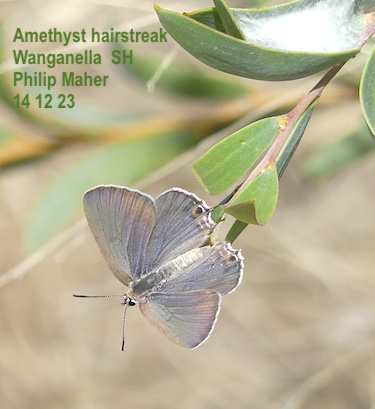
14 December 2023. Amethyst hairstreak at the Wanganella sandhill revegetation area. A pair was hanging around a young boree-type acacia, which are a larval food plant for this species. I don’t often see these guys.
 bb
bb
12 December 2023: Out with Grigory and Veronika from Russia. We didn’t start until 7 pm but did pretty well. We saw an adult, female plains-wanderer, and stubble quail, little buttonquail, banded lapwing, barn owl, fat-tailed dunnart …
Before nightfall we had painted honeyeater, striped honeyeater, black honeyeater, spiny-cheeked honeyeater, and about forty budgies. At the Wanganella sandhill we saw a red-backed kingfisher and two owlet nightjars. Lots of Pacific swifts around. Much to Trisha and my amusement, Grigory and Veronika, already running late, overshot Deniliquin by about thirty kilometres having actually driven through the town from north to south and turning around at Mathoura — hence the late start. They were lovely people if not great navigators!
5 December 2023: Out with Kirsty from the ACT, James from Sydney and James from Ohio for the day and evening. In the afternoon we located the Australasian bittern, which was found by Robert a couple of days ago. After dark, we got a pair of plains-wanderers. James from Ohio described the day as one of the best day's birding he's ever had — which is gratifying to hear.
3 December 2023: Robert saw an Australasian bittern on a swamp north of Wanganella.
3 December 2023: A large Rockjumper Tours group, led by my mate Steve Davidson, and Glen from Rockjumper, were out for an evening's plains-wandering. On foot, we found a female plains-wanderer and a couple of little buttonquail, several stubble quail and banded lapwings. Earlier, at the Wanganella sandhill, we had owlet nightjar, several black honeyeaters and red-backed kingfisher. Back at the boree, we saw about six painted honeyeaters, a pair of southern whiteface, a couple of groups of white-winged fairywrens and some bluebonnets.
2 December 2023: My mate Chris from Adelaide came over for an evening's birding. We saw the same trio of plains-wanderers that I saw with Alfred and Christina, i.e., a female and two males.
30 November 2023: Alfred, who immigrated to Australia from Germany, and his daughter Christina, spent two days with me. Alfred, a keen photograher, has been with me a few times and wanted to share the experience with Christina. Very wet underfoot but we saw a trio of plains-wanderers, i.e., a female and two males. A few little buttonquail were seen as were some fat-tailed dunnarts.
28 November 2023: Julie, Merinda and I headed out at 8 am to bird the local area for the morning. We recorded a couple of dozen superb parrots and two male painted honeyeaters. We also saw a few groups of white-winged fairywrens, with two nice adult males in the mix.
27 November 2023: Julie and Merinda from the NSW South Coast and I were due to go out plains-wandering tomorrow night but thunderstorms and up to 40 mm of rain were forecast, so we headed out to the plains-wanderer propery soon after they arrived in town this afternoon. We saw striped honeyeater, red-backed kingfisher and owlet nightjar at the Wanganella sandhill revegation site, and after dark, barn owl, Australian pratincole, a red-chested buttonquail, about fifty stubble quail and a pair of plains-wanderers.
26 November 2023: Angela and Andrew from the UK and I were out for the day and evening. We found a female plains-wanderer at night and a male was seen in flight in daylight. We also recorded little and red-chested buttonquails, stubble quail, Australian pratincole, banded lapwing, barn owl and during the day, two owlet-nightjars.
24 November 2023: Tonight with a Firetail group, we found a pair and a trio of plains-wanderers, making five in all. We also ticked stubble quail and little and red-chested buttonquails. On our way out to the plains-wanderer property in the late afternoon, we spotted a spotted harrier.
18/19 November 2023: The final plains-wanderer weekend of the season produced three plains-wanderers — two females and a male. Little and red-chested buttonquails were also recorded.
Species list
15 November 2023: Out with another Rockjumper group. We saw three plains-wanderers: two females and a male. Bird of the (early) evening for me was a black-eared cuckoo at my Monimail revegetation enclosure — a first for the site. We also saw lots of Australian pratincoles on the plains, including one on a nest. We couldn't find this species two nights ago.
13 November 2023. Back from a great week with Sue and Phil from South Carolina. We birded the mallee, the Great Ocean Road, Healesville and the Beechworth/Chiltern area. But tonight Robert and I were out with Tropical Birding from the States. We recorded seven plains-wanderers, being two females and five males. We also saw a male little buttonquail with at least two chicks, a male red-chested buttonquail that may have had chicks, about fifty stubble quail, three barn owls, at least thirty banded lapwing, over a hundred black-tailed nativehens, Horsfield's bushlark, brown songlark, white-winged fairywrens, black-faced woodswallows, among other species. Spade-foot frog was seen and we heard a lot of growling grassfrogs.
8 November 2023: Robert out with a big Bellbird group. Still wet underfoot but they managed two female plains-wanderers. Earlier, back at the Wanganella sandhill, they got owlet nightjar and black honeyeater, and at the Billabong Creek they recorded crested shriketit.
7 November 2023: Robert took Mark Finn, of Birding Breaks (Scotland) and his client out for a wet evening on the plains. (The plains-wanderer property had over two inches of rain from a couple of thinderstorms).They got a male plains-wanderer standing in water.
4/5 November 2023 Plains-wanderer Weekend. Three female plains-wanderers and two males seen. Three buttonquails for the day. Species list
2 November 2023: Out with Birding Ecotours, based in Ohio,for the evening. We recorded a female plains-wanderer and two males. We also saw red-chested and little buttonquails among other good species.
29 October 2023: Keen Australian photographers, Richard, Dean and Daniel, went out with me for the day and evening. It was a late night but we found a trio of plains-wanderers, i.e., a female and two males, and then another two females and finally, in another paddock one more male, making six in all.
27 October 2023: Another VENT group for the day and evening. We located five plains-wanderers in all: a pair, a female and two males.
21/22 October 2023: The second Plains-wanderer Weekend of the season produced two pairs of plains-wanderers. Saturday morning we saw a black-eared cuckoo, among the four species of cuckoo we recorded at Gulpa, and a square-tailed kite. Species list
19 October 2023: Out with a big VENT group. We got two pairs and a male plains-wanderer.
16 October 2023: Three Belgium birders, Mark, Luc and Peter went out with me for the day and evening. Mark had been out with me last century (1989). Very windy day but we found a pair of plains-wanderers and another male.
11 October 2023: Out with my old friend Steve, guiding for Rockjumper Birding Tours. We got a swag of plains-wanderers — nine in all: three pairs and three males.
9 October 2023: Out with Bellbird Tours for the evening. We got six plains-wanderers all up: a pair of plains-wanderers, three male plains-wanderers and a female plains-wanderer.
7/8 October 2023: Just back from our Strzelecki Track Outback Tour and straight into the first of the season's Plains-wanderer Weekends. Perfect weather and six plains-wanderers all up — a pair, a female, and three males. Species list.
2 October 2023: Robert out with three Polish birders, Jacek, Tomek and Darek. It was blowing a gale but they managed two male plains-wanderers and a possible female that flew.
29 September 2023: Robert out with a couple of Chinese birders and their guide. Four of more plains-wanderers sighted. Hard to keep track with the birds moving around in the moonlight. All males.
28 September 2023: Robert out with another Australian couple. They got a male and a female plains-wanderer and a red-chested buttonquail.
25 September 2023: Robert out with an Australian couple for the evening. They saw nine plains-wanderers: one female and eight males. Robert got his first rainbow bee-eaters of the season.
16 September 2023: Out on the plains with my Strzelecki Track Outback Tour group before we head off on this epic tour. Only two male plains-wanderers seen and another got away before we could get our bins on it.
11 September 2023: Out again today with Andrew and Roland. As they had been here previously (2019) they didn’t have many target birds and were down to the toughies. We got off to a good start, scoring a pair of diamond firetails as we headed south to Gulpa. This is the fourth locality I have seen this species in in the last couple of months so they are definitely making a comeback but are still a scarce bird and there is still none back in Gulpa Island where they were once reasonably common. We had a great sighting of around fifty superb parrots (mostly males) feeding in a paddock of oats out in the farmland near Gulpa.
In the revegetation area at Gulpa a couple of pairs of western gerygone were seen and a pair of mistletoebirds that were feeding on the nectar of the grey mistletoe flowers and the berries of ruby saltbush. There is obviously still a shortage of ripe mistletoe berries in the area. It won’t be long before the box mistletoe berries start to ripen, and some grey mistletoe berries won’t be far away.
A female painted buttonquail was calling in the revegetation area at Gulpa but only Roland was lucky enough to get a brief view. She was not as bold as they sometimes are when they are breeding so decent views where hard to get.
Rufous songlarks were calling at various localities in suitable habitat south of town and my first white-winged triller for the spring was seen on the sandhills in Gulpa Island.
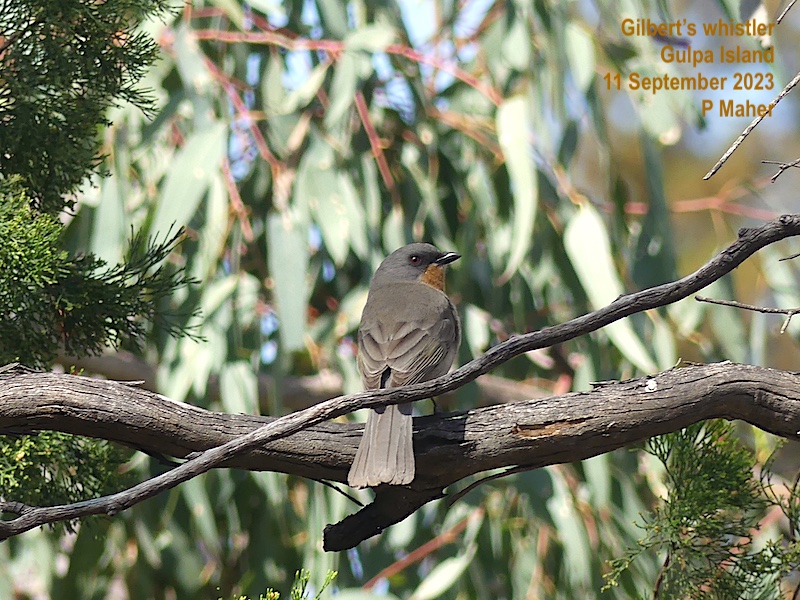
Four pallid cuckoos were seen between Deniliquin and Gulpa, which is the most I have seen in a day around here for many years. My friend Eris reported dozens on his farm about twenty kilometres west of Mathoura in the last week so obviously they have got their numbers up quite a bit in the last couple of good seasons. Strangely enough we did not see any inside the forest at Gulpa Island but we did see three other cuckoo species: fantailed cuckoo and shining and Horsfield’s bronze-cuckoo. We tried hard for black-eared but none could be found. In the 1980s and 90s they were regulars on the sandhills in Gulpa Island for a short period in the spring. Both red-capped (two adult males) and hooded robins (also two adult males) were seen on the sandhills at Gulpa as well as brown goshawk, white-browed babbler and dusky woodswallows. Our best sighting in Gulpa Island was a superb, adult male Gilbert’s whistler. I first heard this bird call back on 13 March of this year but this is the first actual sighting since 1 November 2019. I thought we had actually lost this species from the river redgum forests altogether so it is great to know they are still hanging on, albeit precariously.
10 September 2023: Andrew (UK) and Roland ( Germany) were to go birding in Gabon this month but the military coup at the end of August put paid to that plan. So Andrew and Roland returned to Australia, and most particularly Deniliquin, for plains-wanderer, which they missed when they were here in February 2019, during the mother of all droughts. We saw a pair of plains-wanderers and another female plains-wanderer. We got heaps of stubble quail, two barn owls, two banded lapwing including one on a nest. During the late afternoon, we saw a black falcon and a spotted harrier.
9 September 2023: The Gulpa revegetation area rain-gauge this morning showed 6 mm. It looks like September is going to be a lean month for rain. Gulpa has had a tad more than 200 mm so far for the year, which is around half the yearly average with only about three and a half months to go. I did manage to see a Horsfield’s bronze-cuckoo and a pallid cuckoo down there this morning. It is my first sighting of pallid cuckoo this spring. A few superb parrots passed over, indicating that some are nesting down in the forest. Spiny-cheeked honeyeaters were calling and plenty of singing honeyeaters were about. Noisy friarbirds were feeding in the red-flowered yellow gums and I heard brown-headed honeyeaters and weebills calling. One, possibly two, pairs of mistletoebirds were very active. At least one pair of mistletoebirds has been present here all winter. At home, our three garden mistletoebirds have almost cleaned up all the ripe mistletoe berries in about a week! There was a lot there too.
3 September 2023: Delighted to report a male red-capped robin at the Wanganella sandhill this morning.
29 August 2023: A pair of mistletoebirds sighted in our garden. The male was chasing the female, indicating an interest in breeding perhaps.
27 August 2023: One ground cuckoo-shrike sighted south of Pretty Pine. They have been hanging around this area lately so they may be nesting. To my eye, the area appears too grassy for them.
26 August 2023: There were two groups of diamond firetails feeding along the side of the Old Morago Road. One of the groups I've seen over the last six months or so. The new group comprised about six birds and included some juveniles. Diamond firetails are a scarce species in the district nowadays.
22 August 2023: About thirty pink-eared ducks and a dozen or so black-tailed nativehens at Johns. Robert saw a white-breasted woodswallow at his house, the first for the season.
19 August 2023: Ian from Christchurch and Theodoulos from Cyprus and I went out plains-wandering. We found a pair of plains-wanderers and another male plains-wanderer.
16 August 2023: Out with Scott from Sicklebill Tours and Americans, Trent and Meta, for an evening tour. In the afternoon at Pretty Pine we had a few diamond doves that probably overwintered and a painted buttonquail. After dark, we witnessed a barn owl catch and eat a stubble quail. Stubble quail was on the 'specials' menu for barn owls — we must have seen fifty stubble quail. Plains-wanderers were also out in force. We saw a total of seven — five males and two females. Four of those males were in close proximity to each other. Don't know why. Banded lapwing was also a new species for Trent and Meta.
1 August 2023 Wanganella Sandhill revegetation area: I’ve been out at Wanganella Sandhill revegetation area doing some maintenance on the cliffs where the white-backed swallows nest. They have not been around for about three months now and I’m getting a bit worried about them.
There has been at least one red-backed kingfisher this year, overwintering, on the Hay Road so I am hoping that they might take an interest in nesting in the cliffs as well. (Red-backed kingfishers often nest with the white-backed swallows). I made some nest holes for kingfishers and the swallows with a piece of metal pipe and a sledgehammer. Even the rainbow bee-eaters might be tempted to nest here this year. They usually call in for a look when they arrive back but have never nested.
The Horsfield’s bronze-cuckoos started singing today indicating that spring has arrived — at least a month early. The weather appears to be turning dry here and the forecast does not look good for the spring so the birds are wanting to nest ASAP. Many species have started singing in the last week.
There are many groups of both superb and purple-backed fairywrens living on the sandhill now so the bronze-cuckoos have plenty of targets. I sighted at least three Horsfield’s bronze-cuckoos today.
About half a dozen common bronzewings are present on the sandhill at the moment and appear to have settled in so I am hoping that they too might breed here for the first time this season.
30 July 2023: Wanganella Sandhill: A little eagle was sighted flying over the sandhill. Possibly a new bird for the revegetation plot list.
29 July 2023: I am guessing that the three ground cuckoo-shrikes I saw today at the Monimail are the same three Angus saw on Wednesday just north of town. The ground cuckoo-shrikes today were being harassed by noisy miners.
29 July 2023: Wanganella Sandhill: A new species for the Wanganella sandhill revegetation plot — three or four zebra finches. This is the first time I have seen them inside the enclosure. Also sighted two Horsfield's bronze-cuckoo — the first returns for the season. Western gergones were calling. It looks like it's going to be an early spring. Swamp harriers have been displaying and calling over the dry swamp these last two weeks.
26 July 2023: Angus found three ground cuckoo-shrikes about three kilometres north of Deniliquin.
16 July 2023: Delighted to see a pair of rufous whistlers in our garden.
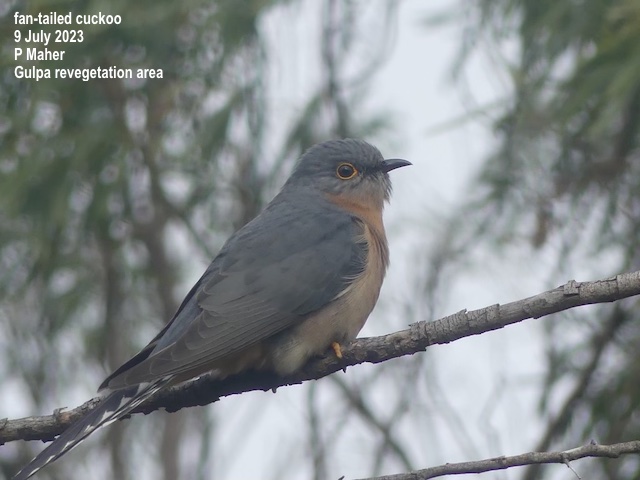
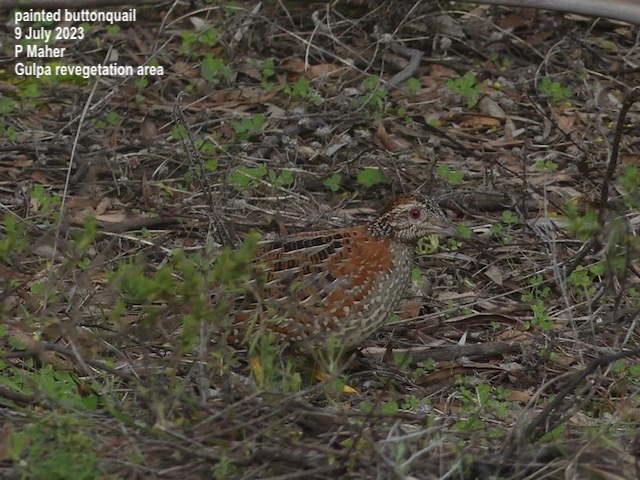
9 July 2023: Gulpa revegetation area: a fan-tailed cuckoo and a painted buttonquail observed in the plot.
8 July 2023: Male collared sparrowhawk recorded at Wanganella Sandhill, and a western gerygone, a couple of rufous whistlers and the regular Wanganella sandhill species.
6 July 2023: Out with my old friend Ron from Sydney, Adam from Rockjumper Birding Tours, who lives in South Africa, and Richard, also from Africa but now living in Tasmania, and Adam's two young sons. This was Adam's tour and he had a short list of new birds to see, most of which we saw: buff-rumped thornbill, blue-bonnet, brown-headed honeyeater, superb parrot, purple-backed fairywren, white-winged fairywren, zebra finch ... But of course, plains-wanderer was the most important species on the list, being Adam's last family. We found four birds, two male and two females. The females seemed to be adult birds, as their legs were bright yellow but their gorgets had not quite coloured up. During the day we also saw four or five sitellas, and my owlet nightjar at the Monimail revegetation site. After dark, we got stubble quail, a barn owl and a tawny frogmouth. We observed a few fat-tailed dunnarts and plenty of red and eastern grey kangaroos.
25 June 2023: Sighted a red-backed kingfisher on the powerlines near Clarkes Creek, just south of Wanganella. It's an unusual record for June; they usually turn up in September.
19 June 2023: Trisha and I have just returmed from the warmth of Far North Queensland where we ran a couple of big birding tours from Cairns to Cape York to Mt Isa and back to Cairns.
It was back to the local haunts on this dreich afternoon with Steve from Michigan. We headed out to look for Steve's two target species: superb parrot, of which we saw about half a dozen including a couple of nice males, and plains-wanderer. We found a female plains-wanderer within minutes of starting our search, and also saw a score of stubble quail. While not on Steve's two-species target list, it was good to see an adult pallad cuckoo at the Monimail revegation site, the first I've seen for several months.
26 May 2023: Roibert took Irby, a Cornell University professor, out to look for a plains-wanderer. Irby lecures in Bird Families of the World so had 'a hankering to see the birds in unusual families'. Robert didn't disappoint him, getting three female plains-wanderers. They also saw stubble quail, banded lapwing and fat-tailed dunnart, among other species.
18 April 2023: The revegetation area at Gulpa is finally starting to produce birds again after the long years of drought. This morning a large group of about fifteen dusky woodswallows appeared and fed in the tree tops. I was pleased to find a pair of restless flycatchers with the woodswallows, a scarce bird in the district nowadays. The restless flycatchers have not been in the Gulpa revegetation plot for many years.
A large group of white-plumed honeyeaters were present, some feeding in a flowering ironbark. Quite a few juveniles were among the white-plumes, indicating a good breeding season. They were trying to see off a spiny-cheeked honeyeater to no avail. There are lots of singing honeyeaters here at present. A couple of mistletoebirds are still about although the mistletoes are not fruiting as profusely as I expected. Still, there will be lots more ripening in coming weeks.
Quite a few peaceful doves are here aand the diamond doves are still about. The peaceful doves were a new addition to the avifauna here in recent months, as were the diamond doves.
My most prized sighting this morning was a brown flame robin. This is the first sighting in here for maybe fifteen or twenty years, probably since before the years of drought that commenced in the early 2000s. There’s hardly been any sightings in their regular haunts in the district in the last five years although a few were seen last winter. It appears their numbers are starting to pick up with the better seasons over the last three years.
At least one brown red-capped robin is still present and has been singing so is probably a young male. Striated pardalotes are feeding in the grey box and a large group of yellow-rumped thornbills is about and quite a few yellow thornbills. The single chestnut-rumped thornbill is still around; I am hoping it finds a mate.
17 April 2023: Robert reported that about six blue-winged parrots were feeding in saltbush country on their property, north of Wanganella. To my knowledge, this is the first record for the district this autumn and about a month later than their usual annual appearance in the last couple of weeks of March. There has been some good rain out there in the last few weeks.
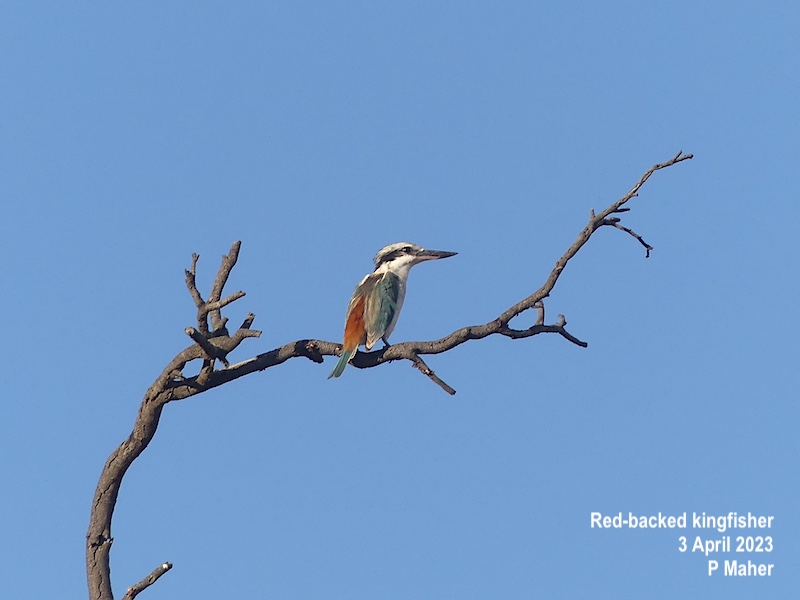
3 April 2023: Simon from Firetail Bird Tours and his client Tim and I went out for an evening's excursion. We found eleven plains-wanderers, comprising three females and eight males. It's difficult at this stage to tell the immatures from the adults. Among the other good birds we saw was a male red-chested buttonquail. On the way out, in the boree country, I was thrilled to see my first red-backed kingfisher in this district since 6 October 2020.
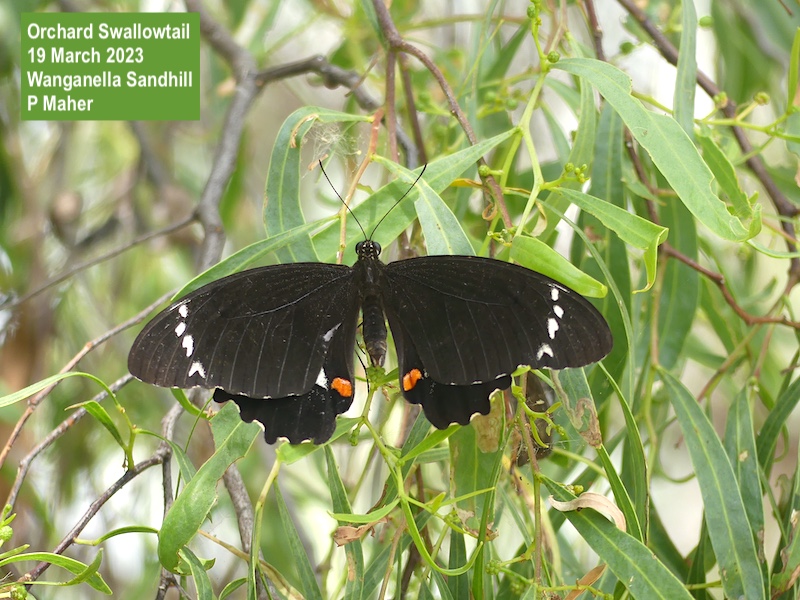
19 March 2023: A first for the Wanganella Sandhill revegetation area — an orchard swallowtail butterfly. Last seen (by me) in this district on 15 January 2011 at Gulpa.
16 March 2023: My old mate George Appleby and his partner Chrissy and I went out for the day and evening. On the drive out in the early morning, the green iridescence of a male superb parrot crossed the road in front of us but didn’t stop. We headed out to the boree country to check the hot spot I found late on Tuesday afternoon only to find it was not quite so hot. Still, we persevered and eventually George spotted a juvenile painted honeyeater, which I think was a new bird for Chrissy. We hunted around until we had some great looks at striped honeyeaters. Yellow-vented bluebonnets were seen and eventually a pair of white-browed woodswallows but no sign of the hundred or so I had seen on Tuesday. We moved on to the black box near Monimail to try for superb parrots and we soon located some but no adult male. Some nice looks were had of juvenile birds. We headed up to the revegetation area to see my owlet nightjar who rarely disappoints. Some brown quail were seen briefly as we approached the owlet nightjar tree. We searched some more boree country and luck was with us as a single full adult male superb parrot was seen up close in a boree tree. Feeling satisfied now with our morning we headed back into town for lunch and a break. The day was warm so we ventured out again at 5 pm.
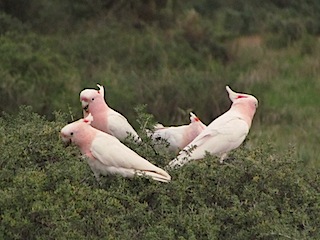
We headed straight out to Wanganella and just north of Wang, George spotted three ground cuckoo-shrikes sitting on a fence by the road. As we approached them to try for a photo, pink cockatoos were observed feeding in an introduced pine tree. Wow, two mega birds in about a minute! Unfortunately, a kid came past on a motorbike and flushed the ground cuckoo-shrikes before we could get decent photos. The cuckoo-shrikes appeared to be two adults and a juvenile. It is unusual to see them here as it is mostly all black soil and they primarily feed on red or grey soil plains. The grass is usually too dense for them to feed on the ground in black soil country but on this occasion a wide fire break had been recently slashed on the north side Wang and I think that may have drawn them to the area. We were distracted by the pink cockatoos at any rate and the ground cuckoo-shrikes disappeared. The pink cockatoos were more obliging and came up close for photos. There were two adults and two juveniles — we saw the adults feeding them. They do love the introduced pines (Pinus halepensis, I think) and will come from many miles away to seek them out. It was great to see that they have bred as very few young were raised during the drought years.
We were all in good spirits now as we headed for the plains-wanderer property. We just had enough light to get the obligatory emus and red kangaroos before we reached our destination in the plains-wanderer paddock. We had a bite to eat as we waited for nightfall. Venus was showing brilliantly in the western sky as darkness fell. We started our search on foot with the thermal scope and soon had no less than six plains-wanderers including and an almost fully-coloured juvenile female. Also, on our walk, several stubble quail were seen including a female with three well-grown young, a couple of little buttonquail and surprisingly, we recorded an owlet nightjar in the plains-wanderer paddock — a first. Several fat-tailed dunnarts were observed. Two of the female dunnarts had young clinging to their bellies. (They are a marsupial but only have a rudimentary pouch). We had a reasonable look at one and it appeared to have six young clinging to it, which seems an extraordinary number. I didn’t appreciate they had such big litters. No wonder there are so many out there at times. They probably need to get their numbers up a bit as there was likely a high mortality when the country was flooded last spring. The incredible numbers of insects out there at present would certainly support their having big litters of young.
After our great success on foot, we went for a drive spotlighting and another three plains-wanderers were located, making nine in total for the night, including a superb adult female.
Next up, we had no less than four red-chested buttonquail although not the highly desired adult female. George and Chrissy could scarcely believe their luck. A drive through a bare area around the edge of a dried out swamp produced a superb juvenile inland dotterel and an adult banded lapwing. There was not much left to look for now and as it was approaching 2 am we decided to head for home. A single barn owl was seen on our drive back to town.
14 March 2023: I birded this morning with James from Sydney and in the afternoon we were joined by John and Christine from Perth.
The first stop in the morning with James was a drying out lagoon in North Deniliquin. We started our list with a nice lot of herons, egrets, night-herons and yellow-billed spoonbills feasting on small carp. We moved on as I was keen to find James a painted honeyeater, which had been a bit elusive of late. Luck was with us on this occasion though, as our first stop in the boree country produced a juvenile painted honeyeater. It allowed us some nice photos.
We moved on to some black box country out near Monimail where our target bird was superb parrot. They too were obliging and a couple of males posed nicely for us in the top of a black box tree. Grey-crowned babblers were putting on a good show. We called in at the revegetation area at Monimail where my little owlet nightjar peeked from its roost hollow.
We birded more boree country further north where yellow-vented bluebonnets were added to the list. Striped honeyeaters were heard at several localities but refused to show themselves. Plenty of spiny-cheeked and singing honeyeaters, as well as chestnut-rumped thornbills were seen. An owlet nightjar gave a call from a nearby black box tree but we were unable to locate it. I was hoping the ground cuckoo-shrikes we had seen around here a few days previously might put in an appearance but it was not to be.
Our last stop of the morning was in another clump of black box where we added southern whiteface, red-capped robin, weebill and western gerygone to the list. Nice photos were had of all four species. Yet another owlet nightjar gave a brief call here. They are starting to build their numbers up a bit now after becoming so scarce during the long years of drought.
Pleased with our morning’s efforts we headed back to town for lunch and a break as the day was starting to heat up.
Later in the afternoon, James and I were joined by John and Christine. We headed out north again to bird the boree country which has been productive of late. On route to the boree, an Australian hobby was seen sitting in a dead tree. It was very rufous on the breast indicating that it was a juvenile. We tried again for painted honeyeater as John and Christine were keen to add it to their list. It was still quite hot and the birds, initially weren’t too active. After an hour or so of not seeing much, it started to cool down. Soon we had birds going every which way. We barely knew which way to look. At least four juvenile painted honeyeaters were seen and a similar number of striped honeyeaters. A large flock of around a hundred white-browed woodswallows seemed to materialise out of nowhere. A single white-winged triller was seen and a couple of rufous songlark, both of which have become scarce of late as they have started to shift about. An adult pallid cuckoo suddenly appeared. This surprised me as I thought it a bit early for them although Robert had also seen a pallid cuckoo a few days prior out on the plains. It has been an unusual season though with the massive rains in the spring. Plenty of yellow-vented bluebonnets and singing and spiny-cheeked honeyeaters were mixed in with all the other birds. White-winged and purple-backed fairywrens were also seen in the same bush at one stage, although the coloured males were a bit elusive. It was some of the best birding I had had in the district for some time.
We headed out onto the plains, having overstayed our time in the boree country. We stopped at Cooper’s Swamp on the plains and nice views were had of a couple of spotted crake. Swamp harrier was seen, and a few immature black-tailed native-hens were still about (the adults seem to have moved on). Hoary-headed grebes and little grassbird were added to the list. We hurried out to the plains-wanderer property now as the shadow of the earth was starting to appear in the eastern horizon.
We had a bite to eat as we waited for darkness. We had not walked far from the vehicle before we had our first plains-wanderer. A couple of males were seen before we hit the jackpot with an adult female. Stubble quail and fat-tailed dunnart were added to the list. All up we had six plains-wanderers on our walk, most of them juveniles.
We went for a drive to try for some buttonquails. It was a hot night and the insects had been horrific, swarming all over me whenever I turned the torch on. As we started driving, we were amazed by the incredible number of bats that were following us around, catching insects in the lights. There were up to ten bats circling the vehicle, catching insects, at any one time. There were several different sizes in the bats. I don’t know how many species of bat we saw. The largest bat may have been Gould’s wattled bat. In a lifetime of spotlighting, I can’t recall ever having seen the incredible number of bats seen as on this night. It was a spectacle.
Our luck was still holding with the birds and we didn’t have to go far before we had a couple of little buttonquail. We finished the night off with a male red-chested buttonquail. A single barn owl was seen on our drive back. It was barely midnight when I dropped a happy James, John and Christine at their accommodation.
13 March 2023: I went down to the Gulpa Island forest (Murray Valley Regional Park) for the first time since the floodwater had receded. In the thick pines and dwarf cherry around the sandhills I could scarcely believe I could hear a male Gilbert’s whistler calling. The long droughts over the last twenty years pretty much wiped them out at Gulpa. The last record I have is from 1 November 2019. It was great to hear one back in their old haunts.
Some of the other passerine birds have picked up their numbers. I saw a couple of groups of yellow and buff-rumped thornbills, a few pairs of red-capped robins and some brown-headed honeyeaters. All these species have become scarce in the last two decades. Other species seen in reasonable numbers included peaceful dove, dusky woodswallow and rainbow bee-eaters. The bee-eaters were doing a lot of flying about and making quite the racket, perhaps getting excited about their approaching migration. A big female brown goshawk was observed keeping a close eye on a pair of wedge-tailed eagles. The brown goshawks have nested in this area for years. I was disappointed not to see any white-browed babblers. The species has been declining in the Gulpa sandhills for years. The pair of hooded robins that inhabits that part of the forest was not seen either, but they are easily missed and the day was warming up. I searched for black-chinned honeyeater around the flowering grey box and box mistletoe that they are fond of, but I didn't have any luck. I don’t think we have seen them in Gulpa since 2007 but after my success in Millewa forest last week, they could well turn up in Gulpa again. The grey box looks fantastic, and some trees are covered in flowers. It is the best flowering I can recall — ever.
It was interesting to see that nearly all the dwarf cherries growing in amongst the river redgum trees have been killed due to the exceptionally high floodwater this past spring. The flood stayed high for quite some time during October and November. I have not seen the dwarf cherry killed en masse like this in previous floods, but this past flood is probably the highest I have seen in my lifetime. It went at least a foot higher than any of the floods in the 1980s or 90s and most likely the 1970s as well. The dwarf cherries growing in amongst the river redgums in the 2022 flood were completely covered by water. The dwarf cherries growing in and around the sandhills on higher ground are all doing fine, so there is still a fair amount of habitat for species that like tall shrubs. It will have some effect on the forest for some years to come as big areas have been killed and it will need to come back from seed as the bushes are showing no signs of life. On a more positive note, the dwarf cherries have almost certainly increased in density over the last couple of decades due to the lack of flooding.
Overall, the river redgums and the forest is looking the best it has looked since the 1990s. This past flood saved the river redgum forests, which have been badly drought affected these past two decades. The pines too are looking the best they have looked for many years. The floodwater has killed a few pines in the lower areas where they have grown in recent decades. The floodwater also killed many introduced weeds that were growing in the river redgum forests but unfortunately many have germinated since the floodwaters have receded.
11 March 2023: Robert, while mustering sheep, saw a male plains-wanderer.
11 March 2023: Paul from the Blue Mountains and I went out in the late afternoon. Our first stop was the boree country north of Monimail where painted honeyeater was our target species. We searched a few localities before finally two birds flew in but chose not to hang about and only distant flight views were had. They circled about a few times but didn’t settle. A few white-browed woodswallows flew over up high. A bit further along a big group of white-winged fairywrens was seen in some dillon bushes but again the coloured male eluded us.
Our next stop was Cooper’s swamp north of Wanganella where Paul was pleased to see quite a few black-tailed nativehens, Baillon’s crake and swamp harrier. We were amused by about a dozen hoary-headed grebes that swam up quite close to check us out. I have had them do the same thing on other occasions; they are quite inquisitive.
We headed out to the plains-wanderer country as the sun was sinking fast. Red kangaroos, emus and wedge-tailed eagles were seen on the drive in. We waited for cover of darkness watching the planets and constellations as they appeared. It was a beautiful evening with not a breath of wind.
I could see Paul was anxious to get the first plains-wanderer under his belt so we began our search. We had not walked more than fifty metres from the vehicle using the thermal scope when the first plains-wanderer, a juvenile female just colouring up, was located. Paul was a happy man. We continued our search and over the next hour, much to Paul’s delight, at least another six plains-wanderers, all males, were located within a couple of hundred metres. I suspect most of the birds seen were from the same clutch as around four birds were within about twenty metres of each other. I think the adults have stopped breeding for now and have not kicked the juveniles out of their breeding territory as they would have if they were going to breed again. About half a dozen stubble quail were seen on our walk and a couple of juvenile little buttonquails. Nankeen night herons were on the move with several flying over calling. The juveniles are all dispersing now from the big breeding colonies up on the Lachlan and Murrumbidgee Rivers. Many house mice were seen with the thermal scope and at least one fat-tailed dunnart.
We drove to another locality in the paddock to try our luck for the red-chested buttonquail. On our way, more stubble quail and little buttonquail were flushed as well as brown songlark, Australian pipit and the odd Horsfield’s bushlark. Yet another male plains-wanderer was seen. A couple of suspected red-chested buttonquail got away on us before finally we had great views of an adult male. Paul was well satisfied so we started to make our way to the exit. We had only gone a short distance when yet another plains-wanderer flushed up and landed nearby. I could see from its size it was a female but was surprised when a good view was obtained that it had almost no colour at all. On examining my photos later I could see the slightest trace of the chestnut gorget starting to appear and a couple of minuscule traces of the checkered collar. The bill and legs were starting to turn yellow as well. I imagine this bird to be not yet three months of age as they are generally fairly well coloured up at three months. Still, I was a bit surprised with the size of the bird and the fact that the legs and bill were colouring up, it had so little colour in the plumage. It seems there is a short period when they are full grown before the coloured plumage starts to appear in the female. Our final tally of plains-wanderers for the night was nine birds, probably all juveniles. It is a little harder to determine the difference between adult and juvenile at present, particularly with the males, as some of the juveniles are quite well-coloured now.
On a nearby dam Paul was pleased to see a dozen plumed whistling ducks and a family of pied stilts. Before we reached the gate, a pair of banded lapwing was in the bag. To finish the night off we saw a pair of barn owls on the drive back into town plus a couple of close encounters with roos. Paul was tired but pleased with our evening outing.
8 March 2023: This morning I went out with Ian from the Dandenong Ranges and Warren and Yolande from the NSW South Coast. First up, we searched for superb parrots and eventually found a good flock feeding in black box trees near the Monimail. Ian, Warren and Yolande were keen photographers so the superbs needed to come down lower and be at good angle. Rather, they wanted to feed up high against a white sky. After a while, some half-decent photos of the adult males were had. The majority of the flock consisted of juvenile birds, indicating they have bred well again this season.
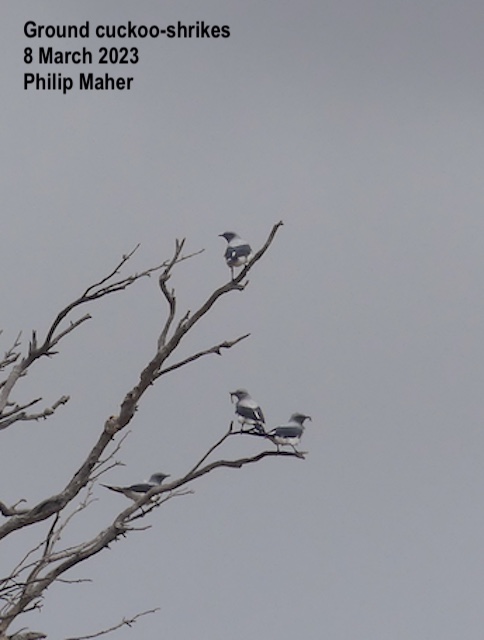
We visited the revegetation area at Monimail and my resident owlet nightjar did not disappoint. Next up we went looking for striped and painted honeyeaters in the boree country. Both species were seen but obtaining good photos was another story. We gave up on them eventually and we started heading back towards town having had quite a tough morning. All of a sudden four birds appeared in front of us, Ground cuckoo-shrikes! They were on the move but we gave chase. After following them for a couple of kilometres we managed to catch up with them. However, they’re a wary bird and difficult to approach for photographs. Eventually some okay shots were had. They were going after grasshoppers when they were feeding and at times a couple were flying around carrying grasshoppers in their bills. We only knew this because Ian could identify the grasshoppers from the photographs taken with his big lens. I believe it was two adults and two juveniles as l’m fairly sure two had yellow eyes and two had dark eyes (the juveniles).
In the late afternoon, and with Jill joining the group, we headed out to the north of town. Just south of Wanganella, near the revegetation area, we stopped for a pair of black-shouldered kites hovering by the roadside, always a good sighting.
North of Wanganella, we stopped at Cooper’s Swamp, which is full of water for the first time since 2011. A big group of white-winged fairywrens was seen in the goosefoot beside the swamp but the coloured male eluded us. White-fronted chats and little grassbird were beside the drying-back swamp and both hoary-headed and Australian grebes were out in the water amongst the lignum and goosefoot. We called in at John’s house out on the plains-wanderer property and the group enjoyed sightings of yellow-vented bluebonnets. These birds have become slightly less wary around John’s house, so better views were had. The big mob of white-necked herons are still feeding on the canegrass swamp behind John’s house and more and more juvenile nankeen night-herons are turning up. We counted about thirty there today, indicating a very good breeding season on the Lachlan and Murrumbidgee Rivers where they have most likely originated. Just one adult bird was seen.
We headed up to the plains-wanderer country, stopping for red kangaroos and emu. We arrived in good time and waited to see what nightfall would bring. I was a little apprehensive as conditions were not great, being overcast and windy with a cold front approaching. We did not go far before a beautifully plumaged, adult male stubble quail was spotted and posed nicely for photographs. A short distance further on our first plains-wanderer, a male, was spotted. Soon after another male was seen and then a female was located nearby. All the birds were in close proximity and were all juveniles including the female. The female was colouring up nicely although not quite in full colour yet. The legs of all three birds were starting to turn yellow so I suspect they were around four months of age, and given they were in close proximity may have been from the same clutch. We kept searching, hoping for an adult female and did not have to go far before another three birds were located, again in close proximity. We were in luck this time as one was an adult female in nice plumage. We then turned our attention to little and red-chested buttonquails as the night was still young and the group keen.
We ventured to another part of the paddock that had some subtle differences in habitat. Several little buttonquail were soon located and photographed and then after a short search two male red-chested buttonquail were also in the bag. The group was starting to tire a little so we started the drive out of the property. Before we got out the gate, a pair of banded lapwing put in an appearance. They have become a bit scarce in recent weeks so I was pleased to see them. On the drive back to the highway, a tawny frogmouth was spotted on a fence post not far from the box clump, which was a surprise. Along the highway, a barn owl was seen and surprisingly another tawny frogmouth on the road in the boree country. It is rare enough to see one frogmouth in a night let alone two. We were almost back to caravan park when a boobook owl was spotted on electricity wires and obligingly flew to a nearby river redgum tree to be photographed. A seriously cute owl. Wow, what a night it had been. I had some happy campers — and it wasn’t even midnight!
Total plains-wanderers — nine. Six male plains-wanderers and three female plains-wanderers. At least five juveniles and at least two adults and the other two, I didn't see well enought to be sure of their age).
5 March 2023: Mikiye, from San Francisco, was part of a Rockjumper group in town last October. It was to be the only occasion during a very wet spring when we were unable to get out looking for a plains-wanderer. So keen was Miki to see a plains-wanderer, she returned, having arrived on the Deniliquin bus last night. Miki’s luck had turned. It was one of those days when things went like clockwork.
Our first stop of the day was a small drying up lagoon on the edge of town. Many white-faced and white-necked herons, as well as nankeen night-herons, great egrets and yellow-billed spoonbills were feasting on the mass of small carp that are currently in all the drying out swamps after the massive floods last spring.
To the north of town, four pink cockatoos, in the boree opposite the Monimail, were our first surprise of the day. It is at least four years since we have seen them this close to town. They didn’t hang around long though, we only just got onto them before they took off and headed across the highway and over into the black box to the east of the revegetation area, not to be seen again.
Big mobs of white-browed and a few masked woodswallows in the boree county north of the Monimail were our next surprise. Apart from the ten or so pairs that nested in the boree a couple of months back, this is the first influx into the district this summer and indicates that the inland is at last starting to dry out. Miki and I also had great views of a pair of striped honeyeaters near the woodswallows.
Our next stop in the boree produced at least three painted honeyeaters, all juveniles. No adults were seen, which may mean that the adults have started to move north already. We saw juvenile rainbow bee-eaters here as well, which may also indicate that the adult bee-eaters have started their northward migration. They will all be gone by the end of March. A little further along in some open boree there was a group of eight black-faced woodswallows, with about four southern whiteface nearby. Both these species have become rare in the district and it’s many years since I have seen them in this particular locality. The woodswallows had juveniles with them, indicating a successful breeding season. White-winged fairywrens were seen in some dillonbush nearby but the coloured male refused to show himself.
Next up we tried some black box on the east side of the highway, back towards Monimail. I was hoping for red-capped robin here and we were not disappointed. After a short search, a full colour male was located. They are quite a scarce bird in the district at present. Just as we were leaving a diamond dove was spotted on an adjacent sandhill with a few remnant hopbush left on it. This was another new bird for Miki. This is the first time I have seen diamond dove at this locality. There has been quite an irruption into the district in the last six weeks with birds seen at the revegetation area at Gulpa (where I think at least one pair is breeding) and in the box country west of Pretty Pine.
It was starting to warm up so we returned home for lunch and a break. Later in the day we ventured north again out onto the plains north of Wanganella. We pulled in at Coopers Swamp and were pleased to see both swamp and spotted harriers (both immature birds) hunting nearby. In the swamp we had Baillon’s crake as well as pink-eared ducks and Australian and hoary-headed grebes. Moving on to the plains-wanderer properties, Miki was delighted to see both red kangaroos and emus.
We called in at John’s house and were greeted by a flock of about forty blue bonnets. John showed us the huge mob of a hundred or so white-necked herons feasting on the carp in the small swamp at the back of his house. John has lived here all his life and has never before seen such a huge congregation of white-necked herons on the swamp, nor the numbers of carp in the swamp the herons are feasting on. It appears that the herons have had a big breed up inland after the massive floods down every river in Western NSW in 2022. Nearly all the white-necked herons on the swamp were immatures. This swamp was so seething with carp that some of the white-necked herons were snatching carp on the wing. There were also good numbers of white-faced herons and white ibis and a few nankeen night-herons and yellow-billed spoonbills feeding in the swamp.
Miki and I headed up to the plains-wanderer country at dusk for a bite to eat and see what the night would bring. A front was coming through so there was a brisk breeze blowing and the moon was almost full, neither particularly conducive to searching for plains-wanderers. Miki had come a long way, so I didn’t want to let her down. Our luck held and we had only just driven into the plains wanderer country when a male flushed up. We walked around with the thermal scope and another three or so males were located but still not the female. We continued our search and after an hour or so two females were found close together. We focused on one and after she settled down, great views and photos were had. Mission accomplished. Miki was elated and I was relieved.
We continued our spotlighting and had great looks at stubble quail, little buttonquail and a single red- chested buttonquail. All up about a dozen plains-wanderers were seen; l think it was three females and nine males with perhaps one of the females being juvenile and about five of the males also independent young. On the drive back out to the highway we had great views of a barn owl on a fence post. Not a bad day for the off season.
Despite being jetlagged, Miki managed to stay awake for the drive home, such was her level of excitement. There was some light rain and spotted marsh frogs, where water had been lying around months earlier, were soon out on the road in their thousands. Miki was a delightful companion for the day.
1 March 2023: Brian Holden and I saw about four black-chinned honeyeaters in an area of flowering grey box in Millewa forest behind the old forestry plantation of introduced pines. This is my first sighting in the district for fifteen years — the droughts having all but wiped them out over the last two decades. Historically, they bred in good seasons in the river redgum forests along the Murray and Edward rivers around Deniliquin. There was often an influx during the summer months when the box mistletoe came into flower. Their numbers were depleted over the dry years in the box/ironbark forests around Chiltern, Wangaratta and Heathcote but have recovered somewhat in the last three years with the better rainfall. Most of the birds that are seen around Deniliquin probably originate from these box/ironbark forests.
21 February 2023: Peter, a keen bird photographer from Canberra, and I went out for the evening. At the Monimail, one of the resident owlet nightjars was photographed in its hollow. Peter got photos of striped honeyeater and mistletoebird. Small flocks of superb parrots flew over. Further out, in the boree country, a male painted honeyeater was photographed. On the plains-wanderer property before dusk, Peter got good photos of banded lapwings feeding on grasshoppers. Just after dusk, a southern boobook was photographed near John’s house. John hopped in the vehicle and went down to the plains-wanderer paddock with us. On foot with the thermal scope, we saw several little buttonquail, fat-tailed dunnarts, an adult male plains-wanderer, and then a juvenile male plains-wanderer. Back spotlighting from the 4WD, we got another twelve plains-wanderers — six females and six males, with some of those males being juveniles. It was quite windy and the birds were particularly flighty, more flighty than I've seen them in years.
We saw about four red-chested buttonquail — two adult males and a couple of juveniles. We got about a dozen stubble quail, more little buttonquails, probably around twenty for the night with about fifteen being juveniles. The inland dotterel couldn't be found. On the outskirts of Deniliquin, a barn owl crossed our path. A new record in lateness — home at 4.30 am!
12 February 2023: Russell and Debra went out with me on the 4th February to photograph a plains-wanderer (of which we found a pair, as well as inland dotterel and a heap of little buttonquail). We didn't find a red-chested buttonquail that evening so I gave them a heads up that we had been finding red-chested since the 4th, so they returned to Deniliquin. We found around ten red-chested buttonquail, a score of little buttonquail, a score of stubble quail and two plains-wanderers, an adult male and a juvenile female. We didn't get in til about 4 am, so probably somewhat of a record in lateness.
10 February 2023: My Deniliquin birding mates Tom, Kev and Angus and I went out to photograph red-chested buttonquail on the plains-wanderer property. We recorded at least fifteen birds, comprising adults and juveniles and one male with chicks. We located the buttonquails in a part of the plains-wanderer paddock that was a little on the thick side for plains-wanderers; never-the-less, we flushed one plains-wanderer.
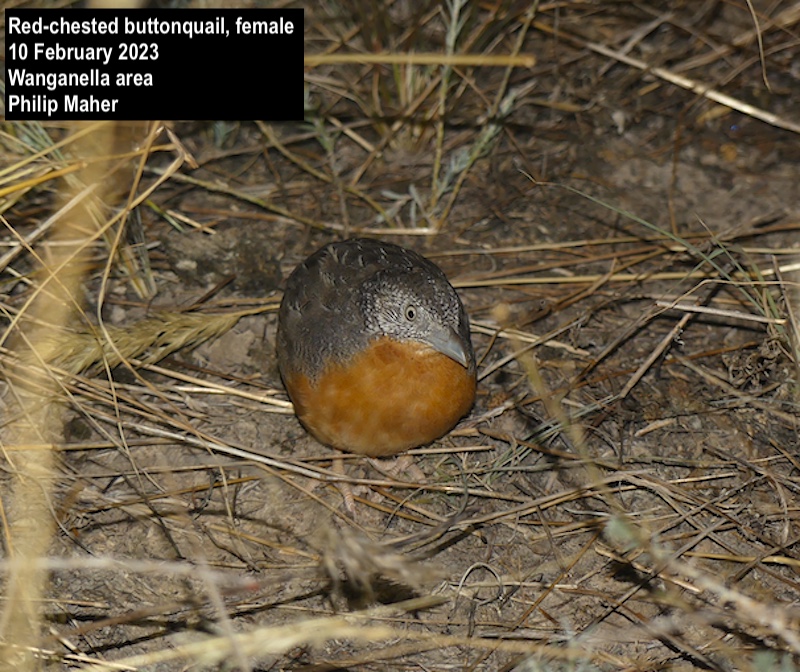
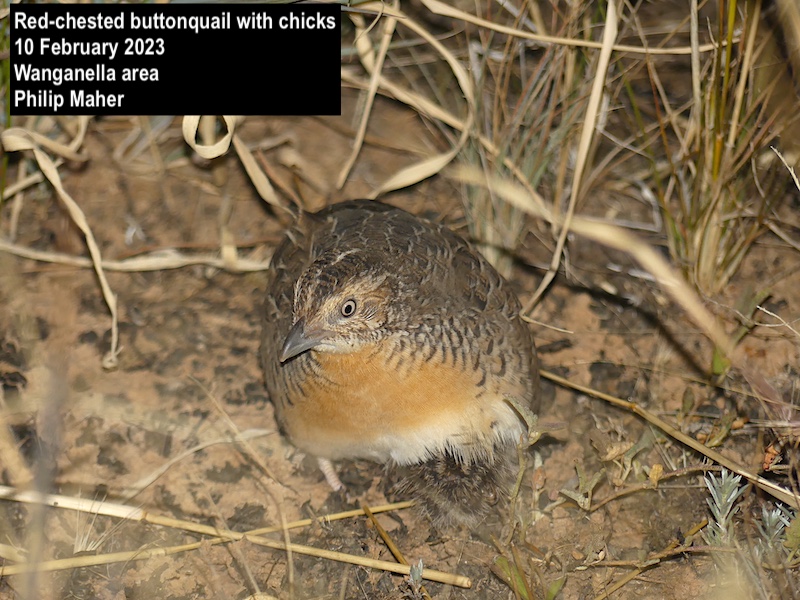
6 February 2023: Melissa and Pete from Sydney (more Leeton bittern conference attendees) and I ventured out at 5 pm. Melissa and Pete recorded forty-seven bird species with plains-wanderer and owlet nightjar being their top birds. As well as the nightjar in the late afternoon, we saw painted and striped honeyeaters. After dark, we found a courting pair of plains-wanderers, and four or five individual, immature plains-wanderers, approximately ten stubble quail, twenty to thirty little buttonquail, one red-chested buttonquail, banded lapwings with three-quarter grown young, thirty or more brown songlarks, around ten Horsfield's bushlark and a barn owl.
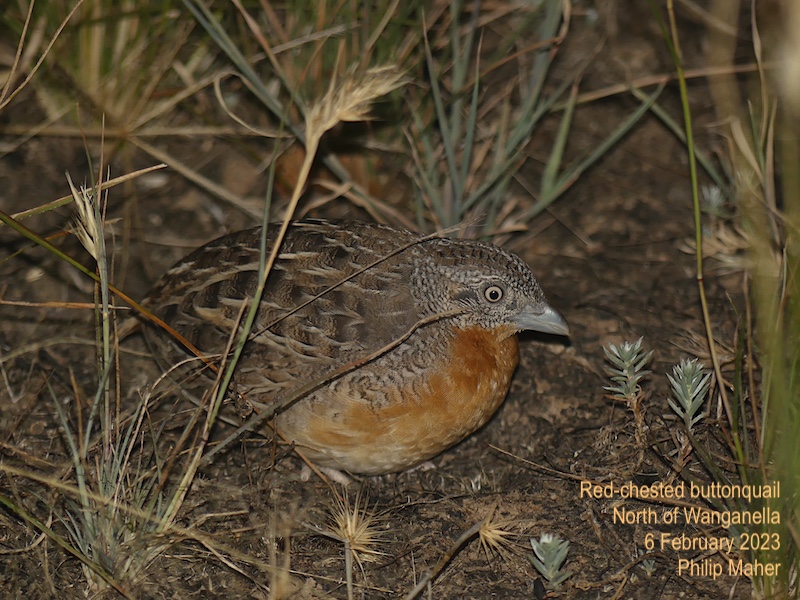
5 February 2023: Debra, Russell and I had a later start after getting in at 3 am this morning.
West of Pretty Pine in the black box woodland a few painted buttonquail were recorded but not photographed, and diamond doves and a male hooded robin were sighted. I think this is the first time I have seen diamond doves here, if not ever, then a very long time. Hooded robins are also a scarce bird in the district. Several pairs of striped honeyeaters were duetting in the black box country.
North of Monimail in the black box country the diamond firetails were located, an adult male and a juvenile. The adult was doing a courtship display so could be breeding again, which would be great. (The female was not sighted but wouldn't have been far away). A few distant photos were had.
Further out in the boree country, two male painted honeyeaters were located on their territories but weren’t particularly cooperative for photos. It was great to see them breeding — that makes about six pairs I have located breeding in the boree country this summer. Some are on their second clutch. More striped honeyeaters were seen here, as well as mistletoebirds. A few pairs of white-browed woodswallows have nested in the boree — the only ones in the district this year as far as I know. A single female-plumaged white-winged triller was seen. Wedge-tailed eagles were prevalent at times during the morning, with several immature birds passing overhead.
4 February 2023: Debra and Russell from the North Coast of NSW went out with me in late afternoon. Russell is a keen photographer. We found a pair of plains-wanderers, roughly twenty little buttonquail with about six sets of juveniles, eight stubble quail and one inland dotterel.
30 January 2023: Out with Karen from South Australia in the late afternoon and evening. Karen was also on her way to the bittern conference in Leeton.
At the Monimail revegetation area, we saw an owlet nightjar in a nest hollow and photographed a male rufous songlark.
In the boree country we observed a male painted honeyeater carrying food to young. Also at the boree, there were several thousand tree martins drinking on the wing from the channel and then sunning themselves perched in the tops of boree trees..
Striped honeyeaters were photographed at the Wanganella revegetation area.
Out on the plains spotlighting we had sightings of twenty or so little buttonquail including several adults, many juveniles, and a male with half-grown chicks. A male, and later, a female plains-wanderer, which was calling, were photographed. We also saw about twenty stubble quail, eighty or so banded lapwing, around six fat-tailed dunnarts and three species of large kangaroo.
29 January 2023: A big night with four South Australians who are attending an Australasian bittern conference in Leeton on Tuesday. All up, we got thirteen plains-wanderers including a male with a clutch of four big young, about four independent juvenile plains-wanderers, three adult males and one adult female plains-wanderer. We also saw around eight little buttonquails, a pair red-chested buttonquails, three stubble quails, one inland dotterel, eight banded lapwings, four fat-tailed dunnarts and one growling grass frog. All in one paddock
26 January 2023
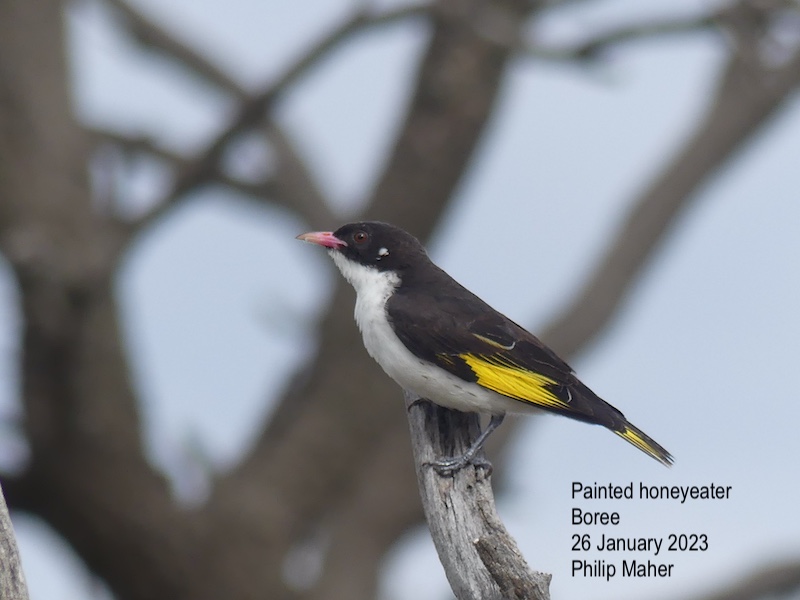
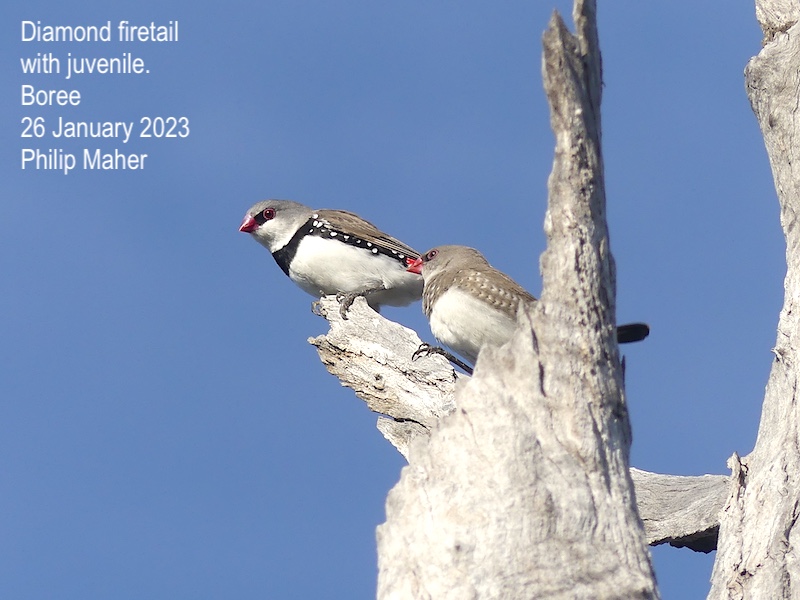
25 January 2023: Robert, while mustering, saw many stubble quails and little buttonquails and a couple of red-chested buttonquails. He also had a pink cockatoo at his house.
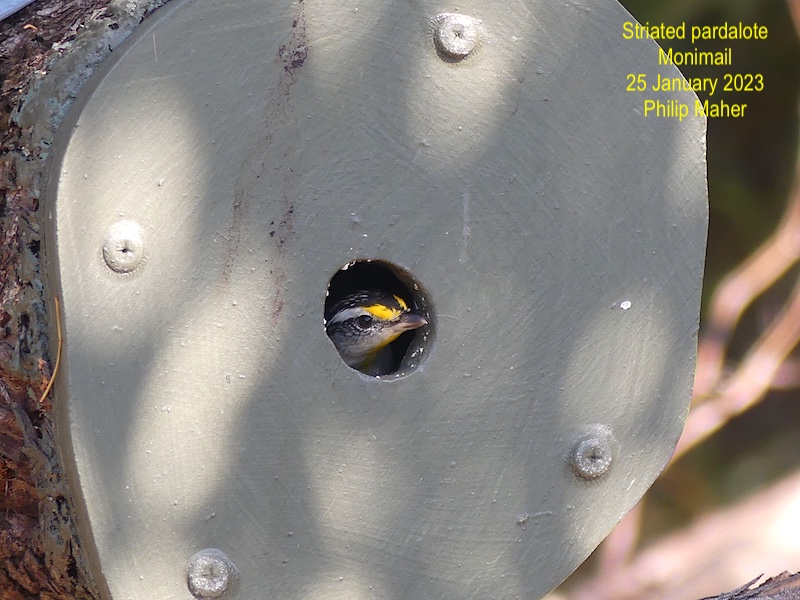
25 January 2023 Monimail: At least one white-fronted honeyeater was seen at the Monimail revegetation plot feeding on flowering wire-leaf mistletoe. There were also lots of adult, juvenile and immature mistletoebirds. Many rufous songlarks including many juveniles were sighted and I believe the adults are on, at least, their second clutch. Also three owlet nightjars, two sighted at the nest hollows and another one calling away from a nest hollow.
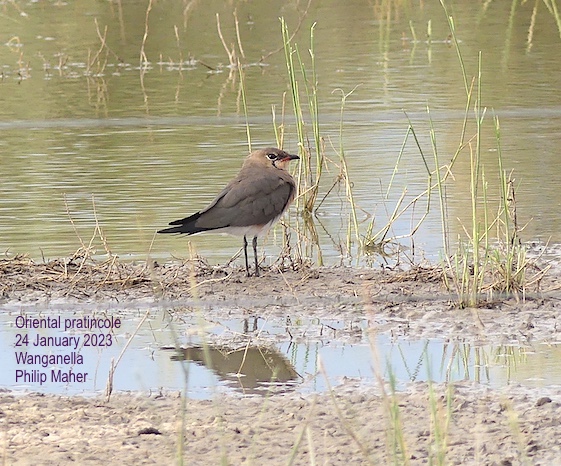
24 January 2023: I arrived back from our Wet Season tour at Iron Range on Cape York with another bout of Covid. (It's becoming an occupational hazard). I waited until I tested negative and headed out with Angus to look for Robert's Oriental pratincole. (The last and only time I have seen an Oriental pratincole was near Lake Tutchewop on 15 December 1996). As well as the pratincole, we saw about twenty red-necked avocets, including juveniles, about six whiskered terns, a juvenile spotted harrier, about forty banded lapwings, and six Baillon's crakes, which have bred in the canegrass swamp.
23 Janaury 2023: John reported about thirty rainbow bee-eaters on his place, north of Wanganella. The juveniles are moving around since fledging.
21 January 2023: I called into the Gulpa revegetation plot on my way home after the Iron Range Wet Season tour. Delighted to see two new species for the plot, i.e., at least two diamond doves and about six brown quail.
7 January 2023: Robert, while working, saw a well-grown plains-wanderer chick in the daytime. I'm not sure if it was fully fledged but unlikely.
5 January 2023: Robert kicked off the 2023 Latest News with a great find today. An oriental pratincole on the plains-wanderer property! A new bird for him and I think for the district.
30 December 2022: Robert, while working, located a female plains-wanderer in the daytime.
29 December 2022: Dave and Liz from the UK and and Luis from Portugal (now working in Melbourne) were looking for a day and evening's birding, between Christmas and New Year. Trisha and I are up in a very wet Iron Range so Robert stepped into the breach. He did particularly well, getting, among many other species, four ground cuckoo-shrikes, painted honeyeaters, superb parrots and a likely pair of plains-wanderers, i.e., a male and female quite close together.
23 December 2022: A magic day out with Andy and Janet from the Midlands in the UK. In the morning we saw crested shrike-tit and a pair of dollarbirds behind the golf club.
North of the Monimail, in the boree country, we superb parrots, two male painted honeyeaters, white-browed woodswallows (first seen this season; a pair was mating so they might nest). Two or three diamond firetails were recorded. (The first seen for over a year and the first ever seen by me north of Monimail in boree/black box county). We also saw striped honeyeaters and lots of white-winged trillers singing. We also had two white-fronted honeyeaters and the owlet nightjar at Monimail.
At John's, we had over two hundred banded lapwing feeding around a drying back swamp — one on a nest in another part of the paddock. (This is very late for banded lapwing to be breeding). Four common greenshanks and about twenty sharp-tailed sandpipers were seen and the red-necked avocets, pied stilts and masked lapwings now all have small young or are on eggs. About twenty whiskered terns were seen, and an immature spotted harrier. Three female plains-wanderers, an inland dotterel and three little buttonquail were located.
17 December 2022: Out with my mate Chris, from Adelaide, to get some better photos of plains-wanderers. We found three male plains-wanderers and one female. We also got some little buttonquail and stubble quail.
12 December 2022: A juvenile fan-tailed cuckoo was recorded at the Gulpa Island revegetation plot. This is the first breeding record for the district for lomger than I can remember. There was a superb blue fairywren nearby, which are known to be a host; however, I didn't see any interaction between them.
10 December 2022: Warwick from Christchurch is doing an Australian Big Year. He and I, along with Aleisha, Bridgette, and Danielle, went out to find a plains-wanderer for his list. Out at the Monimail, we saw lots of superb parrots, which was Warwick's other needed species. Took a while to find a plains-wanderer but we ended up with a male and a pair of plains-wanderers.
9 December 2022: Out with my Deniliquin buddies, Gus, Tom and Kev to look for red-chested buttonquail on the plains-wanderer property. We didn't find a red-chested but saw plenty of little BQ (around eight). We recorded six plains-wanderers in total, comprising four females and two males, with one of those males on a nest with four eggs. Ten adult stubble quail were recorded and three clutches of large young, with one clutch having at least five chicks. Before sunset we got some waterbirds on John's: red-necked avocets, red-kneed dotterels, pied stilts, black-tailed native-hens and plumed whistle-ducks.
7 December 2022: There has been the odd sighting of red-chested buttonquail lately, including one seen by Robert today.
5 December 2022: Out with a small group of Deniliquinites, new to birding. Dianne's son, Leighton, had gifted his mother an evening out to see a plains-wanderer and Dianne brought along her sister Lorraine and Lorraine's partner, Alan. They saw some waterbirds out on the Wanganella swamps including red-necked avocet, pink-eared duck, plumed whistling duck and magpie goose. On the road into the plains-wanderer property, we saw a Latham's snipe. We found two female plains-wanderers. We got a barn owl on our way home.
3/4 December 2022: A Canberra group of birders organised a private plains-wanderer weekend. One hundred and nineteen species were seen and two heard. Some of the better birds for the weekend included square-tailed kite, spotted harrier and a little eagle at Gulpa and another at Mathoura. Australian hobby and spotted crake were recorded at The Sisters, north of Wanganella. Curlew sandpiper, red-necked avocet, red-kneed dotterel and whiskered tern were recorded on the plains-wanderer property. At the Monimail, we had suberb parrots feeding on the immature berries of grey mistletoe, and cockatiels flying over. Bluebonnets were feeding in the sugarwood flowers, and we saw the cute owlet nightjar in a nest box. We located a female plains-wanderer and a little buttonquail. Full list.
2 December 2022: Robert had a possible sighting of black-breasted buzzard at the Black Swamp. This would be the first record in over a hundred years in the Riverina of which I am aware.
Historically, they nested in the Booligal and Moulamein areas.
30 November 2022: Both Robert and John, while working on different parts of the property during the day, recorded a female plains-wanderer.
29 November 2022: Out with Harry from Braidwood who joined forces with Shaun and Marie from the UK for the day and evening. We found two female plains-wanderers. Some of the highlights during the day included a pair of azure kingfishers displaying and a pair of crested shriketits with two fledged young at Mathoura; a male painted honeyeater in the boree country north of the Monimail, an immature spotted harrier at Coopers Swamp, and a black-faced woodswallow at John's.
26/27 November 2022 Plains-wanderer weekend: Two pairs of plains-wanderer found and an inland dotterel. Full list.
24 November 2022: Simon from Firetail Bird Tours and his group and I ventured out this afternoon. We saw the spotted nightjar at the Monimail and a male and a female plains-wanderer on the plains-wanderer property.
19 November 2022: A first for the Monimail revegetation area — a spotted nightjar!
18 November 2022: With the forecast not looking good for tomorrow night's scheduled plains-wanderer excursion, Hanni, Bob, Eric (from California) and I headed out at 7.30 pm to the plains-wanderer property soon after we arrived in Deniliquin from Beechworth. We located a pair of plains-wanderers and didn't look for
any others. We witnessed something I have never seen before, a fat-tailed dunnart swimming in floodwater!
12 November 2022: Out with Angus from Inala Nature Tours and their group. With about 30 mm of rain falling after we left the plains-wanderer property, it was a good call by Trisha to go out this evening rather than their booked date, which was tomorrow evening when another 10 to 20 mm is forecast. (Note: 45 mm had fallen by the evening of the 13th). On the way out there we got owlet nightjar at the Monimail, a spotted crake off the highway, black-tailed native-hens everywhere, plumed whistleducks everywhere, magpie geese at Wanganella, white-winged and purple-backed fairywrens at Wanganella, boobook owl at John's and a pair of plains-wanderers and a stubble quail.
11 November 2022: Neil from Canberra Guided Tours and his group and I went out for the day and evening. In the morning at Gulpa, we recorded a square-tailed kite. At the Monimail in the afternoon we saw a owlet nightjar in its hollow. (The nightjars nested successfully in the nest hollows that I made for them). We got pink-eared duck and red-capped plover near Robert's place. The evening excursion on the plains gave us four plains-wanderers (one male, one female and a pair) and a pair of stubble quail.
9 November 2022: Big thanks to Robert for fixing the cattle grid that had been undermined with flood water so we could get out there with Tropical Birding from Ecuador tonight. We did better than my last outing with Tropical Birding when we had the only miss for this season. Tonight we got a pair of plains-wanderers. During the afternoon we saw a pair of pink cockatoo, and banded lapwing, Horsfield's bushlark, brown songlark and white-winged fairywren.
8 November 2022: Andy Walker of Birding Ecotours and his group and I went out for the evening. We recorded two female and two male plains-wanderers. A stubble quail was also spotlighted.
7 November 2022: Out with Bellbird Tours again; we found one female plains-wanderer. We didn't look for more.
6 November 2022: Matthias from Hamburg and I went out this evening. We ended up seeing five plains-wanderers, two females, a male and then a pair. Also a little buttonquail.
30 October 2022: My old friend Tom Hince, ex Canada and now USA, and his group were booked to go out tomorrow but the weather forecast suggested that it would be best to head out for plains-wanderer tonight. We found a pair soon enough.
29 October 2022: With only three starters, this was the smallest plains-wanderer weekend we've ever held. Those not daunted by the weather and road conditions were rewarded with one female and three male plains-wanderers. Full list.
27 October 2022: Another VENT group out with me on a plains-wanderer excursion. We found a pair of plains-wanderers and a little buttonquail.
25 October 2022: Philip from the Netherlands and I headed out to the plains-wanderer property in the late afternoon. En route we called into the Monimail revegetation site and saw owlet nightjar in its nest hollow and flushed a little buttonquail. At Wanganella, we recorded a magpie goose. At John's we recorded five individual plains-wanderers, comprising three males and two females. While looking for plains-wanderers we saw stubble quail and some fat-tailed dunnarts, and on the road we had brown songlark, a pair of banded lapwing, and a barn owl that had just caught a house mouse.
19 October 2022: I was out with a VENT group tonight. We saw a female plains-wanderer with a male closeby, and another female plains-wanderer.
17 October 2022: Out with John from Ohio and Scott from Melbourne. It seemed impossible to find a way through a flooded state to Deniliquin from Melbourne. Third-hand information, on the family grapevine, suggested a possible route late last night and John and Scott made it to Deniliquin for an evening plains-wandering excursion this afternoon. They were rewarded with a pair of plains-wanderers.
15 October 2022 Our first Plains-wanderer Weekend of the season produced six plains-wanderers, two pairs and two males. More about this weekend later, suffice to say that the conditions were not as bad as we anticipated. Getting back home was a challenge for some participants with roads cut by flood water in Echuca and Shepparton and seemingly all around central and western Victoria.
Full list.
12 October 2022: Today was day one of two very wet days forecast so Trisha suggested to Helmut and Ingetraut, from Germany, that they were probably better to come to Deniliquin today rather than tomorrow when the paddocks and the road in would be doubly wet. The road down to the plains-wanderer paddock was perilous and we were moving sideways both coming in and leaving. I was relieved to reach Cobb Highway without having to call John to come and pull us out of the table drain with his tractor! In lightly falling rain, we saw three male plains-wanderers in the same location we got the pair last night. I assume those three have just arrived in that paddock from elsewhere.
11 October 2022: Out with my old mate Steve Davidson who was leading a Rockjumper tour. We located a pair of plains-wanderers.
9 October 2022: Nigel from Castlemaine arrived with two friends from New Mexico who had been thwarted in their attempts to get to Australia for a couple of years. Tonight they got lucky. We located a female plains-wanderer.
7 October 2022: The area where we were finding plains-wanderers is flooded and they, understandably, had moved. I could not find them on higher ground so a disappointing night for Tropical Birding Tours.
6 October 2022: Three ground cuckoo-shrikes recorded at the Monimail.
5 October 2022: Sadly we had to cancel a plains-wandering excursion with Rockjumper due to very wet and windy weather.
4 October 2022: Out with three Bellbird Tour clients for the day and evening. We did well with the plains-wanderers, getting a pair and a male wtih three chicks. Earlier at the Monimail we saw an owlet nightjar with at least two large young in a hollow.
27 September 2022: Ted, from Oregon, had booked a nine-day personal tour before the covid pandemic. It was a pleasure to finally meet him in Melbourne and set off on Ted's Big Adventure. We came through Deniliquin after a couple of days in Beechworth. Ted, who had birded in Australia some years ago, was very keen to see a plains-wanderer. We were relieved that Ted saw a female plains-wanderer in roughly the same place we saw the same female a week before. Hopefully the male is sitting on eggs.
20 September 2022: Trisha and I returned yesterday from eleven weeks of bird tours in the Pilbara, Central Australia and the Eyre Peninsula and Nullarbor Plain. We had our first plains-wanderer outing of the season with Wings from the USA tonight. We scored a pair of courting plains-wanderers, so a good start to the season.
20 September 2022: Robert recorded a spotted harrier on Spring Plains.
18 September 2022: My sister Susan recorded a dollarbird in the Deniliquin forest.
8 September 2022: Robert recorded white-breasted woodswallows on his place.
21 August 2022: Tom recorded a square-tailed kite in Deniliquin.
18 August 2022: Robert reported a Gilbert's whistler calling at Wanganella sandhill.
13 August 2022: Robert recorded a pink cockatoo at Wanganella and a ground cuckoo-shrike in boree country south of Wanganella.
8 August 2022: Gus recorded an olive-backed oriole in Deniliquin.
31 July 2022: Robert recorded little buttonquail and about ten blue-winged parrots on his place.
24 July 2022: Flame robin and pallid cuckoo on Robert's place.
6 July 2022: Tom Wheller recorded a yellow-plumed honeyeater in the Deniliquin forest (aka Murray Valley Regional Park). It is at least a couple of decades since the last sighting.
5 July 2022: Robert reported a rufous songlark calling over at John’s property. north of Wanganella. This is very early for rufous songlarks to be returning south and starting to think about breeding.
4 July 2022:
I went down to Gulpa forest with my old mate Tom Wheller to see if we could find any flame robins, which have become scarce in the district in recent years. We pulled up for a jacky winter on the west side of Gulpa Creek in an area that had previously been good for flame robin. As soon as we stepped out of the vehicle a female scarlet robin was seen but no male, which we thought unusual. After some scouting about quite a few birds were seen including buff-rumped, yellow-rumped, striated and yellow thornbills, brown and white-throated treecreepers, golden (adult male) and rufous whistlers, grey fantail and finally around twelve flame robins (about eight brown birds and four coloured males). This is the best lot of flame robins seen in Gulpa for quite a few years. It follows on from others seen this winter in Millewa forest (Cornella sandhill). Robert has also had a couple of sightings on his property north of Wanganella recently. These are the first sightings out at Robert’s for at least fifteen years. Numbers are still low, but they are heading in the right direction.
Tom and I went further down into Gulpa, around Tea Tree Road. Around the sandhills a pair of hooded robins and a pair of red-capped robins were seen — making four species of robins for the morning. We had a look for Gilbert’s whistler in the locality we last recorded it (1 November 2019) but none were seen or heard. No diamond firetails or sittellas were sighted, two species that were formerly fairly common in the forest.
2 July 2022: A painted buttonquail calling at the monimail revegetation site.
30 June 2022: My sister Susan reported a white-winged chough building a nest in Deniliuqin forest.
29 June 2022 A black falcon at Robert's place.
29 June 2022 A hobby and collared sparrowhawk hunting at Wanganella sandhill.
28 June 2022 About two hundred tree martins hawking insects over Wanganella sandhill.
22 June 2022 As I was checking the rain gauge (5 mm) at the Monimail revegetation site, a bird flew in and landed nearby in the dead top of a tree. I didn’t immediately recognise it so put the bins on it and was pleased to discover it was an olive-backed oriole, a new record for the Monimail. I have had them at Gulpa and Wanganella sandhill revegetation areas in the last twelve months so now I have had them in all three revegetation areas. They move inland in the autumn/winter and head back to the mountains and foothills to breed in the spring. The odd pair nests along the Murray River in our area. Other species seen included purple-backed fairywren, yellow thornbill, rufous whistler, singing, spiny-cheeked and white-plumed honeyeaters, bluebonnets, superb parrots and grey-crowned babblers. A group of about four wood duck flew from a tree that had nest boxes in it and another wood duck emerged from one of the nest hollows, so it appears breeding is imminent This is the first time they have attempted breeding here.
21 June 2022: I’m just back from six weeks in Far North Queensland so I was keen to get out to the revegetation area at Wanganella sandhill to see how everything was going. Today was a miserable sort of day so there were not many birds calling. There were six or so western gerygones feeding in the native willows, by far the largest number I have ever had in there. Most of the gerygones appeared to be immature birds. They were in company with a grey fantail, rufous whistler and singing honeyeater. Other species seen included grey shrike-thrush and yellow and yellow-rumped thornbills plus most of the regulars. Striped honeyeaters were calling.
A pair of white-backed swallow was observed and a pair of black-shouldered kite was chasing each other over the swamp at the back of the sandhill. Hoping they might nest. Strangely enough I did not see or hear a spiny-cheeked honeyeater, a species that is usually dominant here.
30 April 2022: A whopping twenty-two plains-wanderers, including two males with five and three young in tow.
26 April 2022: I went out to a friend’s property near Moonacullah (Aboriginal Reserve) this morning to spread some mistletoe berries in his revegetation area. On the way back to Pretty Pine, on the Old Morago Road, I noticed some dusky woodswallows on the roadside. On reflection, there appeared to be a bit of activity there so I back tracked to see what else was with the woodswallows. The first bird I put my binoculars on was, surprisingly, a diamond firetail that was soon joined by another. The firetails are a scarce bird in the district at present and this is my first sighting since last spring. Where I saw them was not far from a house and there was a fenced-off tree plantation along the fence with quite a bit of native grass. The road reserve as well was ungrazed and contained many native grasses.
In about fifteen minutes I I observed red-rumped parrot, brown treecreeper, tree martin, rufous whistler, white-plumed honeyeater, jacky winter, striated pardalote, the woodswallows and diamonand firetail.
24 April 2022: Tom Wheller recorded a brown flame robin near the Deniliquin Cemetery. This is the first sighting around the town for two years at least. They have become a scarce bird in the district due to the severe droughts over the last twenty years. Strangely, last year was the worst year ever for them around here — odd given we received quite good rainfall. Presumably their numbers were so low that only a few birds pushed out this far last winter, such as the small group that was located in Millewa forest east of Mathoura by some of my fellow birders. Flame robins were once thick in Millewa and Gulpa forests' sandhill country in winter in the 1980s and 1990s. Hopefully they've had a good breeding season up in the mountains and more birds will turn up.
23 April 2022: Robert reported a pair of pink cockatoos across the highway from the Monimail revegetation area today. They were perched on a dillon bush, presumably eating the berries, which they are fond of. This is the first sighting since Robert saw saw five in the same area in February 2019.
Today, as I was direct seeding quondong seeds at the revegetation area near the highway at Gulpa, l observed a white-fronted honeyeater feeding in flowering grey mistletoe growing on a boree tree. This is a first for the Gulpa revegetation area. This species must be quite widespread in the district at present as this is the fifth locality I’ve seen them in in the last month. They don’t often venture south of town.
Also at Gulpa revegetation area today, I had a group of at least five chestnut-rumped thornbills. This is the first sighting in the revegetation area for many years. This species has suffered badly during the droughts over the last twenty years and is now a scarce bird in the district, so it was pleasing to see such a good-sized group back here again. They were feeding with yellow-rumped, buff-rumped and yellow thornbills, which I think could be a first for me. I can’t remember having had all those species of thornbill together before.
18 April 2022 Elizabeth and Jim from the NSW Central Coast went out with me in October 2020. I failed to find them a plains-wanderer on that occasion but we came up trumps tonight. We found an adult male with FIVE well-grown young and nearby was an adult female plains-wanderer. It was about 6.30 when we located this group and barely dark. Then we got an immature female and then an adult male. While it lightly drizzled now and then while we were searching for the wanderers, it started to rain when we were leaving. That's what I call a great night! (Note: 17 mm fell overnight on the plains-wanderer property).
7 April 2022
David Nevinson reported over forty pink cockatoos (Major Mitchell’s) feeding on paddy melon seeds near his house at Booroorban today. This is the highest number I have ever heard of in the Booroorban area. They have been hard to find about Booroorban since the big droughts and we have not found a nest there for many years. I suspect very few young have been raised there in recent years. It's quite baffling where these forty birds originated. Presumably the entire population from Booroorban to Moulamein is currently at David’s house.
6 Apri 2022 I was out with Lyn and Mandy from the south coast of New South Wales today. Although the weather was a bit overcast, we had a good day and Lyn and Mandy saw most of their target species. Most importantly, we saw a male plains-wanderer with two big chicks and another two juvenile male plains-wanderers.
Earlier in the day, we had the first spotted pardalote for the season in the redgums by the lagoon in north Deniliquin, and we had the first pallid cuckoo for the season on the powerlines at 8 Mile Creek, south of Wanganella.
Surprisingly, big mobs of white-browed woodswallows (with a few masked) were going over again at both the Monimail and Wanganella revegetation areas. They seemed to be generally heading in a south or south-easterly direction but who knows where they might finish up.
The group of about six black-faced woodswallows was seen again on the powerlines just south of Clarke’s Creek, near Wanganella. Although I have been out there many times since I saw them there a couple of weeks back, this is the first sighting since then.
4 April 2022 I erected a couple of nest hollows at the Wanganella sandhill revegetation site today, as well as restoring one that had come down in a mini tornado a couple of months back.
A large flock of white-browed woodswallows went over, which is getting a bit late for them to be in the area. They are usually starting to head further inland by now, but I guess conditions are pretty good around here and there's no shortage of insects.
Also, while I was working, a Horsfield’s bronze-cuckoo was heard. It’s a bit unusual for them to be calling this time of year. I chased him up to confirm it. This is the first I’ve seen for a couple of months. They migrate north I believe, so it's a bit unusual to have them around now, especially calling. It’s usually a sign of spring coming when they start calling in about August or at least it was prior to the droughts of the last couple of decades. Hopefully, if the rains continue there will be plenty calling again this coming spring. They have built their numbers up these last two half-decent seasons.
An adult white-bellied sea-eagle was also hunting about the drying-back swamp today behind the sandhill. I've been seeing an adult and an immature around the swamp for about a month or more now. Most likely they have come down from the Murrumbidgee River.
Yesterday I saw one double-barred finch and confirmed there are now two lots of striped honeyeaters living in the revegetation area. A group of three and then a pair at opposite ends of the sandhill.
I knew that striped honeyeaters have a special relationship with grey butcherbirds but I didn’t realise it extended to pied butcherbirds. The pair of striped honeyeaters yesterday were sunning themselves in the top of a dead tree within a couple of metres of three pied butcherbirds that were singing their hearts out. The striped honeyeaters seemed completely unperturbed by the presence of the pied butcherbirds so close to them, and the butcherbirds took no notice of the striped honeyeaters, which to me seemed quite vulnerable. Several times lately I have seen or heard the striped honeyeaters in close proximity to the pied butcherbirds.
30 March 2022 Plains north of Wanganella.
Robert reports single sightings of both spotted harrier and blue-winged parrot today. Both species were reasonably common in the district in the 1980s and 90s but after years of droughts or dry years they are both scarce birds nowadays, so it's noteworthy if we have a sighting of either species.
There were some big rains just north of Wanganella in January/February and early March and the stubble quail are breeding up big time due to all the seeding native grasses. This is no doubt what has attracted the spotted harrier to the area. The seeding grasses and other plants would also be attractive to the blue-wings. Let’s hope a few more turn up in coming days and weeks. In the 1980s and 90s it wasn’t uncommon to see flocks of up to a dozen blue-wings in the autumn or spring. All the Neophema parrots have suffered badly in the droughts of recent decades.
29 March 2022: Double-barred finches not gone at all from the Wanganella revegetation site.
26 March 2022 Wanganella sandhill revegetation area.
I went back out to Wanganella this morning to spread the jointed cherry mulch and some Wilcannia lily seeds in the revegetation area. Looks like the Gilbert’s whistler and the double-barred finches have both moved on. To my eye it looked ideal for both species but they thought otherwise. I did however have one excellent find. Some of the mallees (Eucalyptus dumosa) are flowering well at present and have been attracting lots of insects including butterflies (but strangely few birds). One tree had up to twenty common brown butterflies feeding on the nectar. I noticed a jezabel feeding with them and thought it looked a little dark underneath to be a spotted jezabel, the common jezabel we get in this area. I followed if around the tree for about thirty minutes but it would always alight for only a second or two or be out of range of the iPhone. Frustrating! Eventually, I got a photo and sent it to Robert and he identified it as an IMPERIAL JEZABEL, a new butterfly for this district list!
I suspect they have been around for some weeks and I’d been thinking spotted jezabel. Strange that we have not had them here previously as the distribution maps show them here — at times at least. Perhaps we have overlooked them in the past.
Apart from the imperial jezabel, there was nothing too exciting. Quite a few western gerygones have turned up (as well as at Monimail). Some are juveniles, so they have had a good breeding season. At one stage I saw three together, which is the largest grouping I have recorded there yet. I have planted quite a few eucalypts on and around the sandhill now so hopefully the gerygones might stay and breed, eventually. They always return to the eucalypt forest along the creeks and rivers to breed in the spring. They spend much of the winter months in the acacia woodlands. At the sandhill they like the native willow, Acacia salicina.
A single chestnut-rumped thornbill was still present, hoping it will find a mate and settle in. The striped honeyeaters were in good voice as well with three birds singing together. Seeing the three birds together made me wonder if the pair did eventually raise a youngster. I suspect there may be a second pair on the hill now as well, but I’ve not confirmed that.
The mistletoebird numbers are starting to build up at Wanganella sandhill as well, and I think there must be at least half a dozen there at present, many of which are juveniles. This is the most I have ever recorded here. There are many juveniles at Monimail as well, so they have really bred up big time this season.
25 March 2022
While out at Booroorban today I collected rosewood and Wilcannia lily seeds, and buckets of mulch, hopefully containing seeds from under the jointed cherry trees. The jointed cherry is difficult to grow as it is a partial root parasite. I have spread the mulch under the shrubs in the revegetation areas in the hope that one will eventually germinate. It is one of only two local trees that I have not yet grown at my Wanganella revegetation area. The other being a sandalwood tree and again, not for lack of trying.
Thousands of white-browed woodswallows with just a few masked woodswallows were recorded in the black box along the creek west of Booroorban. Just a few have been seen in the last couple of weeks but prior to that none had been seen since early October. I assume they stayed further north to breed this year due to the extraordinary amount of rain there has been north of Hillston and around Cobar and Bourke. (Although we have had a reasonable rainfall here, really, it’s just a sprinkling compared to what they have had further north). They were making a real racket. I moved around a bit and could hear them calling wherever I went. Eventually I finished up about six kilometres away and I could still hear them. They often feed on leap in the black box but I didn’t see what they were after. There were no flowering trees in the area to attract them.
23 March 2022: Incredibly, we recorded five male plains-wanderers — all with chicks. More about this outing with Simon, Sarah and Michael later.
17 March 2022: Another new bird for Wanganella sandhill — white-winged choughs.These birds, about a dozen, most likely came from the Billabong Creek, a couple of kilometres away. They covered quite a bit of open ground to get to the sandhill. There were a couple of red-capped robins about. I recorded a male painted buttonquail with at least two big chicks. (A couple of females were calling at opposite ends of the sandhill). At least three stubble quail were calling.
15 March 2022: Out with Malcolm from Dimbulah in northern Queensland for the evening. All up we saw three adult females plains-wanderers and a male with two big chicks. We also got half a dozen stubble quails and a pair of little buttonquail, plus a boobook owl. An owlet nightjar was recorded at one of the nest boxes at the Monimail revegetation site and we got the Gilbert's whistler and double-barred finches at the Wanganella revegetation site, as well as a swag of other species — mistletoebirds, etc., in the late afternoon.
12 & 13 March 2022: The Wanganella revegetation area keeps on giving. On Saturday, 12 March, l could hardly believe it when I heard a double-barred finch call. I confirmed it when a single bird flew out of a thick acacia bush. After sending off some quick text messages, I tracked it down and located at least three birds. Today (Sunday) I was out again and located the same three birds and then possibly another two pairs in different parts of the sandhill. I’m reasonably certain I was not seeing the same birds in different localities.
This is my first record in this district since seeing about three double-bars near the Billabong Creek, north of Conargo, at least forty years ago. The Billabong Creek birds were located by my old mate Spike Jones. I am reasonably certain that Graham Harrington also had a pair in his garden on the Tuppal Creek in the early 1980s. These are the only records I am aware of in the district. The closest localities where they occur regularly, to my knowledge, are Albury, Griffith and Hillston/Cobar. They can build up their numbers quickly in good seasons. Like all Australian grass finches they have big clutches and can have multiple broods.
Where these birds at Wanganella came from is hard to say but it is conceivable that they followed the Yanco or Billabong Creeks down from the Griffith or Albury areas. The revegetation area at Wanganella is only a couple of kilometres from Billabong Creek. Besides having thick wattles and pines that the double-bars like to take refuge in, the sandhill at present has copious native Panicum and Digitaria grasses that are seeding profusely — ideal food for finches and quail.
Other records of note at the revegetation area at Wanganella: stubble quail calling, indicating that they are still breeding; about five painted buttonquail were flushed; and at least one brown quail was seen.
Today (Sunday) I had a single chestnut-rumped thornbill — only the second record for the sandhill. A white-fronted honeyeater was also sighted today, which was the first in any of the revegetation areas for almost twelve months. The harlequin mistletoe is flowering at present and the white-fronted is very fond of flowering mistletoe. They have been scarce in the district due to the fantastic rains in the mallee and scrub country to the north where they like to breed.
The Gilbert’s whistler was seen on both days of the weekend and seems to have teamed up with an immature grey shrike-thrush as the two were seen together on both occasions. I think the Gilbert’s may be a male as I have heard it give a few brief calls on several occasions, although there is nothing in its colouration, at this stage, to indicate it is a male.
6 March 2022 John, while moving sheep, sighted a female plains-wanderer.
4 March 2022 Remco and Paul from the Netherlands were, apart from a Singaporean birder on a November 2021 plains-wanderer weekend, our first overseas clients for two years.
Remco was chasing world bird families and his two main targets around here were crested shriketit and plains-wanderer. He had birded Australia extensively about ten years ago, but it was Paul’s first trip to Australia, so everything was new for him.
We started the day in the regional park behind Memorial Park. It was a little slow initially but as ithe morning warmed up the birds became more active. We soon had yellow, striated and buff-rumped thornbills, striated pardalote, weebill and western gerygone. Remco was over the moon when a pair of crested shriketits, with a juvenile male in tow, came in and we had great views of this spectacular species. The birds just kept coming as we added good-sized parties of varied sittella and brown-headed honeyeaters; both species having become scarce in recent years. A couple of superb parrots flew over but were heard only. Yellow-billed spoonbill also flew over, which was a new bird for both Remco and Paul. We added more birds to the list with brown and white-throated treecreepers, superb fairywren, sacred kingfisher (two juveniles) and rufous whistler. I think it was the best birding I have done around town for many years. So many species in such a small area. With two half-decent seasons, the small bush birds seem to be getting their numbers up a bit.
We headed out to the revegetation area at Monimail. A little before Monimail, some birds were noticed in black box trees just off the highway. I suspected they were rainbow bee-eaters and thought my companions might like to see them so I wheeled around. Sure enough, they were bee-eaters and around thirty of them. They were all juveniles and I suspect they were gathering to migrate north. The adults I think have already departed as I have not seen any for some weeks. We continued on to the revegetation area where we added the regulars, spiny-cheeked and singing honeyeaters, purple-backed, superb and white-winged fairywrens although no coloured male was seen of the white-winged. We also enjoyed great views of mistletoebirds, which are plentiful there at present due to a copious supply of mistletoe berries. Paul spotted a pair of white-backed swallows, the first that have been at Monimail for two years — since the mice got into the nest holes and destroyed the nests during the 2020 mouse plague. The mice are largely gone now so I am hoping the swallows will come back to the nest holes.
We moved up the road a bit to a black box clump and eventually, after seeing nothing for about fifteen minutes, added southern whiteface, chestnut-rumped thornbill and male red-capped robin to the list. My two companions were pretty happy as we headed back to town for lunch.
After lunch and a siesta (Remco and Paul were weary, having just arrived in Australia and driving down from Sydney), we headed back out to Monimail to try and locate some superb parrots. We searched the thick boree as it was still warm and I thought the superbs would be hanging out in the shade. Sure enough, a beautiful adult pair was found. Remco thought they were possibly the most beautiful parrots he had ever seen, which was saying something as he had a massive world list including macaws in South American.
We headed north up through the boree and eventually added bluebonnets to the list. We called in at the Wanganella revegetation area but only added yellow-throated miner. Striped honeyeaters called but refused to show themselves.
Out on the plains we added brown songlark, Horsfield’s bushlark and Australian pipit as well as a couple of male white-winged fairywrens. Wedge-tailed eagles, emus and red and eastern grey kangaroos also delighted my Dutch friends. We had a bite to eat as we waited for nightfall. I gave Remco and Paul some Sienna cake, a not very typically Australian cake, and they insisted I try a Dutch biscuit, Kanjers’ stroopwafels, which they had brought out to Australia as a celebratory treat whenever Remco got a new bird family. These were basically a waffle impregnated with caramelised syrup — and pretty good. Apparently to get the full flavour one must sit the round waffle on top of one’s hot coffee so the hot coffee melts the syrup. The Dutch certainly know how to live!
After our celebrations we headed out for Remco’s next family — the plains-wanderer. It was not long before Remco himself spotted the first plains-wanderer, an adult male. He was ecstatic. This was followed by another male plains-wanderer and thirty to forty banded lapwings. Still the prized female plains-wanderer eluded us.
There was an incredible number of flying insects swarming over the lights in a dense cloud. I have rarely seen them that thick in the last forty years. It was a spectacle if a somewhat annoying one with insects crawling into our ears and eyes and down our shirts. They had hatched after a recent rain and it was a hot, humid and windless night.
We tried another paddock and shortly located a pair of stubble quail and had nice looks at the female. Then another male plains-wanderer was seen but this time with three chicks about half grown (~ two weeks old). Remco and Paul were well pleased with their haul and were starting to wilt but I insisted we give it a little longer to look for the female. Sure enough a few minutes later I spotted a beautiful adult female plains-wanderer and all was good in the world (well all is not good in the world but you know what I mean). My Dutch friends took some nice photos and video before we started our return journey to town. On the drive back we celebrated with another delicious Kanjers stroopwafel.
21 February 2022 Some notes on birds at Wanganella sandhill
The good rain over the past two years has promoted a lot of new plant growth at the Wanganella sandhill revegetation enclosure. Subsequently, the area has become much more attractive to birds. When we started planting in 2001 it was a bare sandhill with one old gnarled Eremophila tree, so it has taken a long time for it to become suitable bird habitat.
The following birds have turned up at the sandhill in the past two years for the first time: brown quail, nankeen night-heron, black-shouldered kite, brown goshawk, collared sparrowhawk, Australian hobby, little buttonquail, painted buttonquail, Latham’s snipe, diamond dove, peaceful dove, superb parrot, pallid cuckoo, barn owl, red-backed kingfisher, sacred kingfisher, dollarbird, superb fairywren, striated pardalote, chestnut-rumped thornbill, noisy friarbird, little friarbird, white-fronted honeyeater, red-capped robin, Gilbert’s whistler, golden whistler, olive-backed oriole and silvereye.
Of these species, little buttonquail, superb fairywren and striated pardalote have bred at the sandhill. This last spring (2021), the striated pardalotes nested in at least one nest hollow, which I erected in 2020.
Painted buttonquails are attempting to nest there presently but I don’t yet know how successful they will be. It is somewhat late in the season to be breeding. A pair of rufous whistlers attempted to breed at the sandhill for the first time this past spring but only got as far as nest construction, as far as I know. They were only a young pair, the male still in immature plumage.
Likewise, a pair of striped honeyeaters attempted to nest at the sandhill for the first time this spring/summer and actually incubated eggs for some time but something went amiss and the nest was abandoned. They subsequently built another three nests but never laid eggs again to my knowledge.
The grey shrike-thrush hung around for quite a while this past spring but I don’t believe they bred. Likewise, Horsfield’s bronze-cuckoos were hanging around and calling in the spring and early summer and it is possible they may have parasitised some of the fairywrens but I wasn’t able to confirm that.
Birds that have bred at Wanganella sandhill
The following is a complete list, to date, of species that are confirmed breeding at the sandhill. Australian wood duck (in erected nest hollows), Pacific black duck, nankeen kestrel (in old ravens' nests), little buttonquail, Australian owlet nightjar (in erected nest hollows), superb fairywren, purple-backed fairywren, striated pardalote (in erected nest hollows), yellow-rumped thornbill, yellow thornbill, spiny-cheeked honeyeater, yellow-throated miner, singing honeyeater, willy wagtail, pied butcherbird, Australian magpie, Australian raven, little raven, white-backed swallow (in a constructed bank).
Wanganella Sandhill complete bird species list 2001 to 2022
|
19 February 2022: Simon from Firetail Tours, and two of his clients, went out with me in the late afternoon. We recorded the owlet nightjar at one of my nest boxes at the Monimail, the Gilbert's whistler at Wangnanella sandhill again, and out on the plains, after nightfall, we saw a female plains-wanderer and a pair of inland dotterels. These are the first inland dotterels seen on the property since 14 January 2021. We also saw a couple of fat-tailed dunnarts; and about ten barn owls on our way home.
16 February 2022: I had a good day with Peter and Shelly from up near Toowoomba. Peter and Shelley are having some fun doing a Big Year as well as raising funds for people suffering mental health issues due to the corona virus lockdowns. They are attempting to see six hundred bird species.
We started off our day out around Monimail, chasing superb parrots. There were plenty about but seeing them perched was another matter. Peter wanted to photograph all the birds he saw if possible. We weren’t having much luck with the superbs so we gave them a rest and birded over in the revegetation area. Here we had some luck adding birds for their year list as well as their life list. We added (and photographed) purple-backed fairywren, singing honeyeater and owlet nightjar. More superbs flew overhead but still none posed for a photo. We decided to drive up the road a bit through the boree country. We had not gone far when we saw a large group of superbs beside a channel where they may have been drinking as it was a hot day. It is rare to see them drink, and I have only seen it a few times in my life and always on very hot days. Good photos were had of a male superb parrot. A little further up we tried for painted honeyeater and had some luck when Shelly spotted one sitting up on a dead branch a hundred metres or so away. We tried to lure it in closer, but it was not interested. Eventually it did come in a bit but still managed to elude us, so only distant photos were had. Nearby in the boree we had yellow and chestnut-rumped thornbills as well as an uncoloured red-capped robin. That is the only painted honeyeater to be seen in the district so far this summer; presumably the species stayed further north where the rainfall has been much higher.
We crossed over into some black box country and added white-fronted chat, southern whiteface as well as photographing a male red-capped robin. We were well pleased with our morning but there was more excitement to come in the afternoon. It was getting seriously hot now, with the mercury heading for 39C.
After lunch and a siesta back in town, we again headed out north to Wanganella. We tried around 8 Mile Creek for musk duck and eventually came up trumps with a male. A male white-winged fairywren was also photographed in a nearby clump of dillon bush. We moved over to my other revegetation area hoping for white-backed swallow. I thought I sighted one, so we went around near the nesting cliffs. As we approached, a medium-sized grey bird flew across the track in front of us and landed in a native pine. I thought I recognised the bird by the flight and size but didn’t dare believe it to be the species that popped into my head. Eventually I got the bins on it and indeed it was a ... Gilbert’s whistler! Shelly and Peter were thrilled as it was a life bird for them, and I was ecstatic!
I had been thinking about Gilbert’s whistlers in recent years as the sandhill vegetation thickened up and had been contemplating what I could plant to entice them. I knew they had been recorded not that far away as the late John Hobbs had found them on two properties in the 1950s, about forty to fifty kilometres away to the northwest, and I had seen them on another property a bit closer in the 1980s. Also, in the 1980s I had had a wandering male turn up at another sandhill about two kilometres away and another about fifteen kilometres away. Neither stayed for long at these sandhills, as far as I know. The birds to the north of town are a separate population to the ones south of town in Gulpa, which sadly have been largely wiped out by climate change induced drought in the last twenty years (no sightings since November 2019). While I hoped that one day they may turn up at the Wanganella revegetation area, I thought that day was still some years off, and with declining populations I wondered if they would ever turn up. So it really was a thrill to see this bird, which was either a female or young male. My guess is that it is a young bird that has been pushed out to find its own territory. It is amazing what a couple of half decent seasons will do.
Whilst we were looking around for the white-backed swallows, which still had not appeared, a female painted buttonquail was heard calling. We quickly tracked it down and good photos were had, another life bird for Shelly and Peter, I believe. Another female painted buttonquail called nearby, making it three females setting up territories on the sandhill now. We never did see the white-backed swallows. A swamp harrier was seen over the swamp behind the sandhill, which was a new year bird for Shelly and Peter.
We headed out to the plains country and added emu and brown songlark to the list and eventually a pair of banded lapwing was seen well. We started our spotlighting after a quick bite to eat and had not gone far before a little buttonquail was seen and photographed. This was followed soon after by a pair of plains-wanderer and some nice photos. Two stubble quail were also seen and photographed and another female plains-wanderer. My companions were well satisfied and starting to tire a little so we decided to head for home. On our way back to town, about six barn owls were seen. Peter and Shelly were our first clients of the year. It was a stunning start to 2022.
3 February 2022: There was no January Latest News as Trisha and I were at Lockhart River on Cape York for nearly all of the month. The district had some good rain in January. At my revegetation site at Wanganella, 86 mm of rain was recorded. Not quite so fantastic at the other revegetation sites but still good, with 38 mm at Gulpa, 36 mm at Monimail and 26 mm in Deniliquin. I also returned to find I had won the Environmentalist of the Year award at the Edward River LGA Australia Day awards.
The revegetation area at Wanganella is booming with the trees and shrubs jumping out of the ground and the native grasses going crazy. The native millets and Digitarias are covered in seedheads and there are many other native grasses around I have not seen for many years. This has attracted two new birds to the sandhill in the last week. On 29 January a female painted buttonquail was calling at the sandhill and was subsequently heard again on 30 and 31 January. It is quite amazing how this species expands its range when it rains. Prior to the last twelve months, it was a rare bird in the district with very few sightings in the previous three or four years. I’m hoping they will raise young.
The other new species was a single diamond dove, also seen on 29 and 30 January. Diamond doves have been scarce in the district in the last couple of summers due to the good seasons further north. This has meant they have stayed in the north rather than migrating south to us. It is late for them to be coming south now; they usually turn up here about October. The seasons are so out of kilter that birds can turn up at almost any time.
The pair of striped honeyeaters are still present at the sandhill but I don’t think they have had success breeding. So far, they have built or partly built four different nests at the sandhill but none that I know of has been successful. They incubated eggs for some time in the first nest but something went awry. I’m not sure if they got to the egg stage in the other nests. My guess is they are a young pair and not experienced. Hopefully next year will bring success.
On 31 January and 1 February, a stubble quail was calling alongside the sandhill. This is the first record here since about 2010/2011, which was the last time we had a really wet year. There is quite a bit of Panicum decompositum growing on the clay soil, a species that is known to stimulate breeding in stubble quail.
Lately there have been hundreds of welcome swallows feeding over the swamp adjacent to the revegetation area. No martins just welcome swallows. They have obviously had a good breeding season somewhere. The pair of swamp harriers has successfully fledged at least one young in the wetland. Two separate male musk ducks were seen at the Wanganella wetlands near the revegetation area. Hopefully they have females on nests in the creeks.
On 1 February I had a visit from a reedwarbler in a eucalypt tree in our garden. This is the first since the 1980s or 90s when they would occasionally pass through in the spring or autumn (I can’t remember which now) and were more plentiful. They have bred up a bit around here in the last twelve months due to the good rains so that probably accounts for the sighting, although the time is a little odd, being neither spring nor autumn.
28 December 2021: Robert, while moving sheep, observed a juvenile male plains-wanderer in daylight.
20 December 2021: A grey fantail was observed in the Wanganella revegetation area, which was odd. They usually turn up in the autumn, so what it is doing out there in the middle of summer is beyond me. Presumably, the relatively cool temperatures we have had this spring and summer has lured it north early. (We did have a 41 degrees C day last Saturday, our first seriously hot day).
The white-backed swallows were active this morning around the nesting area with five birds seen. There was only one pair nesting in the spring, which raised two young. I think there must be at least two pairs nesting now.
The striped honeyeaters are on their third nest with the first two failing. Hoping for third time lucky ...
Snakes were out and about this morning with the cooler temperatures. On my stroll around the hill a tiger and an eastern brown were seen, both of good size.
The revegetation area is looking fantastic with all the rain we have been getting although the birds are a little disappointing with nothing much out of the ordinary. Most of the migrants haven't ventured south yet, probably due to it being as good, if not better, up north.
18 December 2021: I went out with Chris from Adelaide. We finished up seeing four plains-wanderers, three adult males and an adult female. Chris was mainly interested in the female as he had photographed a couple of males earlier in the year. He got some cracking shots of the female this time, so all good. All four plains-wanderers were in singles, indicating that breeding is probably on hold for now. Another decent rain out there will likely get them breeding again.
The country looks pretty good after the rain we have had over the last few months. Still, there is not an overabundance of cover after so many years of extreme drought. Another summer rain would be ideal for the plains-wanderer paddocks.
Barn owls are still in good numbers after the mouse plague last year. The drive home produced no less than eight barn owls.
This year has seen the lowest number plains-wanderer outings we have done in a calendar year in the last forty years! We were lucky in the spring of 2020 that people were able to travel, at least within NSW, during peak plains-wanderer season. It didn't work so well this year with travel restrictions not easing until November for a lot of birders.
7 December 2021: Errol and his partner had more luck than they had on their last outing with me in 2019, when I came up with zero plains-wanderers. Last night we got two males and a female plains-wanderer.
5 December 2021: Angus and I went out to the plains-wanderer property for Angus to photograph some orange chats, of which we saw about five.
29 November 2021: Out for an evening excursion with Dave and Jason from Sydney, two keen bird photographers. They were great company. We had excellent looks at a pair of plains-wanderers and a pair of little buttonquail.
27/28 November 2021 Plains-wanderer Weekend: Enjoying some of the best weather we've had in a while, our group of eight birders saw a total of five plains-wanderers, i.e., a pair and three males.One hundred and twenty-three bird species were recorded. Other notable species included a female little buttonquail, diamond firetail, hooded robin with one juvenile, painted buttonquail, and a pair of little lorikeets. Most notable, for this district, was a king parrot in the Island Sanctuary. Robert spotted the elusive pair of brolga at Wanganella, which has successfully escaped my attention for several weeks. Hopefully they will successfully breed this year.
24 November 2021: Robert and I, out with Simon and his tour group, got two adult male plains-wanderers, one juvenile male plains-wanderer and an adult female plains-wanderer. We also found a male little buttonquail with three small chicks, a banded lapwing with two half-grown young, eight barn owls and a fat-tailed dunnart.
21 November 2021: A dollarbird was seen at the Wanganella sandhill revegetion site and an immature spotted harrier at the Monimail revegetation site. Same spotted harrier was seen on Wednesday with Paul.
17 November 2021: Paul, a keen bird photographer from Warrnambool, had previously been out with me after the plains-wanderer, so on this visit, we just day birded, targeting a list of species he was after.
In the morning we birded a bend of the river in town and Paul managed some great shots of a male collared sparrowhawk near the nest. The male took a stick into the nest and played around putting it in just the right spot for about ten minutes while the female was sitting tight on the nest. The male was being harassed by a pair of galahs nearly all the time we watched, before they eventually left him alone.
We then went over to the other side of the river where the little eagle is nesting to try for some shots. The little eagles were not so co-operative. The light-phase female was flying around calling, so Paul had to be happy with some flight shots. The dark phase male must have been out hunting, I expect they would have good size young in the nest by now.
Next we went out to the revegetation area at Monimail as Paul wanted to photograph a mistletoebird. Mistletoebirds are quite scarce at present with most seemingly having left the district. The berries on the box mistletoe (on the eucalypts) are starting to ripen now so the mistletoebirds are probably chasing that but there are very few in Gulpa Island forest, which is still badly drought affected. I suspect most have probably moved south to the foothill forests where there’s been more rain and the box mistletoe should be fruiting well.
The grey mistletoe on the boree at Monimail is getting a few fruits on it and one male mistletoebird has turned up there lately and we managed to find it. It sat up nicely and Paul got some great shots. As the grey mistletoe berries start to ripen in coming weeks, more mistletoebirds should start turning up and hopefully some painted honeyeaters should arrive.
The purple-backed fairywrens were tricky, as they often are, particularly the males. There are three species of fairywrens living in the revegetation area at Monimail at present. The superb fairywrens have moved in there since we started getting rain in the last twelve months. We couldn’t find the male white-winged fairywren, which Paul was after, so went down the road a bit and soon enough found a group. We were initially frustrated by seeing only brown plumaged birds, sitting up for twenty minutes. Eventually two coloured males sat up and Paul got some shots.
After lunch we went down to the Gulpa Island, which has been tough going of late. I had been avoiding going there due to the scarcity of birds but decided to give it another try. We walked around the sandhill and redgum for about thirty minutes and hardly saw a bird and were about to give up when a hooded robin was spotted. A male and juvenile were seen, which was encouraging. Paul managed some nice shots. A couple of pairs of red-capped robins were seen, and nesting jacky winters.
Soon after a single diamond firetail was spotted high up on a dead branch on a redgum where the males often like to display. This is the first sighting in Gulpa Island for a couple of years. They are a very scarce bird in the district now. It didn’t hang around and managed to get away on us before a photo could be had. Nearly at the same time a varied sittella was seen, which is also a scarce bird in the district at present, so two good sightings in quick succession. The sittella didn’t hang around long either and made a bee line off into the redgum. I suspect it was heading to a nest. So, things are looking up a little in Gulpa Island.
A good flood is the only thing that will save the redgum forest and it looks like we have missed out again this year, apart from a little minor flooding in some of the flood runners.
Paul was happy with the day; we managed to get quite a few of his most wanted species.
16 November 2021: Jenni, Margaret and Sally from Sydney and I went out for the day and evening. After dark we saw a courting pair of plains-wanderers and a little buttonquail.
14 November 2021: Out on a cold night with Canberrans, Michael, Léonie, Georgina and Jo. We found a male plain-wanderer with four chicks, a week or so old; and a pair of little buttonquail.
10 November 2021: Olive-backed oriole in the revegetation area at Gulpa, possibly the first one in the plot.
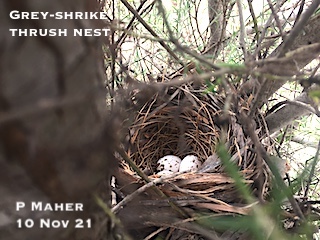
10 November 2021: A grey shrike-thrush nest in a ruby saltbush that is creeping up a boree in the Gulpa revegetation area,
6 November 2021: An adult male black honeyeater was recorded at the Wanganella sandhill revegetation area. All other black honeyeaters seen by me in the district this season have been brown birds. The white-backed swallows have fledged at least two young at Wanganella sandhill.
30 October 2021: First outing with clients since mid April. One female plains-wanderer was recorded while I was out with Karen and Brett from the Shoalhaven area. Other good birds seen during the day and evening were a group of varied sittellas, and a pair of superb parrots feeding young in the nest in town. A barn owl was observed roosting in a native willow tree, not two metres from the vehicle, at the Wanganella sandhill. Also at the sandhill, we got a pair of white-backed swallows. Two species of harrier were seen and about thirty banded lapwings. While we were homeward bound, after the plains-wanderer search, we saw about half a dozen more barn owls.
28 October 2021: Robert saw small stubble quail chicks, and also some orange chats.
28 October 2021 Notes from the Gulpa revegetation area: Thousands of white-browed and masked woodswallows flying over Gulpa, heading north. About ten budgerigars flew over with the woodswallows. Rainbow bee-eater calling. Grey shrike-thrush is building a nest in ruby saltbush that is climbing up a boree. Further in the Gulpa forest, on the sandhill, in a Murray cyprus pine tree, a pair of red-capped robins was building a nest.
27 October 2021: Robert had a juvenile spotted harrier fly over. He also observed a black falcon, which was following the mob of sheep that he was moving.
26 October 2021: Having not gone looking for a plains-wanderer since April, Steve and I headed out on a reconnaissance mission in preparation for next Saturday. We located two female plains-wanderers — the first within half an hour and the second, a couple of hours later. We also saw a little buttonquail and several barn owls. Late in the afternoon, Robert came across a female plains-wanderer while he was working sheep.
24 October 2021
The striped honeyeaters are sitting on eggs in their nest at Wanganella sandhill revegatation area.
22 October 2021
There was pair of white-browed woodswallows this afternoon at Monimail revegetation area. I have had them overhead before, but I don’t think I have ever had them perched at Monimail. They were gone the next day.
The painted buttonquails are back at Monimail as well. I flushed one earlier in the week and in the last couple of days I have found where they have been making their circular scratches in the deep leaf litter under the wattles.
The nest of a pair of willy wagtails was seen at Monimail with three eggs on 21 October, the first I have ever seen in there. A male white-winged triller was also seen in there the same day.
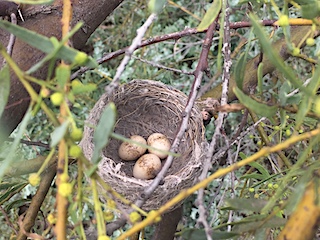
The Gulpa revegetation area continues to get better after the recent rain. Today I recorded about ten budgerigars feeding in there, which is another first. I’m not sure exactly what they were feeding on but at one stage it appeared to be wild oats. Robert has also recently recorded a couple of small flocks of budgerigars north of Wanganella and near Booroorban.
I have been lamenting the lack of small birds in the Gulpa revegetation area, however in the last couple of days there’s been yellow and yellow-rumped thornbill, weebill and western gerygone, so things are improving.
Rufous whistlers are down the back of the plot and I heard my first dollarbirds for the season down there yesterday.
Today out on the plains north of Wanganella, Robert recorded an Australian pratincole, which first we’ve had out there for a couple of years, I think.
21 October 2021
There was an extraordinary number of rainbow bee-eaters flying about at Monimail revegetaion. They still seem to be on the move and have not settled in to start breeding yet. This is probably due to the very mild weather we have experienced in October. Robert said there were a lot of bee-eaters flying about at Booroorban as well.
18 October 2021: Rufous songlarks have finally started to filter south after the recent rain. A male has been calling near the Monimail revegetation area for the last few days, and today a male was in full song at the Gulpa revegetation area. Hopefully it will stay and breed.
The Gulpa site was alive with birds today. Grey shrike-thrushes were in good voice. A male white-winged triller was seen, which was only my second sighting so far this season. Honeyeaters were plentiful. There were spiny-cheeked, singing and white-plumed, as well as little and noisy friarbirds. The noisy friarbirds are nesting not far away as I saw them collecting wool from a fence about a week ago. A brown falcon was getting curry from a noisy friarbird in hot pursuit. It was pulling on the falcon’s tail feathers. The falcon seemed oblivious to the harassment.
The only birds missing are the small bush birds. Their numbers in the river redgum forests are worryingly low now. Not even a yellow-rumped thornbill was seen in the Gulpa revegetation area today although they have been in there of late. Neither weebills nor yellow thornbills were sighted; you would expect to be in there. A couple of weeks back I saw the yellow-rumped thornbills feeding what appeared to be just a single fledged young. It is little wonder they are in decline if they can only raise a single young. It had been dry at Gulpa until 41 mm of rain fell between 28 September and 1 October. Hopefully the yellow-rumps will nest again now it’s rained. All up, there's been 62 mm of rain at Gulpa since the 28 September. The best spring rain in many years.
A few superb parrots flew over but none stopped to feed in the revegetation area. No mistletoebird was seen at the Gulpa site today, so it looks like they might have moved on until the grey mistletoe starts to ripen in a month or so.
17 October 2021: The striped honeyeaters have a nest at Wanganella Sandhill revegetation plot — the first to nest there.
4 October 2021 Monimail revegetation area.
The recent rain has fired up the birds at Monimail. Twenty-seven millimetres has fallen there in the last week. On 2 October, while picking quondongs, I discovered that the striated pardalotes are using one of the nest hollows I put up a couple of years ago. Today I see they are using another nest hollow as well. It's possible that other hollows are also in use. Given that I recorded the first pardalotes in the Monimail revegetation plot only a year or two ago, I am chuffed about this outcome. Some of the mallees I planted have only reached a decent size in the last year or two. Striated pardalotes do feed in other species but eucalypts are their favourites. It is interesting that they have chosen to nest in the revegetation area when there are hundreds of hectares of black box not that far away. Probably the fresh growth on the young mallees is providing a big resource of insects.
Also at Monimail on 2 October were western gerygone and chestnut-rumped thornbill, both of which have only turned up in there recently. I think the yellow thornbills are nesting in there too, which is probably a first. Not sure if the yellow-rumps are nesting in there yet.
Monimail is just alive with spiny-cheeked honeyeaters and they are calling like crazy, There must be many pairs nesting or about to nest. Also, there are lots of singing honeyeaters about and maybe one pair of striped honeyeater. The striped tend to nest a bit away from the spiny-cheeked and singing honeyeaters and have never nested inside the revegetation area, always just outside.
Wanganella sandhill revegetation area.
On 1 October about a dozen cockatiels were sighted flying over, heading north. That was my second sighting this season. Also, about ten glossy ibis flew over the swamp behind the sandhill. The pair of brolga is still around, no doubt hoping for an opportunity to try and nest again this season.
Gulpa revegetation area.
On 3 October I had two grey-crowned babblers in the revegetation area, which was a first. I suspect they were passing through so I may not see them again for a while. A Horsfield’s bronze- cuckoo was also singing away in there, which maybe was a first — I can’t recall having seen one in there previously,
Two pairs of mistletoebirds are there at present, despite mistletoe berries being in short supply. The winter mistletoes have largely stopped fruiting and the spring ones haven’t really started yet, so the mistletoebirds are making do with ruby saltbush berries, and one I saw feeding on nectar on the flowers of grey mistletoe. Due to it having such a short bill it was having to stick its whole head inside the flower, so its head was getting covered in yellow pollen. I have seen them feed on nectar but not for many years. The berries of the grey mistletoe will start ripening in a few weeks and some box mistletoe will fruit at Gulpa soon for the first time. So, there will be plenty of food, which is probably why the mistletoebirds do not want to leave.
28 September 2021: A female black honeyeater recorded at the Monimail revegetation plot.
23 September 2021: A first for the Wanganella sandhill revegetation plot — an olived-backed oriole.
22 September 2021: A sacred kingfisher seen out at the Wanganella sandhill revegetation plot.
20 September 2021: The first rainbow bee-eaters for the season (a group of about six) sighted at the Wanganella sandhill revegetation plot today.
12 September 2021: Tom, Geoff and Steve had a Caspian tern fly over the Island Sanctuary this morning. Possibly the first record for the town.
There was a white-fronted honeyeater in our garden, mimicking singing and other honeyeaters. It was making some unusual calls.
7 September 2021: Angus reported two male scarlet honeyeaters today in a garden in North Deniliquin.
They have turned up in Deniliquin annually for the last four years, usually in late spring/summer. To my knowledge, they have only bred here once, that being January 2018. It's probably due to the vast areas of forest that were burnt in the Black Summer fires of 2019/20 that they are still wandering far and wide. Prior to that event, it was probably related to the severe drought that was occurring over much of eastern Australia.
My only news today was seeing a mating pair of eastern brown snakes at the Wanganella sandhill revegation plot. That was new to me; I’ve seen plenty of brown snakes but not mating.
The sandhill is looking fantastic after 30 mm of rain last Friday, although birds were a bit disappointing, nothing new having turned up.
The young uncoloured male rufous whistler is still calling like mad. He has a female with him so I am hoping they might breed. (I’ve never seen an uncoloured male breeding but I guess it is possible).
The uncoloured golden whistler is still present.
The male swamp harrier was doing a display flight and calling today over the adjacent wetland.
There has been a huge chorus of frogs in the wetland for the last week. Mainly the spotted marsh frog but also one of the banjo frogs and one of the Crinia species.
There’s another rise coming down 8 Mile Creek after the rain in the headwaters of Billabong Creek last weekend.
31 August 2021: While not being one hundred percent sure that I have never recorded them at the Monimail revegetation site before, two, ostensibly, new birds were recorded there today: painted buttonquail and yellow thornbill. Also present was an uncoloured red-capped robin, yellow-rumped thornbill, grey fantail, willy wagtail, lots of spiny-cheeked and singing honeyeaters, noisy miner, grey and pied butcherbirds, bluebonnet, eastern rosella and grey-crowned babbler. A striped honeyeater was heard.
Out on the plains north of Wanganella today, Robert heard the first rufous songlark for the season and saw a group of six ground cuckoo-shrikes on his property.
26 August 2021: It was great to see the brolga pair back at the Wanganella wetlands. There was a minor natural flood down the system about a month ago.
22 August 2021: Lately I’ve recorded striated pardalote and a noisy friarbird at the Wanganella sandhill revegetation area. Both species are new birds for the sandhill. Other species seen in recent days include grey fantail, an immature male rufous whistler, western gerygone, yellow and yellow-rumped thornbill, an adult male mistletoebird, red-capped robin, superb fairywren and grey shrike-thrush.
From Robert
11 August 2021: Three gull-billed terns flyover heading North, southeast of Booroorban
10 August 2021: The first fairy martins have returned to 8 Mile Creek Wanganella.
7 August 2021: Banded lapwings sitting on nests, plains north of Wanganella.
5 August 2021: Pallid cuckoo, one on plains north of Wanganella.
1 August 2021: Horsfield’s bronze cuckoo, about two calling on the plains north of Wanganella.
28 July White- bellied sea eagle: One at 8 Mile Creek, Wanganella.
27 July 2021: Spotted harrier seen on the plains north of Wanganella, very scarce bird at present, first for almost twelve months.
17 April 2021: Chris, now living in Adelaide, and who was on his second visit for plains-wanderer with me, was rewarded with three male plains-wanderers (two adults and a immature — the immature is identified by its pale legs). This is the first confirmation that at least one young bird has reached near adulthood.
15 April 2021: Jack from Melbourne and I went out for the evening. We found two male plains-wanderers.
12 April 2021: Wayne and Helen from Adelaide and I went out for the day and evening. We got a female plains-wanderer in good time. Late afternoon we saw a single blue-wing parrot feeding on the roadside.
8 April 2021: David and Leslie from Woolgoolga and I ventured out for the evening. We found three male and one female plains-wanderers.
7 April 2021: Report on the 2020-2021 waterbird breeding event Wanganella wetlands
2 April 2021: A peaceful dove was a new bird for Wanganella sandhill revegetation area. Also, at least six mistletoebirds seen, and six superb parrots flew over. Striped honeyeaters are back at Wanganella sandhill and two white-fronted honeyeaters were feeding in flowering Eucalyptus leaucoxalon var. rosea.
Grey fantails turned up — these birds are autumn migrants from the hills. A boobook owl was recorded roosting in a mallee eucalypt.
20 March 2021: Vicki and Mark joined forces with Steve and Ethan for an evening excursion. They saw three male plains-wanderers and were lucky to follow that with a female plains-wanderer.
19 March 2021: David, Elizabeth and Malcolm and I located what was, most likely, the same three male plains-wanderers that I found with Pam and Graham on the last outing.
17 March 2021: Pam and Graham, from Melbourne, and I went out in the late afternoon. We started off out at the Monimail revegetation area with at least half a dozen mistletoebirds, most of them immatures. It was great to see the pair of adult mistletoebirds feeding two juveniles not far from the nest that I had been keeping an eye on. A flock of about twenty superb parrots flew over the road. We followed them over and tracked some down, including three adult males. While over there, Pam mentioned she had never seen an owlet nightjar. I had not looked for them in this particular box clump for over twenty years and I was racking my brain to remember which tree I sometimes got them in. They are quite scarce in the district at present and I had not seen any during the day anywhere for a couple of months. I tried a few of trees. On my third attempt — bingo! An owlet-nightjar sat out in the open, allowing great views and photos.
We made haste out to John’s house on the plains to get the bluebonnets before they turned in for the night. We had a bite to eat near the barn owl’s nest tree in John’s box clump and after dark they flew around screeching and eventually perched so Pam could get a good look.
We headed out to the plains-wanderer paddock. Success was ours. Within thirty minutes we located an adult male plains-wanderer. We searched some more hoping for a female but came up with another two adult males within 200 metres of the male we had first located. I suspect the female wasn’t far away but she remained elusive. Graham got some good photos and Pam was happy so we called it a night. Judging by the way all the adult plains-wanderers are hanging out close together, I suspect they might breed this autumn if we get the big rain that is said by some soothsayers to be coming in the next week. A good number of fat-tailed dunnarts were seen during our search for plains-wanderer, as well as the introduced house mouse which, although aren’t plaguing, are still fairly numerous.
15 March 2021: The buff-breasted sandpiper seen again at Wanganella wetlands. John came down and had a look at it.
Video of buff-breasted sandpiper.
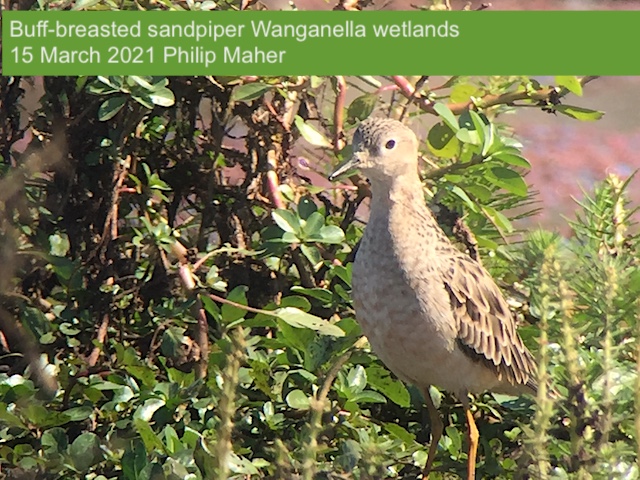
14 March 2021: A buff-breasted sandpiper recorded at Wanganella wetlands; a first for the district. I found it early afternoon and then Robert and I relocated it later in the afternoon.
14 March 2021: A pair of white-backed swallows at the Wanganella sandhill. These are the first seen since mice disturbed them from their nests some months ago.
12 March 2021: Phil from Yarrawonga bought his girlfriend, Jasmine, an evening's plains-wandering for her birthday. Soon after dark, Phil, using his own thermal monocular, found a female plains-wanderer, the same female recorded on 10 March. Also seen were three barn owls and with help of the thermal monoculars, two stubble quails and about thirty fat-tailed dunnarts. Earlier, we had a juvenile painted honeyeater in the boree north of the Monimail and three male white-winged fairywrens sitting close together on a fence near John's front gate.
10 March 2021: Charuka, originally from Sri Lanka, and Jan, originally from southern India, and I went out for a day and evening in the Deniliquin area after three strenuous days over in the Victorian mallee. Charuka and Jan are keen bird photographers. Charuka had spent a couple of days with me in the Deniliquin area in early January.
We worked the boree country over north of Monimail in the early morning. About a hundred superb parrots were seen but most seemed to be going somewhere else and we never did track down exactly where they were feeding. Nevertheless a few good shots were had.
A couple of wedge-tailed eagles and black kites and brown falcons sat up nicely for the guys. We had a try for painted honeyeaters and came up trumps with a male and female, both immature birds. It appears that more pairs must have nested in the area than I thought. That makes three immatures seen now in the last few weeks. We called in at the Monimail revegetation area and the guys got good photos of spiny-cheeked, singing and striped honeyeaters. The purple backed fairywrens were a bit stand offish but not so mistletoebirds and we had no less than six in one locality, most of them immatures. Plenty of bluebonnets were seen during the morning but they did their wary best to deny Charuka and Jan a decent photo. We headed home for lunch and a break, happy with our morning’s efforts.
After lunch we ventured out to Wanganella and took in the wetlands. Nothing too exciting as it’s drying back now. We tried for a photo of the white-fronted honeyeaters at the revegetation sandhill. Three birds came in but they were uncooperative, as is often their wont. We made our way out onto the plains and finally had some half decent shots of an adult male white-winged fairywren. The guys also got photos of red kangaroos and a male emu with nine big chicks. The bluebonnets were a little more cooperative around John’s house as were a couple of barn owls sleepily looking out of their hollow.
We had some tucker and headed out after a plains-wanderer. The first locality was a fizzer so we shifted camp to another paddock. We had almost instant success as I spotted a male with AOS’s new toy (a thermal monocular). We only drove a short distance from him when Jan spotted the female out of his side window. Charuka had the male in early January so he was thrilled to get the female this time. Jan struck it lucky getting both in the one outing. Plenty of photos were had of fat-tailed dunnarts as well.
5 March 2021: A single blue-winged parrot flew over the Monimail revegetation area, the first I've seen in several years here. The mistletoebirds have big young in their nest at Monimail.
27 February 2021: I had some good finds while doing my regular waterbird surveys of the environmental flows at Wanganella. The water is drying back rapidly now so there’s plenty of shallow water, making it ideal for waders. There were 300 — 400 sharp-tailed sandpipers feeding on the mudflats in company with about a hundred red-kneed dotterels. Amongst this lot were no less than three wood and two pectoral sandpipers. This may be the most wood sandpipers I have ever seen together in the district. It’s a good many years since I have seen two pectoral sandpipers together. One of the woodies was handsome with a lot of spotting on the back. There was a good deal of size difference between the two pectorals and they generally fed quite close together, so I took them to be a pair.
At one point, the waders appeared anxious. A black falcon materialized, taking a dive and scattering them in all directions. For the next ten minutes as they performed spectacular highspeed aerobatics complete with synchronised turning. It took them quite a while before they settled down again. This is the third time in recent weeks that I’ve seen a black falcon harassing the waders. I think it may be a young bird still honing its skills. Back in the spring and early summer it was peregrine falcons that were working the swamp over, catching stilts and grey teal and maybe whiskered terns as well that were there in their hundreds. I have not seen them of late but a couple of juvenile Australian hobbies are regularly hunting over the swamp, catching dragon flies. A male immature brown goshawk was also seen yesterday hanging around the adjacent regeneration sandhill. The family of swamp harriers are still working the swamp over as are three white-bellied sea-eagles — a pair of adults and an immature bird, two or three years old.
On 26 February two immature wedge-tailed eagles appeared to be sizing up the immature sea-eagle, flying quite close it but not quite engaging in open warfare. My past observations suggest that the sea-eagles are dominant over the wedgetails.
Two black-shouldered kites are back at the swamp and adjacent sandhill, hunting mice of which there is an abundance; nankeen kestels are having a field day with the mice as well.
The spotted crakes have bred fairly well in the wetlands this season. They started breeding back in October and have continued breeding as an almost full-grown juvenile was seen yesterday. Baillon’s crakes have not been seen for a month or so; they might have gone north already. The spotless crakes are probably still in the reedbeds.
Also noticed yesterday at least one juvenile yellow thornbill at the regeneration sandhill. They turned up at the sandhill about five years ago but this is the first time they have successfully raised young to my knowledge. I think there are at least two groups of yellow thornbills at the sandhill now as I am seeing them in different localities, a few hundred metres apart. The yellow-rumped thornbills are doing quite well and there is a sizeable flock here at present. The white-fronted honeyeaters are still about with two birds feeding in flowering harlequin mistletoe a few days back. A male mistletoebird ihas been a regular visitor in the last week as more mistletoe berries ripen. The fleshy mistletoe has ripe berries now, as well as more flowers so will produce fruit for many months. The grey mistletoe has been fruiting for a while but I don’t have much of this species out there yet. It won’t be long before the wire-leafed mistletoe berries and the buloke mistletoe are ripe, so there will be a bountiful supply of mistletoe berries in a few weeks. It will be interesting to see how many mistletoebirds turn up this year. I can remember being out at the nearby Zara sandhill one Easter in the 1980s when rainfall was still a given and the whole sandhill was alive with mistletoebirds feasting on the fleshy mistletoe berries.
Some of the birds are still nesting, thanks to the good rain in January. A few days back I found a superb fairywren’s nest with young, and not far away the purple-backed fairywrens looked like they might have been feeding young as well. The white-winged fairywrens are building up in numbers with the good season and are getting closer to the sandhill. I have seen two different groups in the goosefoot bushes at either end of the sandhill of late. They have been fairly scarce around here for a number of years now.
The rainbow bee-eaters are still moving around. A group of at least a dozen birds turned up over the wetland yesterday feasting on the masses of dragonflies that are there at present. It won’t be long before all the bee-eaters will go north, I think the adults are gone already as I’ve been seeing mainly juveniles for weeks now. They too must have bred well this year.
Still no sign of the white-backed swallows. They disappeared a few months back when I think mice may have got into their nest holes. Mice numbers were exploding at the time. It could be some time before the mice numbers subside, depending on rainfall, so I may not see the swallows for a while yet.
26 February 2021: A male painted snipe recorded at the Wanganella wetlands.
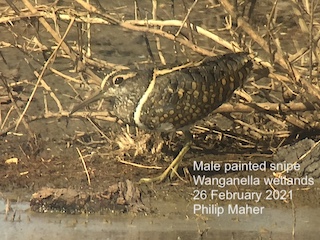
24 February 2021: Pippy from Cairns and I went out for the day and evening. In the early morning we tried along a lane north of town where there had been painted honeyeaters back in early January but we had no luck. At the first stop there were at least four striped honeyeaters in good voice. Plenty of bluebonnets were about, sitting up on powerlines and elsewhere and we had some nice looks.
Moving on to the regeneration plot at Monimail, where, with much mistletoe in fruit or about to fruit, mistletoebirds were in abundance; both adults and immatures noted. I was also pleased to see that the female mistletoebird was still sitting in the nest, so all seems to be going well there. All the usual suspects were seen here: spiny-cheeked and singing honeyeaters and superb and purple-backed fairywrens. Flocks of superb parrots flew low oveheads, which delighted Pippy.
We moved on up the road a bit to an area of black box on the TSR which had been drought stricken for years but has come back to life after the recent rains. Plenty of yellow-rumped thornbills were feeding along with southern whiteface, chestnut-rumped thornbills , weebills and western gerygones. However, the greatest surprise was an immature male painted honeyeater! I had pretty much given up on this bird as I thought they had all cleared out. Strangely enough there is no mistletoe at this site and the bird was feeding like a sittella, working along the branches and peering under the bark. I suspect it was looking for spiders; certainly insects of some sort. Its stout bill is well designed for catching spiders and is reminiscent of the bill of that other specialist spider catcher, the blue-faced honeyeater. I have seen them at this locality previously but not for some years, so it really was quite a surprise. It seems that at least a pair of painted honeyeaters must have raised young somewhere in the nearby boree country. We were pleased with our mornings work so we headed home for lunch and a siesta, ready for tonight
Later in the afternoon we headed back out north where our first stop was the Wanganella wetlands. It is drying back now and the birds are starting to move but we still added quite a few to the list. The highlights were swamp harrier (adults and immature), white-bellied sea-eagle (pair), wedge-tailed eagle (several nearby), musk duck (male and two females), chestnut teal (pair) and pink-eared duck, Australasian and hoary-headed grebes and little grassbird.
We headed north out onto the plains where we had a flock of about fifty white-fronted chats, the biggest flock I have seen out there for years. Plenty of Australasian pipits were about as well. We started our spotlighting after dark and within thirty minutes had found a magnificent adult female plains-wanderer. Pippy was beside herself. After Pippy was satisfied with her views we continued spotlighting. Many fat-tailed dunnarts were about, with at least eight seen including some obvious younger ones.
We checked out another paddock where we had plains-wanderers in early summer and came upon an adult male plains-wanderer almost immediately. Pippy was well-satisfied now so we headed out. A barn owl crossed our path as we were leaving the paddock.
Kangaroos were back along the highway so it was a slow trip back to town but we were still home before midnight.
20 February 2021: John, Trisha and I went out to see if we could find a plains-wanderer with AOS's new thermal imaging monocular. We turned up an adult female plains-wanderer after about an hour and then were able to relocate her. A little buttonquail and a couple of Australasian pipits were also found with the monocular. Being wi-fi connected, we could not only look for bright white spots through the monocular but also on the mobile phone and ipad. Having been a hot day, many of the small bushes retained their heat and were also showing white but generally not as brilliantly white as birds and mammals. We saw numerous fat-tailed dunnarts and house mice, which looked like white butterflies loping across the screen. We are hoping this gadget is a game changer in the amount of time we spend driving over John's paddocks. Four barn owls were spotted (sans the monocular) as we were leaving John's place.
20 February 2020: Stormy weather and a tiny bit of rain triggered masses of insects and in turn hundreds of tree martins between Pretty Pine and the Monimail; observed just before sunset.
13 & 14 February 2021 About fifteen cockatiels went over at the revegetation area at Wanganella, heading in a northerly direction. These are the first I have seen for some weeks.
It was quite windy at the Monimail revegetation area and the female mistletoebird was hanging on for dear life in their nest. The nest was being rocked vigorously from side to side and I feared for the safety of the eggs. I wrote in a previous post that they had young, but I was mistaken. They were in fact putting the finishing touches on the nest rather than feeding young as I assumed. Here’s to a good outcome. The nest is in an Acacia victoriae as was the previous nest a few years back. They are great for all sorts of birds to nest in. The Acacia victoriae has clusters of dry seedpods on it as well, which possibly help to conceal the mistletoebirds’ nest and they are prickly too, so great for nesting. The nest is about two metres from the ground, which is fairly typical for this species.
Today, I surveyed the waterbirds again at Wanganella wetlands, adjacent to the sandhill revegetation area, and scored another black falcon (or maybe the same one I saw couple of days back, which was only a few kilometres away). This one I believe was an immature bird and was testing out its skills trying unsuccessfully to catch a pied stilt. Three immature swamp harriers were also working over the swamp so it’s a dangerous place at present for young birds.
Today I finally confirmed that the blue-billed ducks bred at Wanganella this season. A female was seen with five well-grown juveniles. This makes thirty-five species of waterbirds or wetland dependant species that have bred on the environmental flow in the Wanganella wetlands this season. I had seen the male bluebills doing courtship displays but never managed to find a nest, so it was great to confirm that at least one pair was successful.
11 & 12 February 2021 By the sound of it, at least half a dozen white-fronted honeyeaters were at the Wanganella sandhill revegetation area . This is by far the highest numbers that have been there to date. The first for the sandhill only turned up about twelve months ago. The Eremophila longifolias still have a few flowers on them, courtesy of the good rain in January, and the white-fronteds have been feeding in them. Also, the wire-leafed, fleshy and buloke mistletoes have been flowering for the last month or more; the white-fronted are particularly fond of them. The harlequin mistletoe is just starting to come out in flower now so should provide nectar for a while. The pointed mallee Eucalyptus socialis has been flowering for over a month and is nearly finished now but the congoo mallee Eucalyptus dumosa is just starting to come out so should keep the birds and insects happy for a bit longer. The revegetation area is getting enough diversity in it now that there is nearly always something in flower, which was the goal.
I flushed up a southern boobook today, the first for a year or so. The mice are building up in numbers so there is plenty of food about. It had roosted in a small gum only about a metre off the ground.
A black falcon was also encountered today while I was doing a waterbird survey for the environmental flow down 8 Mile Creek, east of the sandhill. This is the first black falcon I have seen for months. Mostly I have been seeing peregrines and hobbys about the wetlands but saw neither today. I did encounter quite a few other raptors, including a swamp harrier, a pair of white-bellied sea eagle, a little eagle, two or three wedge-tailed eagles and at least ten whistling kites. I’m not sure what the black falcon had its eye on, but it certainly scattered the flock of sharp-tailed sandpipers I was watching. A single male mistletoebird was also recorded at the sandhill today .
There were quite a few birds on the move at the sandhill yesterday, which was hot and windy. First a mob of about a dozen immature rainbow bee-eaters turned up and then a short time later a mob of about a dozen superb parrots flew over, heading north towards Billabong Creek. The bee-eaters have been coming through in flocks for a few weeks now, presumably heading north for their migration. They have all been immature birds. My guess is the adults have already moved north. There was just a couple of bee-eaters out there today.
8 January 2021: I was pleased to find a pair of mistletoebirds feeding young in a nest today at the revegetation area at Monimail. There was a recently fledged juvenile there as well that had come from another nest somewhere in the area, so the mistletoebirds are doing well. This is the third time the mistletoebirds have nested here in the last ten years, the second time successfully. In one drought year they abandoned in a heatwave.
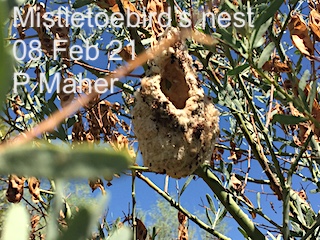
The painted honeyeaters have not done so well this year. Two males came in over a month ago and looked like they were going to nest but I’ve checked in the last couple of days and can find no trace of either bird. Another two or more pairs turned up in the boree country north of Monimail about two weeks ago, but they also appear to have moved on. There appears to be plenty of fruit on the grey mistletoe this year so just what the problem was I cannot say. It was very late when the last two pairs came in and I would have been surprised if they had nested. They have always arrived by December in previous years when they have bred successfully. So as far as I know no painted honeyeaters have bred in the district this season.
A juvenile western gerygone turned up at the Wanganella sandhill revegetation area in the last few days and is hanging out with yellow and yellow-rumped thornbills. This is the earliest I have ever had them turn up at the sandhill. It is usually more in the autumn and winter. The vegetation has really come on in the last twelve months, thanks to the rain. Most of the small birds have bred successfully this year as well so have got their numbers up a bit. This year will be crucial. If we get a good season their numbers will continue to climb back to something like they once were — if we go back to drought as has been the pattern for the last twenty years, then back to square one ... The gerygones breed along the Billabong Creek, which is only a few kilometres away so the juvenile has probably not come far.
In the last few days a few black-faced cuckooshrikes have turned up at the sandhill — another bird that usually turns up in autumn. There was almost 50 mm of rain at the sandhill in January and the area is alive with insects so there is no lack of food. The weather has turned cool as well, so the birds probably think that autumn has arrived early.
Yesterday there were about a dozen juvenile rainbow bee-eaters feasting on the many species of dragonflies that are abundant at the sandhill at present, having taken advantage of the environmental water in the adjacent wetlands. The bee-eaters were no doubt feasting up, getting ready for their migration north. I think most of the adults have already left although I did see one in the boree country yesterday. Today all the juveniles were gone from the sandhill but there was still a few at the Monimail revegetation area, making a lot of noise and possibly also getting ready to migrate.
There was a big group of white-winged fairywrens at Monimail today. This is the first group that has been in here for a couple of years at least. This makes three species of fairywrens that I have seen at the Monimail revegetation area lately. All three species of fairywrens have also been around the Wanganella sandhill lately as well. The superb fairywrens have come back since the environmental flooding of the adjacent wetlands these past two summers.
In the boree country north of Monimail yesterday, I also encountered a juvenile Horsfield’s bronze-cuckoo that was travelling with a group of white-winged fairywrens, which had obviously raised it. This is the second juvenile cuckoo I have seen raised by white-winged fairywrens this season. The cuckoos are breeding up, which is good to see as they have also become quite scarce in recent years.
Yesterday I flushed up a brown quail in the Wanganella sandhill revegetation area. This is the second recorded on the sandhill lately. They have probably been attracted up onto the sandhill by the native millet and other native grasses that have started seeding, thanks to the good rain in January. They have been breeding around the adjacent wetlands these past two summers, courtesy of the environmental watering. This is the first time I have ever seen them up on the sandhill.
The superb parrots have taken a beating on the Cobb Highway of late a few kilometres north of town. Mark Sanders found eight freshly killed birds in late December and someone else found a similar number killed in almost the same spot in late January. This may account for the whole flock that was feeding in this area. I saw about ten feeding on the roadside in the same area on one occasion on a rainy morning a few weeks back and was lucky to miss one bird that flew up in front of me. They cannot afford to lose numbers like this given that their numbers around here are only in the hundreds. Their confiding nature means they do not have much road sense; it renders them vulnerable when they feed on roadsides, which fortunately is not that often.
31 January 2021: Two pairs of painted honeyeater and another single bird located in the boree country north of Monimail. I believe they have only arrived since it has rained in the last week. They were doing a lot of calling which would indicate they were interested in breeding. Four pairs recorded for the season.
27 January 2021: At least two Australian hobbys catching dragonflies over Wanganella wetlands.
26 January 2021: Six gull-billed terns feeding at the Wanganella wetlands; first sighting for this season.
23 January 2021: A chestnut-rumped thornbill; a new bird for the Wanganella sandhil.
14 January 2021: John observed an inland dotterel on a nest. This is the first breeding record for this season. So far, inland dotterels have been few and far between.
4 January 2021: At six-thirty I collected Charuka who hails from Sydney but was born in Sri Lanka. Charuka is primarily a bird photographer and had a massive 600 mm lens. We went out for the day and evening, targeting mainly species he had not photographed before or hoped for better photographs.
We started the morning off northeast of town with painted honeyeater. which performed admirably for us and Charuka got some great shots. The painted honeyeaters are scarce again this year and so far I have only managed to find two males. No females have been seen yet. We also scored a striped honeyeater nearby.
A group of superb parrots was located down the road a bit in some roadside trees and Charuka got some half-decent shots of a male. He also got some great shots of a group of four recently fledged black-shouldered kites in flight and perched. We were off to a good start.
We tried for white-winged fairywren in a patch of saltbush country and scored a full-coloured male at fairly close range. The species being quite wary is not easy to photograph well. Nearby we had a group of grey-crowned babblers that put on a show and some great shots were had.
Next up we tried the Monimail revegetation area. The purple-backed fairywrens proved more elusive, particularly the males but I think Charuka only got decent shots of the female. An immaculate male mistletoebird was obliging and perched up and sang only a few metres from us. It looks like the mistletoebirds might nest in the revegetation area again this year. They have nested there twice before, once successfully. On the other occasion the nest was abandoned during a heatwave. The revegetation area looks great at present after 27 mm of rain a couple of days ago.
We moved up the road a bit to some blackbox country. Our targets here were southern whiteface, chestnut-rumped thornbill and western gerygone. The southern whitefaces were photographed well within a few minutes of leaving the vehicle. We had to work a bit harder for the chestnut-rumped thornbill but eventually some half decent shots were had. The western gerygone was more obliging and it was soon photographed.
Everything was to plan as we headed home for a break. After lunch we tried for some better shots of the superb parrots. They were roosting in the mature boree around Monimail but were not in the mood for photography and kept taking off on us, so we gave it away. Some emus were photographed on the roadside as we headed north.
Next up we worked the swamp over at Wanganella and great shots were had of pink-eared duck and hoary-headed grebe as well as little black and little pied cormorants. I love the beautiful blue eye colour of the little black cormorant and the fine white streaks on the head when it is in breeding plumage — a wholly underrated bird.
Charuka also got good flight shots of black and whistling kites and some more distant ones of an old male swamp harrier which was almost pure white on the breast and with contrasting dark and pale grey on the back. There were a few spotted crakes about but they were not in the mood to be photographed.
With the sun getting lower in the sky we set off for the plains-wanderer property and headed for John’s house to try for bluebonnets. They are a little less wary here than elsewhere in the district, being more used to people around the house. Charuka got some great shots of the yellow-vented bluebonnets in the late afternoon sun.
We next tried for the owlet nightjar. Having resided here for months, he has shifted since the rain a few days ago. We headed for the plains-wanderer country with the shadows growing longer.
We had a break at the old, abandoned homestead and were amused by the interactions between about half a dozen kestrels and a couple of Australian hobbys about to roost for the night. The hobbys put on a wonderful display of aerobatics as they outmanoeuvred the kestrels. Inadvertently, Charuka managed to flush up a barn owl as he concentrated on photographing the raptor display.
As darkness settled, we started our search for the plains-wanderer. It was quite windy and not ideal conditions to look for them. After an hour of searching we had turned up a pair of banded lapwing, which while not our target, was obliging. A single brown songlark was also seen but couldn’t be photographed.
An hour and a half went by and still no plains-wanderer. I thought it time to shift to a different paddock. The next paddock was more productive with more banded lapwing and then Charuka got good shots of Horsfield’s bushlark. After about half an hour, a male plains-wanderer was finally flushed up and good photographs were had. We continued to search hoping to see the female, which was probably nearby. After another half an hour a second male plains-wanderer was located and more good photographs were had. We searched for a while longer but the female remained elusive. Our one and only fat-tailed dunnart for the night was observed. We decided to leave the female for another day and headed out but not before calling in at a redgum clump as Charuka was keen to get photos of barn owl. We had only seen a head in the nest hollow back at John’s house in the day, and the one that was inadvertently flushed but not photographed. The barn owl obliged and good shots were had. They are nesting at present with mice numbers building up. Being about 2.30 am, we headed for home.
3 January 2021: Three little bitterns calling and three Latham's snipe at the Wanganella wetlands; a second male painted honeyeater in the boree country, and two rainbow bee-eaters over the Wanganella sandhill are the better species for the day.
29 December 2020: Four male plains-wanderers located last night with Duan from Brisbane. Mark Sanderson, an ex-local now living in Brisbane, came along to lend a hand. We spotlighted a few fat-tailed dunnarts, banded lapwings, pipits and Horsfield's bushlarks. On the way out to the plains-wanderer property we got a painted honeyeater and a score or so of superb parrots.
26 December 2020: An injured Australian painted snipe at Wanganella wetlands was found at Wanganella wetlands. It probably had hit a fence that was about 200 metres away at night.
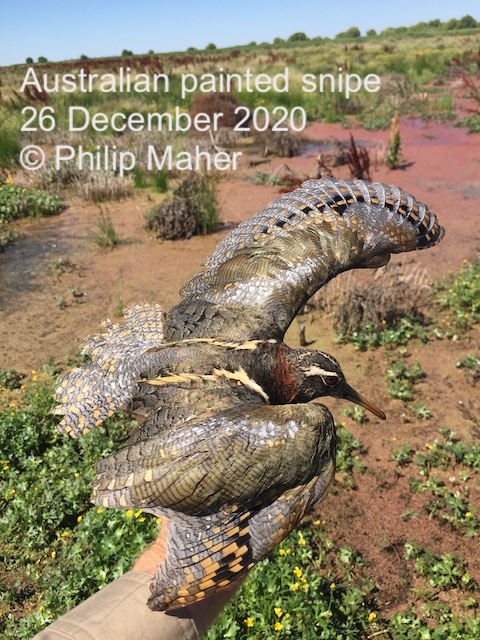
20 December 2020: A male and a female plains-wanderer recorded.
17 December 2020: Out with Bellbird Tours for the day and evening. The better sightings included two male plains-wanderers and a stubble quail, a painted honeyeater and twenty or so superb parrots. We heard little bittern calling with young (also calling), and three magpie geese with about six goslings, about a week old.
15 December 2020: Karen from Canberra and Michelle from Strathalbyn in SA ventured out with me in the late afternoon. We managed a painted, a pair of striped and five black honeyeaters, a score of superb parrots — adults and juveniles; and a group of purple-backed fairywren, At Wanganella we observed an adult and two recently fledged swamp harriers. We also saw what looked like a western brown snake out on plains, about four-foot long and aggressive. At night we had three little buttonquail, about a hundred banded lapwing, around ten fat-tailed dunnart, two Horsfield’s bushlark and three brown songlark. Almost forgot to mention: three female plains-wanderers and one male plains-wanderer.
9 December 2020: John saw a male plains-wanderer while he was working today. We don't see many in the daytime.
9 December 2020: Monimail revegetation area
I was out at the Monimail revegetation area before sunrise to listen to the polyphonical ensemble that is the dawn chorus,. It consisted of spiny-cheeked honeyeaters with about half a dozen singing honeyeaters, interspersed with the occasional call of purple-backed fairywrens and magpies. A little later both grey and pied butcherbirds piped in.
The superb parrots have only just arrived back out at the Monimail so I was also keen to see if they were feeding in the revegetation area. For years they have been flying back and forth over the revegetation area as they move between the boree on the west side of the highway and the blackbox on the east side — frustratingly, only rarely stopping in the revegetation area. This morning, a couple of groups of adults and juveniles flew in and landed in native willows and Eremophila longifolia. Initially they were sunning themselves in the tops of the trees as it was a quite cool. Over the next couple of hours I watched them feeding on the green seeds of narrow-leafed hopbush, Acacia rigens, A. victoriae, and A. brachybotria, sugarwood and on the flowers of Eremophila longifolia and grey mistletoe.
The narrow-leafed hopbush was their favourite with up eight birds feeding in one bush. All up there were about thirty to forty superb parrots feeding in the revegetation area.
The plants have seeded the best they ever have, so it is little wonder the superbs are finding them attractive. In the drought years most of the plants hardly produced any seed at all.
The bluebonnets were also finding the green hopbush seeds attractive and at one stage a bluebonnet tried to see a superb out of a hopbush. The bluebonnets mainly fed on the seeds of old man saltbush during the drought but this year they too are favouring the green hopbush seeds.
A couple of white-fronted honeyeaters were also back today after a long absence. Their presence is probably due to their favourite, the wire-leafed mistletoe, coming into flower. They have often turned up in the past when the wire-leafed mistletoe is flowering. Just how they know when to come is a mystery to me.
A couple of little buttonquail were also flushed up in the native grasses, which could be a first. They appeared to be juveniles so have probably nested in the revegetation area.
The purple-backed fairywrens have also had a good year, with a couple of lots of juveniles seen lately. There must be half a dozen groups in the revegetation area now, as well as at least one group of superb fairywrens.
7 December 2020: Another extraordinary find at the Nevinson's this morning. A regent parrot was recorded by Robert, Rhonda and James in their garden. A first for this district. The bird didn't stick around and couldn't be relocated in the afternoon.
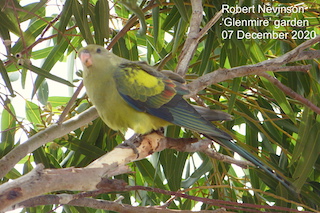
7 December 2020: Matt and Diane, on an evening excursion, scored a painted honeyeater, a ground cuckoo-shrike, a female plains-wanderer and a male plains-wanderer, among other species.
5 December 2020: Out and Kathy and Neville from Leeton for the day and evening. During the morning we had a pair of peregrine falcon, south of town; two different groups, including juveniles, of varied sittella; an adult male hooded robin at Gulpa Island; and an adult male red-capped robin: at Gulpa Island;
In afternoon we had an adult male painted honeyeater in boree country north of town, which was the first return of the season. Eight freckled duck at Wanganella wetlands including at least one adult male in full breeding plumage, and the first record this season. On the plains-wanderer property, we had a mature owlet nightjar, and after dark, two male plains-wanderers, no chicks, in a different paddock to the males with chicks recorded on the recent plains-wanderer weekend. Also seen were five stubble quail, mostly immatures; about six fat-tailed dunnarts, six banded lapwing and two barn owls
1 December 2020: Out with Melissa and Tom from Stanthorpe in Queensland. We saw three plains-wanderers, two males and a female — all within 100 metres of each other.
30 November 2020: A female peregrine falcon has been giving the waterbirds a hard time at the Wanganella wetlands lately.
28 November 2020 Plains-wanderer Weekend. In unbelievably hot conditions, Robert and I and a group of hardy souls got two male plains-wanderers with chicks and another male. The mercury got to 44 degrees C. Species recorded.
16 November 2020: Out with Jill and Brian from Canberra. Best birds in the morning were a female painted buttonquail, about a hundred superb parrots (adults and young) and sittellas feeding two young in a nest. Better sightings in the afternoon included white-winged fairywren, Horsfield's bushlark, owlet nightjar and bluebonnet. After dark we had a female plains-wanderer, little buttonquail, barn owl and banded lapwing, among other species.
14/15 November Plains-wanderer Weekend: Best birds: male plains-wanderer with nest complete with four eggs, a second male plains-wanderer, two female plains-wanderers and little buttonquail. Species recorded
12 November 2020: Great news! A painted snipe recorded at Wanganella Wetlands.
11 November 2020: Out with Phillip from Sydney for the day and evening. Phillip recorded lots of new species for the day, not least an adult female plains-wanderer. During the day we observed a painted buttonquail, a species rarely seen here nowadays.
7 November 2020: Brolgas trumpeting on Wanganella Wetlands with chick — video.
2 November 2020: Still only one chick with brolga parents.
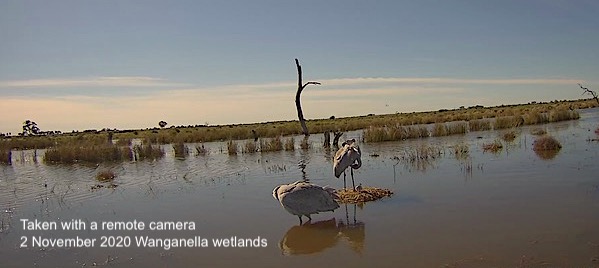
1 November 2020: One of the two brolga eggs in a nest on the Wanganella wetlands produced a gorgeous chick early this morning or late yesterday. Fingers crossed for the other egg.
24 October 2020: The first Plains-wanderer Weekend of the year produced, after a long search, a pair of plains-wanderers. Species recorded.
19 October 2020: More good news on the back of Robert's daytime observation two days ago. A coterie of Deniliquin birders and I went out to do some reconnaissance for the upcoming Plains-wanderer Weekend. Without a great deal of trouble we located a female plains-wanderer. Other good sightings were an inland dotterel and a little buttonquail with chicks and three ground cuckoo-shrikes.
17 October 2020: Good news! Robert, while moving sheep, saw a plains-wanderer.
13 October 2020: Sadly, I failed to replicate Saturday night's success. No plains-wanderers found.
12 October 2020 Wanganella: I spent the morning surveying the wetlands on the west side of the highway in behind the Wanganella sandhill. Some of this area is TSR and some is private land. There is more shallow water here so better for waders. There are also beds of phragmites and some cumbungi in this area and this is where the straw-necked ibis have often set up rookeries in the past. In 2010 when we had the big flood about 13,000 pairs of straw-necks nested here. However, this year I don’t believe they will nest as the water is not deep enough. They usually need at least 60 cm of water under the vegetation before they will form a rookery and the deepest water I could find in the phragmites was only about 45 cm. There is a bank and regulator downstream but it doesn’t back up enough water to get the depth required. There have been up to a 1,000 straw-necks hanging about the phragmites so they are obviously keen to breed.
A few pairs of royal spoonbills have turned up, I think a first since the environmental flows began twelve months ago. They are looking resplendent in full breeding plumage with their full crown. They could nest in the introduced willows even though the water is not that deep underneath. They will be more secure in the willows and they nested there in 2010. Another first today for the environmental water events was intermediate egret with a single bird recorded. This is another species that could soon be in trouble in southern Australia. There has been hardly any breeding in any of the huge rookeries that once existed on the Murray, Murrumbidgee and Lachlan Rivers in the last twenty years due to drought and lack of flooding in the river systems. Not to mention competition for irrigation water.
Black-winged stilts were in good numbers with about three colonies totalling about 200 — 300 birds. They were being raucous and are obviously close to breeding. They went mad when a swamp harrier went over.
Red-kneed dotterel numbers are also starting to build up with about fifty seen today and they too are probably close to breeding. Sharp-tailed sandpiper numbers are also building up with about twenty seen today (only one a week ago). Also today, I flushed up four Latham’s snipe, a species rarely seen in the district nowadays. A golden-headed cisticola nest under construction was observed in the phragmites and the reedwarblers were in full song and are probably building nests.
Swamphens have turned up in good numbers in the last couple of weeks with close to twenty birds today. There were only a few a week ago. The cumbungi started to grow back twelve months ago and I recorded the first swamphen in the autumn. I’m guessing they are being knocked off by the swamp harriers as I’ve seen a couple of fresh kills lately.
It looks great for Australasian bittern and I searched hard for one with no success. It also looks good for painted snipe but no luck yet. Assuming there are any left, some should turn up here this year. There have been no sightings in the district that I know of since 2012.
11 October 2020.Wandanella waterbird surveys on the environmental flow down 8 Mile Creek.
Today I surveyed the area upstream of the highway on private property. The great news was I managed to find the brolgas' nest. I thought they were nesting there after their behaviour the previous week. Today the male flew past me low, watching my every move, I didn’t even see where he came from. Being on his own, I knew the female would be on the nest. Then the female suddenly appeared so the nest was close. Still it took quite a bit of finding, being well hidden — and the pair was cagey. I cleared out of there as quickly as I could so as not to keep the female off the nest too long. I think they have chosen well this year. The nest is quite close to the creek in fairly deep water and the water is backed up from the highway so it should able to be kept flooded if all goes to plan. Water can be pumped out of Billabong Creek as a backup if the flow can’t be maintained down Forest Creek. Last time the brolgas nested (in 2016) they were left high and dry when the creek dropped. They have perhaps only raised young once or twice in the last forty years that I know of, so it is really crunch time for them. There are still a few pairs of brolga left in the district but none of them ever successfully raised young to my knowledge. If they weren’t so long-lived they would have gone from the district years ago. Foxes are being baited around the nest area; however, with all the help in the world, there will be obstacles in their path with swamp harriers and sea eagles about, not to mention wedgetails.
Other highlights of the morning were between two to three hundred whiskered terns that look like they are wanting to breed. They nested here in 2010 when we had a big flood and probably have had little opportunity to nest anywhere in Australia since, so they will definitely be keen to get some young away. Likewise, the hoary-headed grebes nested here in 2010. About fifty birds were present for that flooding event, so hopefully they too will breed this season. A male blue-billed duck was noted (four male blue bills have been recorded to date this season) and many pairs of pink-ears, hardhead and shoveler, all of which should breed — as long as the water levels hold up. The next few weeks will be crucial.
A pair of shelduck was present and a little further downstream two female and one male musk duck were seen. The two females were inquisitive and came up close to me. When they realised I could possibly represent danger they suddenly turned and splashed away along the surface.
A spotted crake was also flushed up in fairly deep water, which suggests that it too is thinking about nesting. There are goosefoot bushes about that they like to nest in. The little grassbirds were calling from the goosefoot bushes as well and chasing each other around, which indicates breeding is imminent. The first glossy ibis were seen today when a flock of twenty went over. Later, more were seen back near the highway, making about fifty for the day. A huge nest of a wedge-tailed eaglewas sighted in a giant river cooba tree along 8 Mile Creek (not in use). It was a productive morning,
10 October 2020: Sydneysiders Jayden and three of his mates and I went out at 4 pm. We called in at the two revegetation areas on the Cobb Highway but there was nothing too exciting. We did manage to catch up with one of the white-backed swallows at Wanganella sandhill. Over the road at the 8 Mile Creek, which has an environmental flow coming down at present, we scored pink-ears, hardheads and Australian shoveler, as well as plumed whistling-duck, which was new for some. Out on the plains there were quite a few emu about and the odd brown songlark. We made haste to the plains-wanderer country where I had had a male plains-wanderer recently. I wanted to listen for the calls of the female at dusk. None was heard. This was not a good sign. We searched the paddock for over three hours after dark but no plains-wanderer was to be seen. We did however see a few little buttonquail and the guys got some photos. In desperation I thought we should try one more paddock that had been reliable for plains-wanderer over the years. (We checked this paddock out a month earlier with no success). When we started spotlighting, I didn’t like the look of the habitat at all and so didn’t like our chances. But we persevered. After about twenty minutes a pipit flew up, and another bird moved nearby. Eureka! A female plains-wanderer! We couldn’t believe our luck. Great photographs were captured and four happy campers and I headed for home. A few fat-tailed dunnarts were seen and plenty of banded lapwing. It had been a tough gig with about four hours committed to finding a female plains-wanderer.
9 October 2020: The Wanganella revegetation area is looking fantastic after another 12 mm of rain yesterday. A sacred kingfisher was another new bird recorded there today. That's two species of kingfisher in just a few days. It looks like the red-backed kingfisher kept going as it's not been seen again.
6 October 2020: Hoping for some useful rain over the next couple of days, I did some more planting at the revegetation area at Wanganella. Normally I wouldn’t plant this late in the year but it appears it may keep raining into summer so it’s worth taking the chance. And with the rainfall as unreliable as it is nowadays, who knows when we will get another good year.
I heard a call that sounded like a red-backed kingfisher and then spotted it perched in a dead tree not far from where I had parked the vehicle. It was calling almost continuously but not its normal loud call but a softer version of it. This is the first sighting of this species in the revegetaion plot since we started the planting almost twenty years ago. It would be great if it stayed and nested in the sand cliffs with the white-backed swallows but chances are it’s on the move.
6 October 2020: A few superb parrots were flying about the Gulpa revegetation plot, but, to my chagrin, none landed. I walked around the plot checking whether the direct-seeded quandongs had germinated. I will need to put guards on them before they are destroyed by rabbits. There’s been good germination this year in all three revegetation areas and if it keeps raining through the summer, most should survive. There should be quandongs aplenty in years to come. It takes five years before they bear fruit so it will be a while. When I was searching for quandong seedlings I flushed up a little buttonquail, a possible first for this area. There’s quite a bit of speargrass growing in there this year, which is a favourite of little buttonquails.
There were also yellow-rumped thornbills feeding recently fledged young. At one time I wouldn’t have got too excited about seeing this species breeding, the most common of the thornbills, However, it's a rare sighting to see any species of thornbill successfully breed nowadays.
3 October 2020 Wanganella wetlands. There was a peregrine falcon hunting over the creek early this morning. They are partial to grey teal, which are abundant along the creek at present. A white-bellied sea-eagle and a pair of swamp harriers were also hunting over the swamp so there are plenty of predators around.
The Australasian bittern couldn’t be found today, however there is quite a bit of water now so it could still be lurking there.
I saw my first rainbow bee-eaters for the season today with three flying over at Wanganella sandhill. They usually arrive back late September and have apparently been in Deniliquin for a few days. They were on the move today as Angus heard them fly over at Monimail. I always hope the bee-eaters will stop and nest at the sandhill but so far they just fly over. There was the kind of hot northerly wind today that always brings the summer migrants south at this time of year and to that end I recorded a white-winged triller at Wanganella sandhill.
1 October 2020: I walked along the 8 Mile Creek into Wanganella Station's wetlands and soon found the missing brolgas. They were being cagey so I suspect they are going to nest at this locality. I hadn't seen them in their usual haunts on the TSR for almost two weeks and was puzzled as to their whereabouts. The water is a bit deeper where they are now so the area should be a better option for nesting. About thirty whiskered terns were feeding over the wetland in the same general area. I recorded them nesting here in 2010, along with hoary-headed grebes. A couple of musk duck were seen up in here as well, making four in total recorded in the last few days. Oddly, they've all been females.
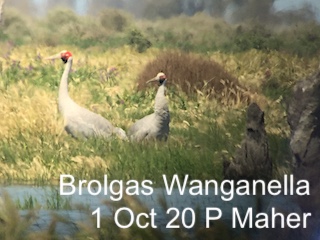
A good variety of ducks were seen including hardhead, shoveler and pink-eared along with the common varieties. Good numbers of hardhead and shoveler were present. A pair of shelduck was seen as well. The ducks are keen to breed given that their opportunities to breed in recent decades have been few and far between.
Back at the TSR in the deep creek lined with cumbungi, a male blue-billed duck was recorded.
29 September 2020: Two female musk ducks were observed in the deeper creek at the Wanganella wetlands. These are the first recorded since the environmental flows started twelve months ago. Hopefully if some males turn up, we’ll see some breeding this summer. There is enough cumbungi in the creek now for them to nest.
An Australasian bittern was seen, probably the same one I recorded a week or so ago although it was about 500 metres from where the previous one was flushed.
A lot more ducks have turned up in the last few days. There are good numbers of hardhead out there now that will be keen to breed. More shovelers have come in as well as a single male chestnut teal and a pair of plumed whistling-duck. Lots of grey teal and Pacific black duck were about as well.
On the revegetation sandhill, I flushed up a pair of little buttonquail which is a first since we started the project nearly twenty years ago. There’s lots of blue crowsfoot and speargrass growing on the sandhill this year and little buttonquail seem to be fond of both.
28 September 2020 Garden birds. I had a spiny-cheeked honeyeater singing and feeding in the garden today. They have been around a bit of late but the red wattlebirds give them a hard time. No wattlebirds about much today so the spiny-cheeked had the run of the garden. I have an Eremophila longifolia in good flower at present which is popular with the spinies. The longifolias in the revegetation areas are not flowering yet due to frost and cold weather damage but mine is protected in town so is flowering early. The spiny-cheeks have the most delightful calls so it's a joy to have them in the garden.
The pair of mistletoebirds are in the garden most days feeding on the fleshy mistletoe. I am trying to get a year round supply of berries for them in the garden but not there yet. There was a lovely mistletoe around the corner on a yellow box tree (in the grounds of the high school) but some one has been going mad with a chainsaw and cut off the branch that had both box and fleshy mistletoes growing on it, taking away the food resource of mistletoebirds and the many honeyeaters that fed on the nectar of the mistletoe flowers. What a shame ...
I noticed today that the wire-leafed mistletoe in the garden is starting to bud up already, which seems early. The good rainfall we are getting this year seems to be bringing flowering on earlier than normal.
Last week the pair of yellow thornbills in the garden were busy collecting insects from the foliage of various plants. Today they seemed to be on a mission and I wondered if they were going to a nest. I thought they must be nesting out of the garden but when I followed them they were only flying to the Agonis flexuosa that Trisha had planted near the back door forty plus years ago. The nest was up fairly high as is their way but not as high as most yellow thornbill nests I have seen in the bush. (The Agonis is not overly tall). Because yellow thornbill nests are generally difficult to find (being up so high) I have only ever seen a handful. They seem to be finding enough food within the garden. They are so busy collecting food for their young that they were completely oblivious to me when I was only a metre or two away. I also have a pair of crested pigeon nesting with young in the nest in a clump of fleshy mistletoe on the front nature strip.
27 September 2020: Del from near Coffs Harbour, having arrived in Deniliquin the day before, thought she'd like to see a plains-wanderer. Warned that her chances were just about nought given the last three outings failed dismally, Del wanted to give it a go. The only evidence we had that they had returned, after departing the drought-stricken district back in February, was a couple of brief calls of a female heard by Robert at dusk a couple of weeks ago. Returning to the spot at dusk where the call had been heard, Del and I listened and listened and .... Nothing. Robert was listening in another part of the paddock with the same result. After half an hour of being hammered by mossies we started to spotlight. I tried to put on a brave face for Del’s sake.
With the breaking of the drought this year there are now thousands of hectares of suitable habitat for plains-wanderers. Add to that, Robert, busy with sheep at this time of year, couldn’t help me for long. With no birds calling tonight to give some clue as to where they might be, it was a Herculean task.
We saw a few banded lapwing including one with small young and a few pipits and brown songlark. (The banded lapwings are having a great year with many adults with nests and young seen in the last month). Then a little buttonquail made an appearance — a life bird for Del. We had a great view of it on the ground. After about an hour Del was starting to realise the enormity of the task and was saying it really was needle in haystack stuff when praise the Lord, a male plains-wanderer took off from closeby and landed about thirty metres away. Del had to ring her husband Greg (who’s not a birder) to tell him about what we had just achieved. Greg sounded impressed.
We had a bit of a look for the female, which was probably not far away but apparently we’d used up all our luck on finding the male! We headed for home spotlighting a barn owl hunting over the plains and another in John’s clump at a nest hole. There could be a mouse plague brewing as there’s a lot of mouse activity at the Wanganella revegetation sandhill lately and the barn owls and black-shouldered kites are turning up.
We’d already had a good deal of luck in the late afternoon when we stopped in at the Monimail revegetation area and had singing, spiny-cheeked and striped honeyeaters as well as a couple of male purple-backed fairywrens. The male wrens were in full breeding plumage and looked magnificent in the late afternoon sun. Several pairs of bluebonnets were seen here as well. The noisy miners started making alarm calls so we were looking about for a raptor and sure enough a black falcon soon appeared.
We called in briefly at the Wanganella wetlands and had a platoon of ducks: Pacific black, grey teal, Australian shoveler, hardhead and a pair of plumed whistling-duck in about fifteen minutes. We took a quick look in at the sandhill revegetation plot and had three white-backed swallows at the nesting cliffs — a new bird for Del. I had only been seeing a pair there in recent weeks so I don’t know where the third bird came from.
Del was a happy camper who brought me some luck. I was seriously worried about plains-wanderers not showing up. The lack of calling is puzzling as they are usually calling their heads off at this time of year. The most plausible explanation is that what birds have turned up have already finished their courting phase and have gone quiet. All will be revealed in coming weeks ...
26 September 2020 The rain gauge at the revegetation area at Gulpa measured 11 mm, which was nice. There was a severe cold snap with the rain that has made it tough for the birds over the last two days. The male rufous songlark I encountered several days ago is still present and he did a little singing when the sun made a brief appearance. This gives me hope that he might be going to settle in to breed if he can attract a mate.
Another sighting of interest down there today was a male mistletoebird feeding on nectar from the flowers of grey mistletoe, which is in full bloom. I don’t think I have observed one feeding on nectar or if I have, it’s a long ago. A week or so ago I saw him feeding on ruby saltbush berries as mistletoe berries are currently quite scarce. He probably needed a hit of sugar with the very low temperatures and was making the best of the situation. I could hear superb parrots calling but didn’t locate them. I have only rarely had superbs feed in the Gulpa revegetation area even though they often fly over. At the moment I have a couple of yellow box in full bloom so that should entice the superbs in given their fondness for the blossoms of yellow box.
21 September 2020: Gulpa revegetation area Cobb Highway.
Today there was only 4.5 mm in the rain gauge at Gulpa revegetation area but add that to the 7 mm on 13 September and it contributes to things looking fresher at Gulpa.
All the grey box has fresh new growth and some of the yellow box trees are in full bloom and look fantastic. This area has been drought stricken for years so this is a welcome change. Even this year the rainfall at Gulpa is still a 100 mm behind Deniliquin and it’s about 20 km south. Historically it has received more rain than Deniliquin.
The birdlife is gradually improving down here with each shower of rain. Today there was a western gerygone calling in the grey box. It's many years since I have had this species in the plot although they often breed in the thick saplings down the back of the old forestry paddock that is only a couple of hundred metres away. The resident yellow-rumped thornbills and singing honeyeaters were about but today they were joined by noisy and little friarbirds and white-plumed honeyeaters. Weebills were calling today; I’ve not had them in here for quite a while. Likewise, a rufous whistler called down the back. A male mistletoebird is still present. While most of the grey mistletoe is flowering, the big old clumps of grey mistletoe are fruiting and flowering at the same time. Most of the other mistletoe species have finished fruiting now so the berries have been in short supply here lately. About a week ago I saw the male mistletoebird chewing on the fruits of ruby saltbush which I have seen them do previously when mistletoe berries are in short supply. They usually just squeeze the juice out of the ruby saltbush berries rather than swallow the whole berry as they do with the mistletoe berries. Grey mistletoe is one of the best bird attractors as some honeyeaters love the fruit and flowers too. The superb parrots are fond of the flowers as well.
The fresh growth on the eucalypts has attracted a few striated pardalotes. They might be tempted to nest in the nest hollows I’ve put up for them this spring. A male rufous songlark was in the plot today, which is a first for the year. Strangely enough I flushed him up off the ground and he was totally silent. I guess he had only just arrived back and hadn’t settled in to breed yet. They sing all day when breeding. There are very few summer migrants in the district to date.
20 September 2020: 20 September 2020: Environmental water has been flowing into wetlands at Wanganella for over a week now so I checked it out a bit more thoroughly.
From up on top of the sandhill I could see that the brolgas had returned. They disappeared about three weeks ago when the water was very low and I was a bit concerned they might not come back. So, all good on the brolga front. My next surprise was a little egret on the shallow floodwater. They are a rarity around here at the best of times and particularly in the last twenty years of mostly dry years. A few pairs used to nest in the big colonies of intermediate and great egret in the river redgum forest around Mathoura in flood years but egret colonies are largely a thing of the past now. It's many years since I last saw a little egret at Wanganella.
The next surprise was an Australasian bittern, which flushed up in shallow floodwater with scattered dead phragmites and a bit of cumbungi. I was hoping they might turn up this year but was completely floored by one turning up so soon. There were three species of frog calling and there's frog sporn in the water already, so there will certainly be masses of food around for bitterns and other waterbirds in the coming months. (The department has sound recorders out and picked up five species of frogs the night before). Australasian bitterns are a difficult bird to manage as they nest in relatively shallow floodwater and need a stable water level for at least six weeks, not easy to achieve in a creek system where the water is flowing through with not much cumbungi to hold it up. We’ll see what happens. It is much the same with the brolgas, but they need a stable level for even longer. Here’s hoping for a successful outcome, certainly we’re off to a good start. A few hundred straw-necked ibis were also hanging around the patches of dead phragmites where 13,000 pairs nested successfully in 2010. A lot of the cumbungi has died out since then (cumbungi can only survive about five years without flooding) and they don’t have the vegetation to nest on now. The water also has to get a lot higher before they will nest. They must be desperate to breed after so many drought years.
A few nankeen night-herons are still roosting in the native willows in the revegetation area beside the wetland. Other sightings of note were more flocks of cockatiel flying over, mostly going east today. An Australian hobby was also over the swamp hunting dragonflies, a favourite food of theirs. The pair of swamp harriers are still hanging around the cumbungi on the east side of the highway and look like they are keen to nest. The Australasian shoveler and hoary-headed grebes also look like they are keen to breed and are coming into good plumage. A couple of male shoveler seemed to be in competition for the favours of a female. About 10—15 white-necked herons were also enjoying the shallow floodwater as were about thirty black-winged stilts, both species having arrived in the last day or two.
20 September 2020: A male white-winged triller, not quite yet in full breeding plumage, was feeding in the Wanganella sandhill revegetation area. Migrants have been scarce so far this spring. It was chased by a singing honeyeater.
20 September 2020: Robert reports more cockatiels, today flying east. One group of five sounded like it had young birds in it so they have bred somewhere in the inland.
19 September 2020: Robert reports three Major Mitchell’s cockatoos around his house on the plains north of Wanganella. They often turn up at his house when the seeds of the introduced pine are ripe. He also recorded twelve budgerigars.
18 September 2020: My mate Brian Holden and I spent a long day at Zara sandhill collecting fruit off the quondong trees. Zara has the most diverse patch of native vegetation left in the district and has many quondong trees. This is a scarce species in the district despite my best efforts.
Sadly there was only a small amount of fruit on the trees this year due to the severe drought conditions prevailing early in the year when the trees were flowering. The rain in early March was probably a couple of weeks too late for the trees to set fruit. It has to be terribly dry for the quondongs to not produce fruit as they are generally a very drought tolerant tree. However, as 2017, 18 and 19 were probably the driest three years in recorded European history in Australia, it is little wonder they failed to fruit. The sandhill has suffered badly during the many droughts of recent decades and quite a few mature pines and various other species have been lost on the sandhill. The latest drought has badly affected many of the rosewood trees Alectron olifolium and although they were mostly still alive, they didn’t look well. And this is one of the hardiest trees in the inland!
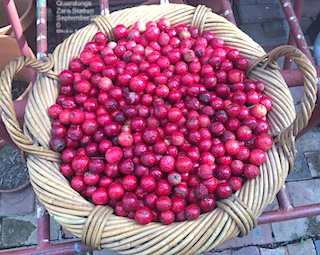
Small flocks of cockatiels were flying over in the morning around Wanganella and Zara. They were nearly all heading west in contrast to a week ago when most were heading in the opposite direction. We presumed they were probably heading towards the forecast upcoming heavy rain to the west of us.
We had a couple of surprises when we were searching Zara sandhill for quondongs. An immature golden whistler was seen and an adult olive-backed oriole. Both are winter visitors to the inland and are making their way back to the mountains and foothills at this time of year. The jointed cherry trees Exocarpus aphylus were starting to fruit well and this would have provided an ideal food source for the oriole.
Further north of Wanganella on the plains, birds were also on the move as Robert recorded a single budgerigar — a bird we seldom see in the district nowadays.
16 September 2020: My friend Eris reported a blue-winged parrot on his property about 20 km west of Mathoura. The blue-wings should be starting to move back towards the coast now. Blue-winged parrots have become very scarce in the district in recent years. We used to see them regularly out on the plains in the autumn and spring but only have the occasional sighting now.
15 September 2020: While working out at the revegetation area at Wanganella I heard a striated pardalote calling, which was a first for the sandhill. I’ve planted quite a few eucalypts in recent years, mainly mallees that have done really well, so no doubt this is the reason for the pardalote's visit.
I also heard and saw a Horsfield’s bronze-cuckoo, the first at the sandhill for some years. Fairy-wrens (particularly white-winged) have been reasonably scarce around the sandhill in recent years. They’re the main host for the cuckoos’ young so there’s been no real incentive for the bronze cuckoos to visit the sandhill. The pair of pallid cuckoos are still hanging around the nearby 8 Mile Creek.
A spotted jezabel butterfly was observed at the sandhill today. They've been very scarce so far this season; this individual being only the second one I’ve seen. They are usually the first butterfly to hatch out in the spring, so it’s unusual there have been so few. (The severity of the recent droughts has taken its toll on just about every living creature). The two-spot line-blue butterflies are also around, feeding on pimelea daisy-bush Olearia pimeleoides.
A satin azure was also seen today; there’s been a few around in the last week.
Waterbirds have wasted no time in finding the environmental flow coming down Forest/ 8 Mile Creek. A pair of black swans was on the creek today and in the last few days I have had a pair of shoveler and hardhead as well as white- necked heron. Both coot and hoary-headed grebe were present on the small amount of water that was left in the creek prior to the environmental water arriving but are starting to look much more interested in breeding now. Two species of frogs have been calling like mad since the water started to rise: spotted marsh frog Limnodynastes tasmaniensis and Eastern sign-bearing froglet Crinia parinsignifera. The swamp harriers are still doing their mating displays.
Still no sign of the brolgas; I hope desperately that they will come back and breed.
13 September 2020: Our first customers for the spring, Hans and Sues, were disappointed not to see a plains-wandererer.
11 September 2020: Went out again with the Deniliquin crew to look for a plains-wanderer in preparation for Hans and Sues' vist on Sunday. John assisted with the search but we had no joy.
9 September 2020: Late last year Robert and his wife Rhonda hand-raised a baby nankeen kestrel on their property north of Wanganella. Sadly, the kestrel chick had lost his parents. Kevie, as he was named, has proved his worth of late in that he is bringing in interesting specimens to their veranda.
A couple of days ago Kevie brought in a narrow-nosed planigale and yesterday he brought ilarge-striped skink Ctenotus robustus. (Note: the earlier cited brown-blased wedgesnout skink Ctenotus allotropis was incorrec. The large-striped skink is widespread though the districtt).
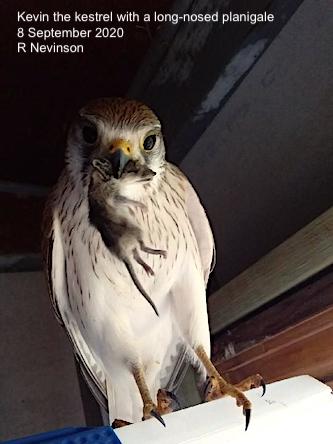 .
.
(Scroll down to the end of this very long page to see a photo of a narrow-nosed planigale that Robert found under a sheet of corrugated iron in June 2014).
9 September 2020: Cockatiels have returned to the district in the last week. On the 5th and 6th, several small flocks were passing over the revegetation sites at Wanganella and Monimail. They were flying east but one contrary flock was going in the opposite direction. Robert also had been reporting flocks on the plains north of Wanganella, and my friend Eris had been reporting flocks west of Mathoura. Seemingly, they’re right through the district.
A pair of pallid cuckoos is still present over the road from the revegetation area at Wanganella. A willy wagtail was in hot pursuit of one a few days ago which made me wonder if they might be attempting to breed in the district this season. It is a rare event for pallid cuckoo to nest around here; I’ve only ever seen a few dependent young in my lifetime.
NSW DPIE is putting another environmental flow down the Forest Creek this season. This time they are running it right through the whole system rather than just pumping it into a section of the creek at Wanganella. This will be the first time the creek has flowed since 2016. The creek is starting to rise at Wanganella now so it will be exciting to see what turns up over the spring/summer.
The swamp had almost dried out in the last few weeks (last environmental flow was back in the autumn) and I think the few pairs of black swans that bred might have lost their young as I've seen no sign of adults or young lately. The brolgas must have also become anxious about the swamp drying out as they took off about a week ago. Hopefully they will come back when the swamp starts to fill in the next week or two.
There's a pair of dusky moorhen on the cumbungi-lined section of the creek that still retains some water, which is a first since they started putting environmental water into the creek twelve months ago. There was no cumbungi left in the creek prior to that flow. The reedwarblers have also returned to the creek in the last week or so, as have the fairy martins. There was a pair of shoveler on the just-rising creek yesterday; hopefully they will nest when the creek starts flooding out.
8 September 2020: Reconnaissance to check out the plains-wanderer situation sadly turned up no plains-wanderers. We did see a handful of flightly little buttonquail.
4 September 2020: Trisha observed a lone magpie goose near the Campbell's/Moonie Swamp roads' corner in the Mayrung area.
31 August 2020: An adult square-tailed kite observed in Gulpa. This was probably a different bird than one of the pair in Deniliquin (23 km south) yesterday. Given that vast areas of mountain forests were burnt last summer, many pairs of square-tailed kites are probably looking for new homes.
30 August 2020: Tom had a pair of square-tailed kites in the Island Sanctuary; he had seen a single adult the previous Sunday, which is very early for them to return.
My mate Brian Holden and I saw two to three fuscous honeyeaters in a flowering gum in his backyard on the Finley Road in Deniliquin. While we were watching the honeyeaters, a black falcon flew over, followed a short time later by a spotted harrier.
29 August 2020: Eremophila maculata in full bloom at the Monimail revegetation plot.
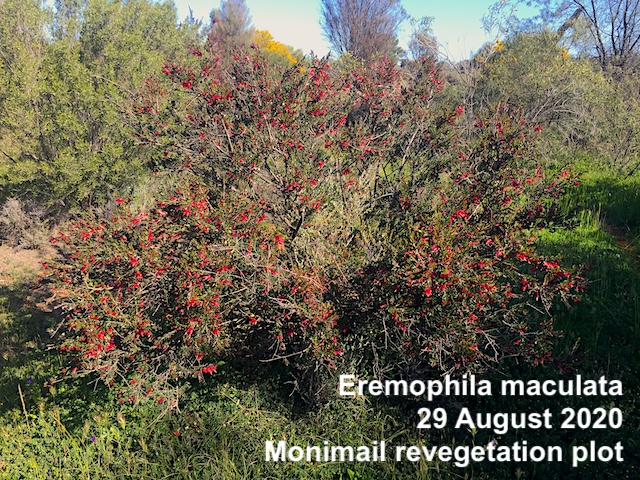
22 July 2020: Robert saw a stubble quail — the first since early October last year. Portends well for the spring.
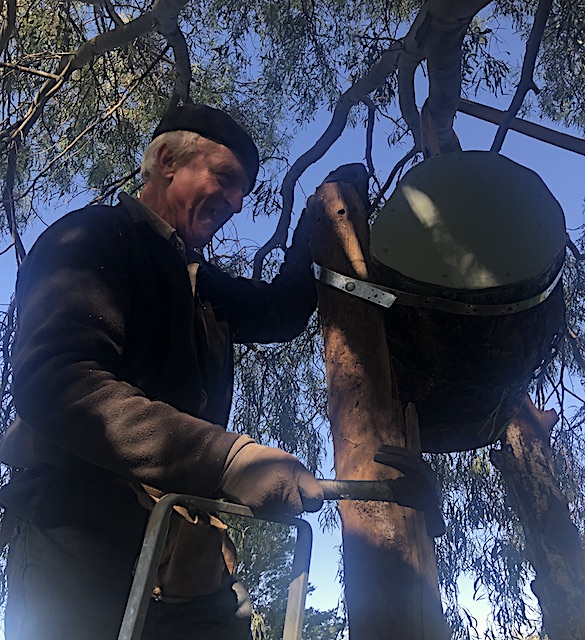
20 July 2020: Me erecting a nesting box made from a fallen black box tree and marine ply at Wanganella sandhill revegetation area. The recycled native cypress pine poles came from old cattle yards at Boorooban. Four nesting boxes up in the last couple of days, about twenty more to go.
18 July 2020: A pallid cuckoo recorded near Wanganella sandhill, first return for the winter/spring.
17 July 2020: Eris O Brien reported three ground cuckoo-shrikes at his property west of Mathoura late in the afternoon. Although never common, it is a seldom seen bird in the district nowadays.
16 July 2020: My mate Brian Holden reports that at least one yellow-faced honeyeater has been feeding in flowering eucalypts in his neighbour’s yard for the last couple of weeks.
Yesterday Tom Weller and Geoff Plumb reported a pair of white-winged trillers from an area of black box in the Deniliquin forest. This is a very early date for trillers to be back in the district — September being the more normal month for their arrival. It suggests that birds are very keen to breed and heralds an early spring. After the disastrous seasons of recent decades, birds will be looking to breed at their earliest opportunity. Tom and Geoff also reported large flocks of striated pardalotes (100 or more) with at least one of the yellow-tipped race from Tasmania. It used to be the norm for enormous flocks of striated pardalotes to come out of the mountains to winter in the river redgum forests along the Murray River system but have rarely seen in the last couple of decades. The good rainfall around Deniliquin and the vast areas of mountain forests burnt last summer have probably been the catalyst for this influx.
13 July 2020: Happy to report a pair of black swans with four cygnets recorded at the Wanganella swamp.
8 July 2020: There's been a pair of mistletoebirds in my garden for the last few days. The male's been about for a month and I'm happy to report he now has a mate. Honeyeater species visiting the garden comprise white-plumed and blue-faced and red wattlebirds. There's been a score or more of silvereyes including some from Tasmania.
2 July 2020: Robert recorded a pair of inland dotterels on his property; the first sighting since January.
2 July 2020: Several groups of superb parrots have been seen north of the town — around the Monimail revegetation plot and back around the Deniliquin rubbish tip.
1 July 2020: At least one pair of black swans has nested out at the Wanganella swamp, which received an environmental flow a few months back — this is the first nesting of swans here for many years. The pair of brolgas is still about and may nest when more water is sent down the creek in the spring.
12 June 2020: Tom Wheller had both fuscous and yellow-faced honeyeaters in the Murray Valley Regional Park in Deniliquin today. This is the first record of these species for many years and may have something to do with the bushfires wreaking havoc on the mountain forests during the summer. They used to be fairly regular winter visitors to the district in the 1980s and 90s.
10 June 2020: A pair of rufous whistler observed at the Wanganella sandhill. Robert had a Horsefield bronze-cuckoo at his place .
10 June 2020: Not having headed north in early May for our four-month stint running tours over the Top End, FNQ and the Pilbara, due to travel restrictions, my time has been put to good use working in 'my' three revegetation plots. From March to the end of May this year 181 trees had been planted in the Gulpa plot, 262 at Monimail and 1,671 at the Wanganella sandhill plots, making a total of 2,114. While I am now low on plants ready to be planted out, there's plenty to keep me occupied such as spraying weeds and pest extermination. I've been direct seeding quondong seeds (which are starting to germinate), Wilcannia lily seeds that I collected at David's at Booroorban, as well as the red-form of harlequin mistletoe and buloke and creeping mistletoes. Sometimes I stop to observe the occasional bird ...
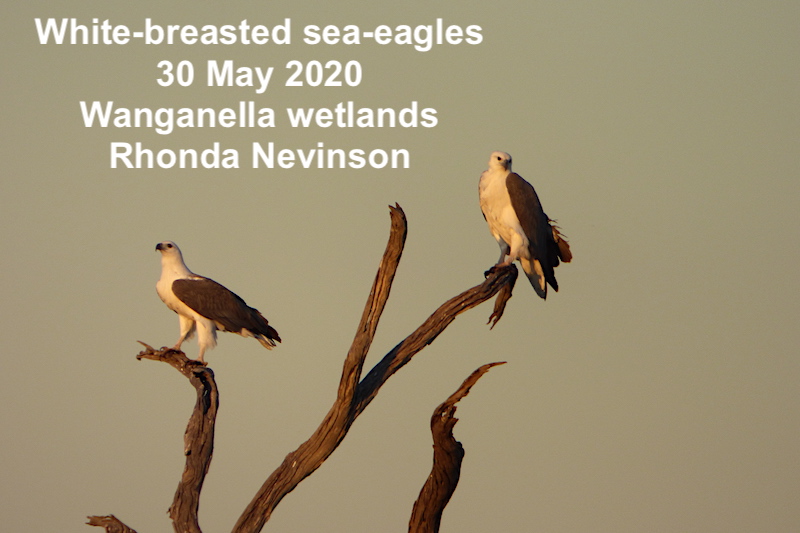
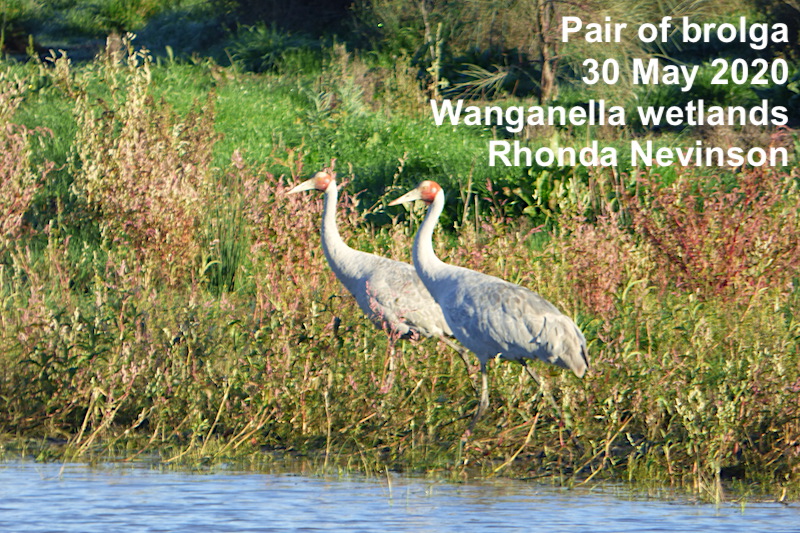
29 May 2020: After a spell of twelve weeks, Robert and I ventured out on a plains-wanderer reconnaissance mission. Despite good rain in that period, we didn't find a plains-wanderer. Lots of fat-tailed dunnarts and banded lapwings with young but not much else.
26 May 2020: The pair of brolga was back at the Wanganella wetland today.
26 May 2020: David Nevinson had an extraordinary find this morning east of Booroorban. A male superb fruit-dove! Certainly a new species for the district —if not all of New South Wales west of the Great Dividing Range. Initially it may have been feeding on ruby saltbush berries low to the ground but flew up into a rosewood tree where it fed on the berries of a harlequin mistletoe. I wasn't expecting to see a rainforest bird when I set off for Wanganella this morning!
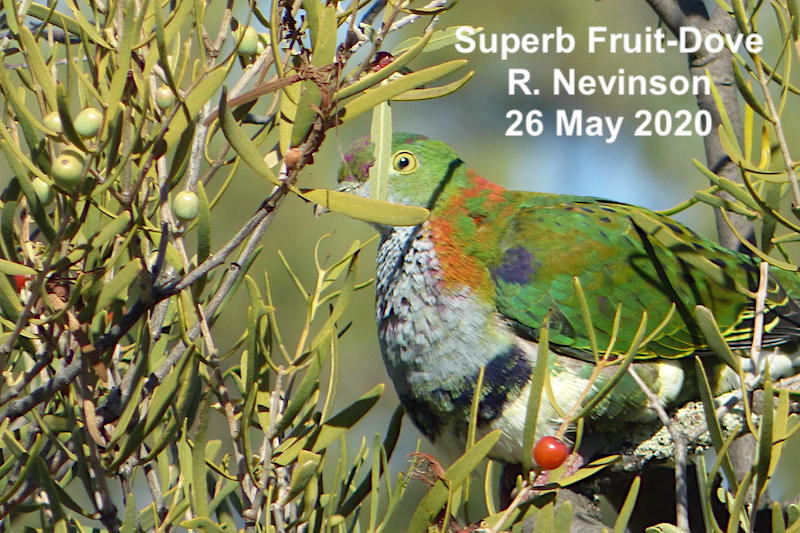
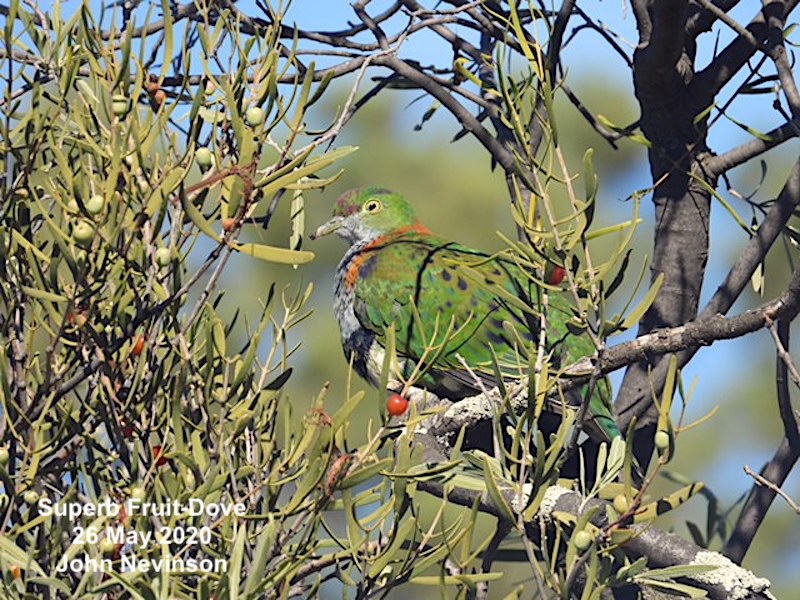
9 May 2020: Wanganella wetlands update. The 8 Mile Creek wetland has been topped up by the Department of Planning, Industry and Environment. It has been pumping for the last three weeks or so and the wetlands are quite full, particularly upstream of the highway. A breeding pair of Australian shelduck (today) and a single male chestnut teal (yesterday) are new species added to the wetland's 2020 species list.
8 May 2020: A new bird for Monimail revegetation site: red wattlebird. There was also a big mob, twenty to thirty birds, going east to west. I have never seen a red wattlebird north of town before. The noisy miners were chasing them — I don’t think they too had ever seen one before!
7 May 2020: After an absence of several months, a couple of pairs of white-backed swallows were back at the Wanganella sandhill. Further to that reappearance, a large eastern brown snake was observed going into a hole where the white-backed swallows have their holes.
30 April 2020: More rain has fallen over the last two days, making it one of the wettest Aprils recorded in this district.
John has had 32 mm on the plains-wanderer property, Robert's had 37 mm, and we've had 36 mm in town. The revegetation plots had good rain, evidenced by the drenching I got in a thunderstorm out at the Wanganella sandhill yesterday afternoon. Deniliquin (i.e., my yard) has received more rain to date this year than all of 2019 — 250 mm vs 235 mm.
21 April 2020: A peaceful dove recorded at the Monimail revegetation plot — a first for the Monimail plot.
20 April 2020: A barn owl recorded at the Wanganella sandhill revegetation plot — a first for the Wanganella plot.
16 April 2020: Two pairs of white-backed swallows were recorded at the Monimail revegetation area; the first for well over twelve months. Robert had forty to fifty folk-tailed swifts at his place today. It is quite late for them to still be about.
8 April 2020: The birds seemed very happy with the recent rain out at the Wanganella revegetation area. The spiny-cheeks and singing honeyeaters were in good voice and the striped honeyeaters were also calling. The striped honeyeaters have been sporadic of late; the last one I saw was a week or so ago and was being seen off by the spiny-cheeks.
Western gerygones were calling in the native willows, and the first grey fantail for the year was observed today. The mistletoe berries are ripening on the slender-leafed mistletoe growing on Allocasuarina luehmannii and I spread some around on other bulokes. The berries of the slender-leafed mistletoe are quite large and very sweet. The mistletoebirds are picking them off as they ripen and I found myself in competition with one proprietorial and indignant mistletoebird! The slender-leafed mistletoe will only grow on casuarinas. There are not a lot of bulokes on the hill and they are spread around but the mistletoebirds have no trouble finding the bulokes with slender-leafed mistletoe with ripening berries.
4 April 2020: Up to two white-fronted honeyeaters sighted in the harlequin mistletoe out at the Wanganella sandhill revegetation area. At least four mistletoebirds were feeding on wire-leaf mistletoe berries. Wanganella had another 8 mm of rain last night. Robert has banded lapwingings nesting at his place, very much out of season.
3 April 2020: I popped down to the Gulpa revegetation area today to check the rain gauge and was pleasantly surprised to find that Gulpa had had more than Deniliquin. It’s been the other way around in recent years, reversing the historic trend for more rain to fall at Gulpa than at Deniliquin. Like everywhere in the Riverina, it’s been badly drought affected in recent years. There was only 15 mm in the gauge but it is making a real difference following the 80 odd millimetres in early March. It’s been quiet down there for years but there were a few birds calling today, Grey shrike-thrush was the first bird I heard, happily singing away. Oddly enough, I couldn’t recall ever having recorded one at the plot before despite the fact there are quite a few on the Gulpa Creek only about a kilometre away. A couple of striated pardalotes were also calling, a species which hasn't been in there for a year or two. Mistletoebirds were also zipping about but have been there for a couple of months. Two common bronzewings were feeding under the wattles. Singing honeyeaters were the only other species seen but I was on site for barely three-quarters of an hour and a longer excursion would have produced more. Happily there was some life to be seen today and hopefully it will get better if it rains tonight as forecast.
3 April 2020: Further to the good rain we had in the first week of March (see 5 & 6 March), the district has had a few mils here and there. We've had another 17 mm in town, Gulpa revegetation plot had 15 mm, Wanganella sandhill another 11 mm, the Monimail revegetation plot 16 mm, and Robert's place 20 mm.
7 March 2020: Alan and Fran from New Zealand brought much needed rain a couple of days ago so we pushed back their outing until today. Sadly, the rain did not bring back the plains-wanderers.
6 March 2020: There was 86 mm of rain in the gauge at Wanganella sandhill early this morning. A couple of immature western gerygones and three rufous whistlers seen, and heaps of striped honeyeaters calling. The Monimail revegetation plot had 92 mm. Delighted to see two immature painted honeyeaters present.
6 March 2020: Added two more species to the flood event list this morning by way of one freckled duck and about eight plumed whistle-ducks.
5 March 2020: Fantastic rain has fallen in the Deniliquin district. By lunch today, I measured about 100 mm at our house in Deniliquin. Gulpa had 82 mm, Robert had 83 mm and John a little over 50 mm.
1 March 2020 Currently, I’m fashioning more nesting hollows from a black box tree that fell down in a storm. I'm using marine ply to block off the ends. The marine ply is expensive but should last a very long time. The ends are secured with Tek screws. These new hollows will be erected on trees on the sandhill at Wanganella. Some of the hollows are big enough for Major Mitchell’s cockatoo and boobook and barn owls to nest in. It will take some ingenuity and grunt to get them up. Species that have used the previously constructed nest hollows at Wanganella include owlet nightjar (a pair nested in one hollow two consecutive years but not this season — the odd one has turned up in other hollows at times; eastern rosella (a minimum of a couple of pairs have nested); Aust. wood duck (a pair nested in a hollow in 2016 when the creek last flooded).
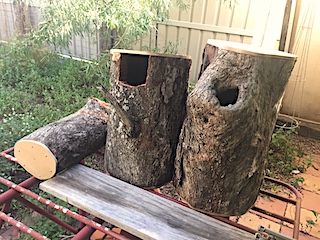
29 February 2020 Mid afternoon I collected my old mate Rich, who originally hails from South Africa but now lives in Canberra, and Rich's mate Chris who is from Britain but now resides in Perth.
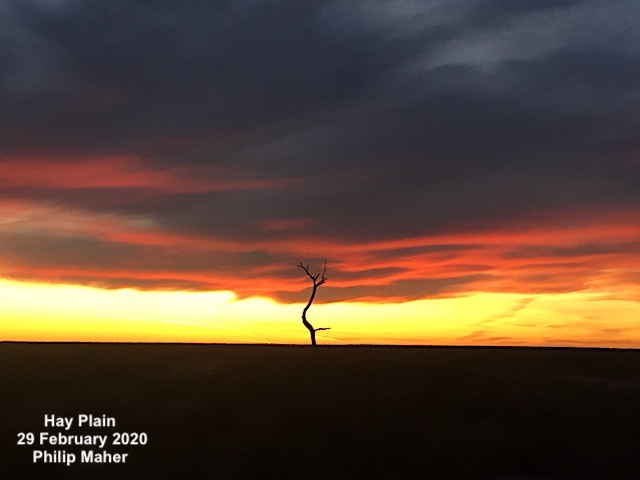
We started off well. I took them into a bend of the Edward River just to show them where the square-tailed kites’ nest was, thinking Rich and Chris could come back early in the morning on their own and the kites might be still hanging around the nest early morning. The lone young fledged a month ago. So, I couldn't have been more surprised to see one of the adults sitting tight on the nest! They should be getting ready to migrate north now so just what they are up to I can’t say. Perhaps this bird was just playing around but it did seem to be sitting tight. I suspect nothing will come of it. Pretty much all the birds have finished nesting now and food for this specialist nest raider must be extremely scarce. What could they now be feeding on? We are still in drought and birds of all species are few and far between.
Next up ,we checked out one of the few rice crops in the district where I had seen Australasian bittern a month ago. Again, we were in for surprise when we managed to locate at least four Australasian bitterns and almost certainly five were sighted. How many are actually nesting in the crop I can’t say, and whether they can fledge any young before the rice is harvested is another matter. They will need a lot of luck on their side to successfully raise any young. Sadly, it’s down to luck for this endangered species. (The breeding of Australasian bitterns seems to have failed yet again at Reedbeds swamp at Mathoura due to fluctuating water levels at the crucial breeding period. Various government departments have attempted to manage this wetland for breeding waterbirds for the last forty years, yet it seems we are no closer to achieving that goal than we were forty years ago).
But I digress ... Our next target was painted honeyeater. I suspected they were about to nest on my last encounter with them over a month ago and I had not looked for them since. The weather had been relatively mild for the last month with only a little patchy rain. Last summer they were caught up in a heatwave which largely wrecked their nesting although a few nested a second time and had some success. It appears this season they have had success as two probable juveniles were seen today. No adults were seen so it looks as though they may have shifted out already. This is the same with rainbow bee-eaters as juveniles were seen here but no adults. In fact, no adult bee-eaters have been seen for about a month. It’s amazing that the adults of these species can leave their young behind yet the juveniles still know where to go when it is time to migrate.
Our next stop was in the boree country near Monimail where superb parrots were the target. We didn’t have to search long before a couple of females were located and then as the afternoon cooled down and they became more active, some lovely adult males were observed. In all, about fifteen birds were present.
Next we called in at the Wanganella wetlands and had a brief view of a female blue-billed duck before it dived under, not to be seen again. Coots were also observed here. Both were new list species for the wetlands this season. See notes on the environmental release of water into the 8 Mile Creek system this summer.
We called into the revegetation sandhill across the road next. About three pied honeyeaters were seen briefly, proving they are still around — I had not seen them for a couple of weeks. A large flock of about twenty yellow-rumped thornbills were seen here as well, I think the largest number recorded here yet.
We had had a brilliant afternoon but sadly it was all coming to an abrupt halt. Despite my best efforts spotlighting, the plains -wanderers refused to show themselves nor did an inland dotterel. There has been very little rain up that end of the property for several months and it was extremely dry although there was still plenty of dry cover there for them. Birds were generally scarce on the plains and it took us over two hours before we saw our first Australian pipit. Dunnarts however were plentiful and we probably finished up seeing about fifteen individuals and Rich got some nice shots. A couple of good- sized curl snakes were seen as well, which was nice as they have been scarce in recent years. It was a warm night so ideal for reptiles and there were plenty of insects and small bats around. A couple of barn owls were seen on the drive out to the highway. Kangaroos were back on the roads in big numbers so it was a slow drive back to town. Hopefully the plains-wanderers and inland dotterels will be back with the next rain.
28 February 2020 Wanganella revegetation sandhill and wetland.
There appears to be a big influx of spiny-cheeked honeyeaters to the sandhill in the last week. This is probably due to the ruby saltbush coming into fruit — a favourite food of the spiny-cheeks. The wetland keeps giving although there is not a lot of water left. Today there was a single red-necked stint and a single common greenshank, both of which have been here this season. There’s just a few sharp-tailed sandpipers left now. A few red- kneed dotterels were back today after disappearing for a week or two. Still a lot of white-fronted chats feeding around the drying out swamp. A single white-breasted sea-eagle was also still hanging around the swamp.
22 February 2020 Wanganella wetland update. The water levels are getting lower in the shallow swamp but still a few birds are present. Three new species were added to the wetland list: one black swan, one wood sandpiper and one marsh sandpiper. This is the first sighting of both sandpiper species in the district for many years. There was also about forty sharp-tailed sandpipers present, which is the highest count this season.
16 February 2020 Wanganella wetland. The highlight today was a male peregrine falcon hunting around the swamp. It had starlings going in all directions but I didn’t see it catch anything. Grey teal is the favourite food of the peregrine — an old name for the species in this district is ‘duck hawk’. There are still a couple of hundred grey teal on the swamp as well as some pink- ears, shoveler and black duck. A very dark-coloured swamp harrier was also hunting at the same time. I have not seen this particular harrier here this season. The peregrine is also the first I have seen in the district for many months. They mainly stick to the river in this area.
Cockatiels are on the move. Every time I have been out here lately there has been small flocks of about fifteen to twenty going over. A few days ago they seemed to be heading north-east; today south-east.
15 February 2020 Wanganella sandhill and wetland. Brown quail are enjoying the flooding of the wetland with at least two different birds heard calling today in dense vegetation in the drying out swamp. I was surprised to find a couple of red-capped robins and an immature western gerygone feeding out in a clump of introduced willows out in the wetland. There is clearly more food out there for them at present than there is in all the native plants I have growing on the sandhill, which is rather galling. Hopefully they will come over to the sandhill when the wetland dries out — and we get some decent rain on the sandhill.
The waterbirds are starting to disperse as the wetland dries out. Highlights today included: about fifteen glossy ibis, four royal spoonbill, thirty hoary-headed grebe, twenty-seven sharp-tailed sandpiper, fifteen red-kneed dotterel, seven black-fronted dotterel and one Latham’s snipe. Mistletoebirds must be moving about at present I've had one at the sandhill on the last two visits. The grey mistletoe has a few ripe berries (I only have a couple of mature clumps of this species); the other species won’t have berries for a month or two yet.
12 February 2020 Wanganella sandhill revegetation area. My mate Tom Wheller and I spent a couple of hours walking around the sandhill this morning. I was pleasantly surprised to find there had been 15 mm of rain here in the last couple of days, making a total of 36 mm so far this year (37 mm this time last year). There are still about thirty pied honeyeaters present but they take off soon after sunrise and fly off somewhere else to feed. This has been their pattern in previous years here and also at the Monimail revegetation area after the emubush finish flowering. What they are feeding on I have no idea; there is little flowering at present apart from a few mallees and some mistletoes on the sandhill. Like in previous years they will probably hang around until there is good rain inland. A couple of female-plumaged rufous whistler have also turned up since the rain, the first I have seen here for a year or two.
12 February 2020 Wanganella Wetlands. Water levels are slowly dropping and waterbird numbers are starting to decline.
Highlights today were Latham’s snipe, one bird flushed, the first record here this season; white-bellied sea-eagle, one adult oberved; red-necked avocet, eight birds still present; Australasian shoveler, about ten birds still present; hoary-headed grebe, about fifteen birds still present; sharp-tailed sandpiper, twenty-seven birds still present; red-kneed dotterel, numbers down, only about twenty seen today.
10 February 2020 Tom Wheller reported a dozen white-throated needletails over his house this afternoon during some thunderstorm activity. I raced outside and saw at least one go over my house. The species is quite rare in the district nowadays. Previously, it was regularly seen around the river or over the river redgum forest south of town during the summer months.
8 February 2020 Eris O Brien reported a pair of mallee ringnecks near Womboota west of Mathoura. I have never heard of any in that vicinity but I don't know the area well. It may be drought related as it's very severe around Moulamein/Balranald where the species was once moderately common.
8 February 2020 A pallid cuckoo was seen near the Monimail; this is quite early for them to be on the move. Robert reported one from his property north of Wanganella the previous day, possibly even the same bird.
8 February 2020 Wanganella Wetland bird species update (see link below for more species seen this season on the wetland).
Highlights included an immature white-bellied sea-eagle (immature) circling over shallow floodwater, stirring up the birds. This was a different bird from the pair I have been seeing here on and off for the last couple months.
Collared sparrowhawk: male tried unsuccessfully to catch a white-fronted chat within fifty metres of me.
Goshawk/sparrowhawk: another bird seen poorly at nearby sandhill; unsure as to which species it was.
Australian spotted crake: one bird seen under a clump of drying out goosefoot bushes, the first record here this season.
Red necked avocet: eight birds still present.
Sharp -tailed sandpiper: at least thirty birds present this morning; the most recorded here this season.
Red-kneed dotterel: over a hundred birds present; the highest number recorded here this season.
White-faced heron: at least twenty birds present.
White-necked heron: at least ten birds present.
Hoary headed grebe: at least fifteen present, all in full breeding plumage.
Glossy ibis : around six birds still present.
White-fronted chat: well over a hundred birds present; biggest flock seen for many years.
8 February 2020 The 8 Mile Creek/Wanganella wetland flooding report
Jan 2020 Wanganella sandhill revegetation progress report
5 February 2020 . Some of the more notable species at Wanganella wetland today included:
Swamp harrier: one hunting over the swamp, a rare bird in the district now.
Collared sparrowhawk: a male hunting out in the swamp, no doubt after some of the hundreds of white-fronted chats hanging around the swamp.
Black-shouldered kite: one immature bird hovering around the drying-out wetland; the first seen in the district for some months.
Pink-eared duck: Well over a hundred on the swamp, most seen in district for some years.
Australasian shoveler: At least twenty birds seen, another rare bird in the district nowadays.
Red-kneed dotterel: Around eight birds present.
Sharp-tailed sandpiper: About twenty birds feeding with dotterels.
Red-necked avocet: Eight birds still present.
Rainbow bee-eater: Ten or so mainly immature birds feeding around the swamp and sandhill.
White-fronted chat: A couple of hundred birds present, the most seen in district for some years.
Orange chat: Pair at least with white-fronted chats.
Little grassbird: One calling, first record here this year, since the wetland flooded.
Golden-headed cisticola: Calling in phragmites.
Common myna : Two flew over the sandhill heading east, the first record here. The species continues to spread in the district.
2 February 2020 Wanganella sandhill revegetation area and wetland
Mistletoebird: One female seen at the sandhill, drawn in by the ripe berries on the grey mistletoe, the first mistletoebird for about twelve months.
Pied honeyeater: One adult male seen.
Yellow thornbill: At least two seen .
Yellow-rumped thornbill: A group of about ten seen.
Rainbow bee-eater: Two at least, feeding on sandhill, the first I have ever seen feeding here. Another two feeding in the wetland behind the sandhill.
White-backed swallow: One at least, feeding over the wetland in company with tree martins and welcome swallows, the first I have seen here for over a month.
Orange chat: Two uncoloured birds in company with a big mob of white-fronted chats, feeding around the edge of the drying out wetland.
Red-necked avocet: Eight birds feeding in the wetland, the first seen in the district for some years.
Red-kneed dotterel: About thirty feeding in drying out wetland (there was about seventy a few weeks back).
Whiskered tern: About six or so feeding over wetland.
29 January 2020 Wanganella sandhill revegetation area and wetland
A few golden-headed cisticolas were observed in the phragmites in the swamp. They are the first out here for some years and scarce in district at present. A black falcon hunting over the swamp caused a few hundred tree martins and welcome swallows to fly up in a great cloud. A few immature bee-eaters were feeding out in the swamp. Five sharp-tailed sandpipers and about twenty red-kneed dotterels were also feeding out in swamp. A flock of about twenty cockatiels flew over the sandhill heading south. One pied honeyeater was seen this morning. A white-fronted honeyeater, the first sighting I can confirm on the sandhill, was recorded.
29 January 2020 Monimail revegetation area
A mistletoebird observed building a nest about one metre off the ground
in a small eucalypt .
26 January 2020 Wanganella sandhill revegetation area
I was surprised to see about twenty of so Pacific swifts feeding over the sandhill and adjacent wetland this morning. It was calm and clear with no sign of the storm activity which is often associated with this species' movements. They were feeding quite low down which afforded some great views. At times there were large numbers of welcome swallows and a few tree martins feeding with them. They hung around for at least an hour.
I was also checking on the wetland behind the sandhill that has been receiving a flow of environmental water this season. Due to some management issues the waterbirds were a bit disappointing but a small flock of rainbow bee-eaters flew over. They came from the west and appeared to be travelling. They have only recently fledged young and some movement often occurs at this time of year. I am keen for them to nest on the sandhill and have been doing lots to try an encourage them but to no avail. They often call in to have a look but so far none have responded to my efforts to get them to stay. My friend Ken Hooper this year came up with a novel idea of trying to stop foxes digging the young out of the nests. He sprinkled pepper all around the nest holes which seemed to keep them away as no young were lost. Last year he lost all his nesting bee-eaters to foxes (about eight nests). This year he only had about four nests but Ken believes they all fledged young.
But I digress … While I was walking around the wetland I was surprised to see at least seven wedge-tailed eagles overhead. They were up high and soon out of sight. There is often a pair or so around the wetland stirring up the ibis but I have never seen this number previously. No idea where they were going or what they were up to.
One white-bellied sea-eagle was also hanging around the wetland. A pair has been present here ever since it was first flooded over a month ago. Possibly they have come down from the Murrumbidgee River which has, or at least used to have, quite a population of sea-eagles.
In the revegetation area the striped honeyeaters have come back, having been absent since the early spring. A pair had been hanging around the sandhill for a couple of years but they still haven’t bred here. The vegetation has to be quite mature before they will breed as they eat a lot of insects and like feeding in mistletoe which will only grow on fairly mature trees. Maybe next year ...
The grey shrike-thrush has also returned to the sandhill. It has been wintering here the last couple of years. I was a bit surprised to see it so early.
An immature red-capped robin has returned lately and yesterday I saw one feeding right out in the wetland well away from any dry land which was a first. I guess they, like everything else, are desperate due to the ongoing drought so are feeding in areas they wouldn’t normally inhabit.
There are a few pairs of zebra finch about the sandhill at present which is generally a rare bird in the district nowadays. I think they are feeding around the edge of the wetland where there is some seeding native grasses.
A brown quail called from around the edge of the swamp. They are quite a scarce bird in the district at present.
22 January 2020 Painted honeyeaters -— survey and comments
Boree country on TSR north of Pretty Pine
Painted honeyeaters were very late returning to the TSR boree country this season although one bird did turn up in November but only stayed for a week or so before disappearing. The birds now in this area turned up in early January. The reason for this was probably the cool weather we had in spring and early summer delaying the ripening of the grey mistletoe, their main food source in this area. The country is in drought, so no doubt that is having some influence on their movements as well.
Some other painted honeyeaters turned up a little earlier, in early Decemberr, ENE of town. These birds are inhabiting roadside remnant boree. Three pairs were located this morning, that is, one pair together and two single males, assuming each of the single males had females on nests nearby, They were behaving as if they were on their territories.
The number on the TSR north of Pretty Pine is down by more than half from when I surveyed them in the summer of 2017/2018. I couldn't find any in many of the localities l had painted honeyeaters in that season. This is understandable as it was a much better season - we have had two years of severe drought since then. On the plus side, I found two males on territories in early January 2020 at a locality east of Monimail where I didn’t find them in 2017/2018.
To sum up this season to date:
Two pairs ENE of town in roadside remnant boree.
Two pairs E of Monimail in roadside remnant and paddock boree.
Three pairs N of Pretty Pine in boree country on the TSR.
Seven pairs in total, no doubt there are other pairs around that I have not yet located. It will be a battle for them to raise any young with drought, high winds and heat waves to contend with in coming weeks.
Other species of note seen today include:
Superb parrot: Small flocks scattered around through the boree country from the Monimail revegetation area to the north. Appears to be no big flocks around this season and not many juveniles have been seen so far. Perhaps not many young were raised this season, it being a tough year. They didn’t hang around the river long after the young fledged.
Cockatiel: Localised small flocks in the boree country north of Monimail; not sure what they are feeding on, the ground is still quite bare.
White-winged triller: A few pairs still scattered through the boree country. No breeding occurred in the district this year that I am aware of even though they have been present throughout the district in reasonable numbers since spring.
White-browed woodswallow: A few pairs scattered through the boree country. Only a few pairs that nested along the river in town and in Gulpa forest south of town this season.
Crimson chat: A pair seen in boree country in company with white-browed woodswallows. A few remain in the district; the inland is still in severe drought so they have few options for leaving.
Pied honeyeater: Big flocks of twenty to thirty birds at the revegetation areas at Monimail and Wanganella. Still a few flowers on the emubush and the fleshy and wire-leafed mistletoes are in flower so they have a food source. Some also appear to be flying off in the early morning to feed elsewhere. They have few options for leaving the district until it rains in the inland. This season's influx is the biggest I have seen in my lifetime. Even though they have been present since the spring they never demonstrated any inclination to breed. They have never bred in the district and perhaps never will. They must require very special conditions for breeding.
|
20 January 2020: The plains-wanderer property has had about 20 mm of rain this month.
16 January 2020 Bush stone-curlews
I called in to the greybox woodland on the TSR near Moama and was delighted to see the pair of bush stone-curlews has returned. I had been unable to find them over the past six months so it seems they have other roosts around the area. I also recently heard of another pair nesting along the Edward River downstream from Deniliquin. The area has been fox baited three times. My informant didn’t know the ultimate outcome. The eggs disappeared but the chicks weren’t seen. We can only hope they made it through.
12 January 2020 Still with Brendan from NYC for the morning. Fiona had had a rough night due to a leaking air mattress, amongst other things, so had opted for a little more sleep.
Our first stop was the river bend where the square-tailed kites have been nesting. I was half expecting that the juvenile kite would have left the nest as it was getting close to fledging on my visit a week ago. Sure enough, it was out of the nest but was only about fifty metres from it. The pair of adults were roosting another fifty metres on from the juvenile. We watched the adults fly around a bit, checking on junior. Eventually junior flew back and landed on the nest, not quite ready to leave home. This is the first time in three years that we can be certain that the kites have successfully raised a chick. It has been hard going for them with ongoing drought reducing the number of breeding birds. They are specialist nest raiders so need a lot of breeding birds around to have a successful nesting.
We searched the river redgums and added buff-rumped, striated and yellow thornbills to the list and eventually brown treecreeper. It took a surprisingly long time to find this normally common species. We made a quick visit to the town lagoon where we added little grassbird plus lots of long-billed corellas and a single little corella. Our next destination was southeast of town. Here we searched one of the few rice crops in the district. A pair of brolgas had been seen here recently but I was keener to search for Australian bittern, a bird that is now a rarity in the district. Good Lord! We spotted one! This was my first sighting in the district this season. We never did see the brolga but seeing the bittern more than compensated for that. A golden-headed cisticola was also seen here, another species that is now scarce in the district. As we continued along the road, a bird flew across which I thought may have been a cuckoo and after it landed some distance away we got the scope on it. It was indeed a Horsfield’s bronze-cuckoo. Further on we checked out an area of blackbox woodland. It was hard going but we managed to add red-capped robin, Jacky winter and western gerygone to the list. On the way back to town, in some yellow box country, we had up to thirty superb parrots which all took off as did lots of other birds, when a collared sparrowhawk flew over carrying a kill. Another lane on our way back in produced a hundred or so plumed whistle duck. Yet another lane produced a pair of striped honeyeaters and in another clump of Eremophila, more pied honeyeaters ...
Brendan and I had a successful time together particularly given that the district is still in severe drought and it was mid summer and well past prime breeding time. Luck of the Irish I guess.
11 January 2020 I took out Brendan and Fiona, a young couple from New York City, for the evening. Both are into Irish music. Brendan plays the Irish pipes while Fiona sings and plays fiddle and various other instruments. How could I not like them?
The weather was relatively cool as a cold front had come through the previous day. The downside was it was fairly windy which made the birds harder to see.
We started off in the boree country north of Deniliquin. In some roadside boree we had our first looks at about six superb parrots that were not cooperative and largely escaped before we had a decent view. A bit further along where the boree was a bit more extensive, we pulled up to try for painted honeyeater and were not disappointed. A lovely male came in and posed for us and another male called from the adjoining paddock. The painted honeyeaters were very late coming in this year, I think due to the spring and early summer being so cool. This meant the grey mistletoe berries were late ripening. They have arrived back here in the last couple of weeks and are only starting to nest now. Last year when they nested, they were caught in a heat wave and most of the nests failed. Some nested again and subsequently a few young were raised. Let’s see how they fare this year. A small flock of superb parrots were seen here and better views were had. Just a single male was present. Great views were also had of a well-coloured male mistletoebird. Also, along the road we saw a group of grey-crowned babblers.
We called in at the Monimail revegetation area. Pied honeyeaters were flying around in small flocks of up to ten or so birds. More have come in here again lately since the wire-leaved and fleshy mistletoes have started to flower. There’s still flowers on the Eremophila longifolia. The usual spiny-cheeked and singing honeyeaters were seen as well as bluebonnets. A single immature male superb parrot was feeding on the green seed pods of Acacia victoriae. The superb parrots regularly fly over the revegetation area but rarely land to feed, much to my chagrin. Purple-backed fairywrens were heard here but refused to be seen. A pair of banded lapwing with a single immature was seen here as well, probably the pair that nested in an adjoining paddock this season.
We called into the Wanganella sandhill revegetation area and more flocks of pied honeyeaters were seen here as well as a female black honeyeater and a couple of crimson chats including an adult male.
We again had the trifecta of black, pied and painted honeyeaters in the one day, the second time in a week. We looked for white-backed swallow around the nesting cliffs but none were seen today. We called in briefly over the road at 8 Mile Creek which has received some environmental water this season. A few waterbirds were added to the list here as well as a tiger snake swimming across the creek. Black-tailed nativehens were also seen here which pleased Brendan greatly.
Our next stop was out on the plains-wanderer property. The clump of river redgums behind John’s house produced the regular owlet nightjar — a scarce bird in the district at present. It was roosting in the tree above one of John’s sheepdogs. While we were waiting for darkness to fall a southern boobook flew in and landed and was seen silhouetted in the late evening light.
It was crunch time so we headed up to spotlight for the elusive plains-wanderer. It was still windy too and there was a full moon which is not ideal for spotlighting.
Many eastern grey and red kangaroos were observed while we were driving over to the plains-wanderer paddock, delighting the New Yorkers. We started spotlighting in earnest for plains-wanderer and after about thirty minutes I was starting to think it might be a long night as on my previous excursion we had found a female in about fifteen minutes. I had Brendan and Fiona watching the side lights and suddenly Brendan spotted something which turned out to be a beautiful female plains-wanderer. Hallelujah! We did a little more spotlighting in the paddock and added brown songlark to the list.
We tried the next paddock for inland dotterel and found a single adult almost immediately. On the drive back to the highway a large male red kangaroo flushed up a Horsfield’s bushlark from the roadside which we managed to get in the spotlight. Brendan and Fiona had had a long day, having driven over from the mallee and were getting sleepy so we called it a night and headed for home.
|
7 January 2020 Again out with Richard: for the morning. We had a pair of square-tailed kites with an almost fledged juvenile in the nest, black wallaby, pied and black honeyeaters, southern boobook, red-kneed dotterel, Baillon’s, spotted and spotless crakes with the spotless heard only, an adult male Australian little bittern (heard only), black falcon, two half-grown red-bellied black snakes.
6 January 2020 I spent the late afternoon and evening with Richard from New Zealand. The better birds we saw included striped, painted, black and pied honeyeaters, rufous songlark and white-browed and masked woodswallows. Two recently fledged rainbow bee-eaters and one adult rainbow bee-eater were observed. (These are the first fledged juveniles observed this season). We also got white-bellied sea- eagle, and a cattle egret (near Wanganella in full breeding plumage).
On the plains we had white-winged fairywren, banded lapwing, an adult female plains-wanderer in a very short time, an adult and an immature inland dotterel, fat-tailed dunnart and a curl snake. On our way home, a tawny frogmouth.
2016-2019
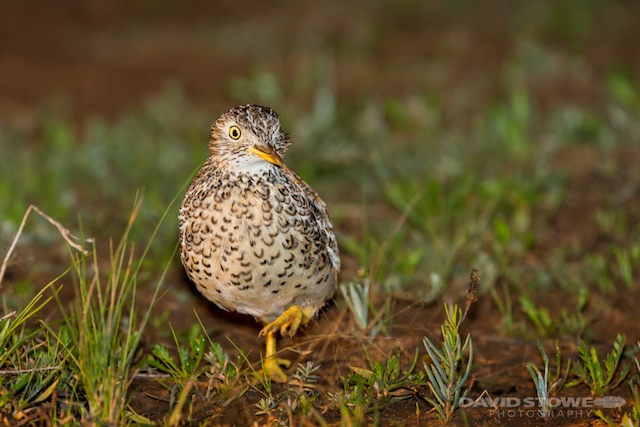
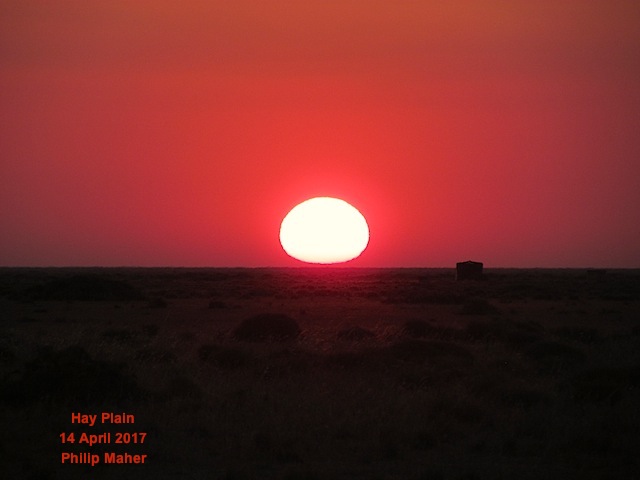
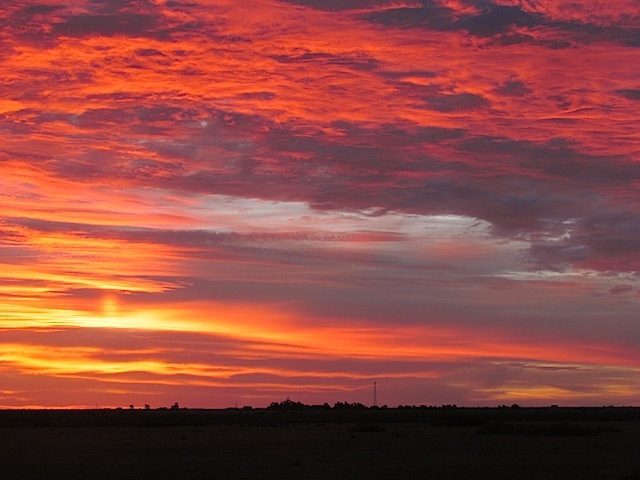
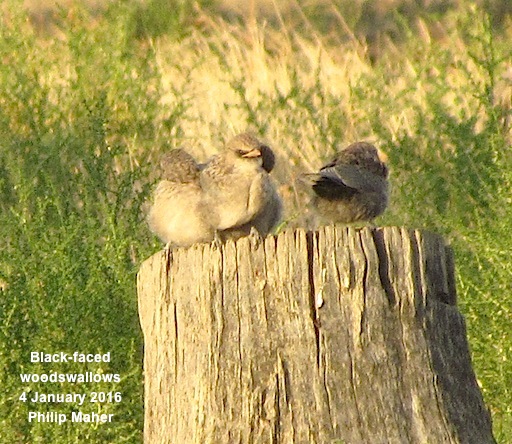
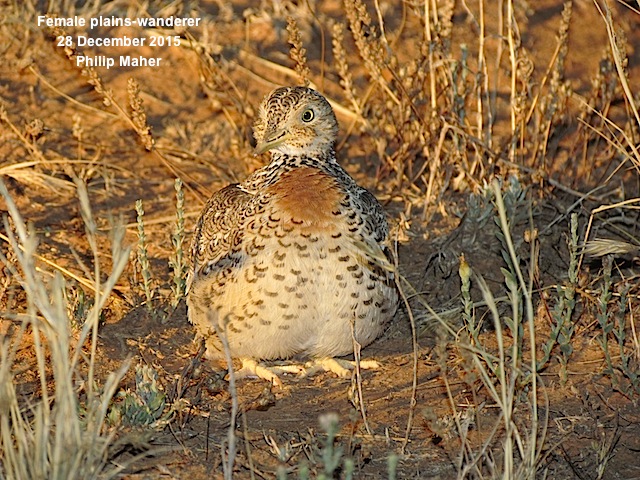
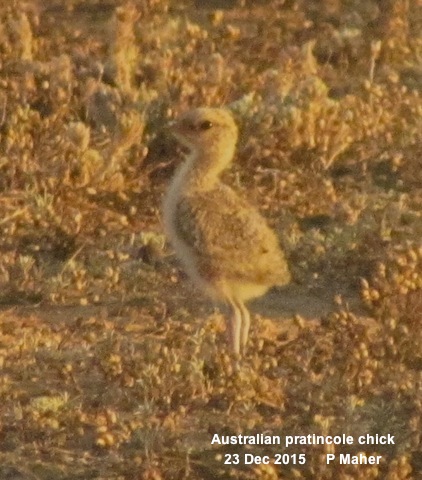
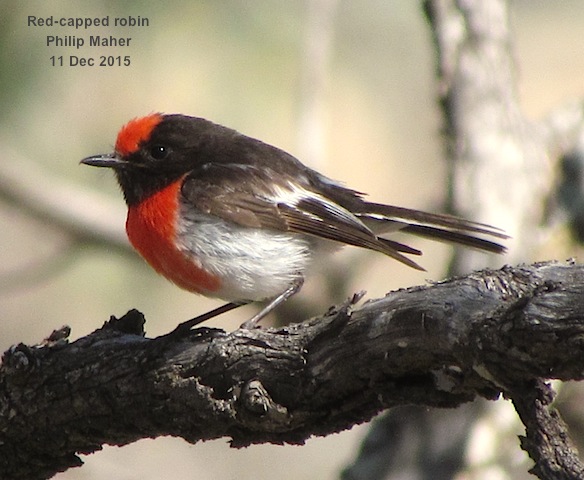
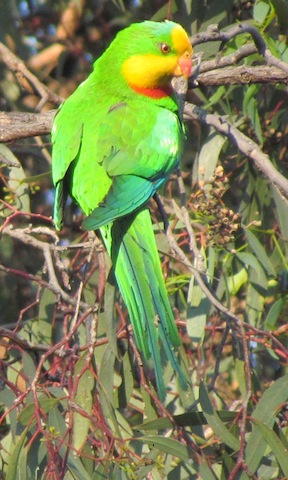
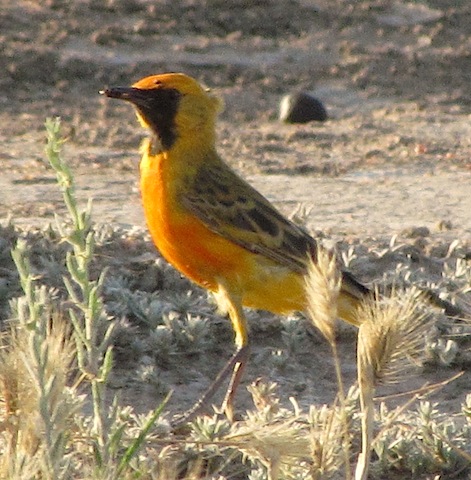
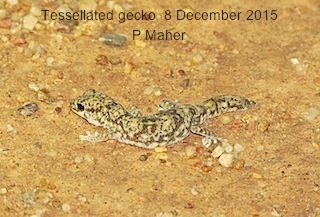 ..
..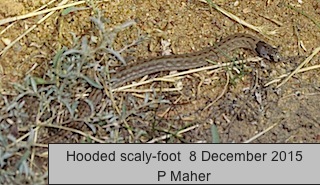
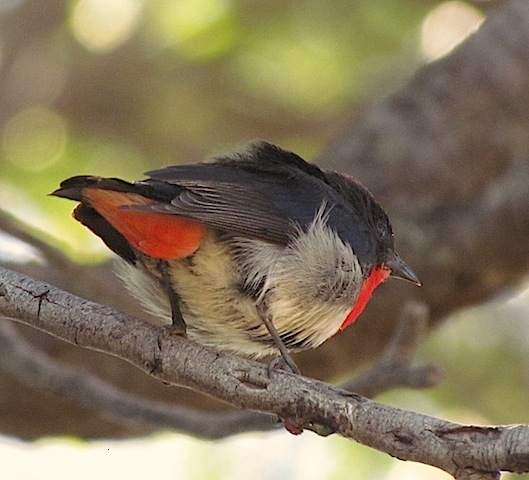
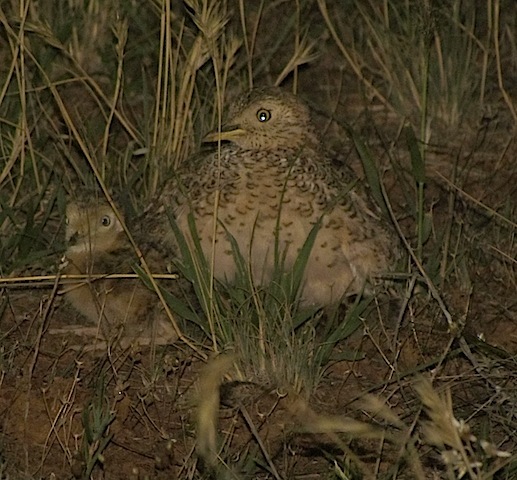
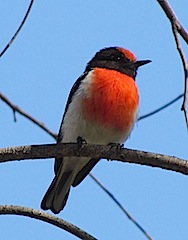
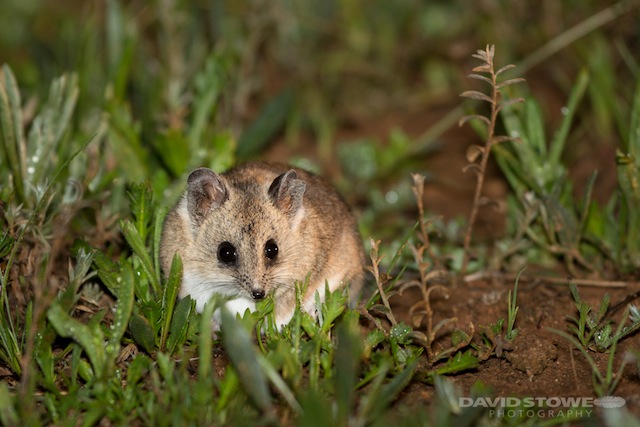
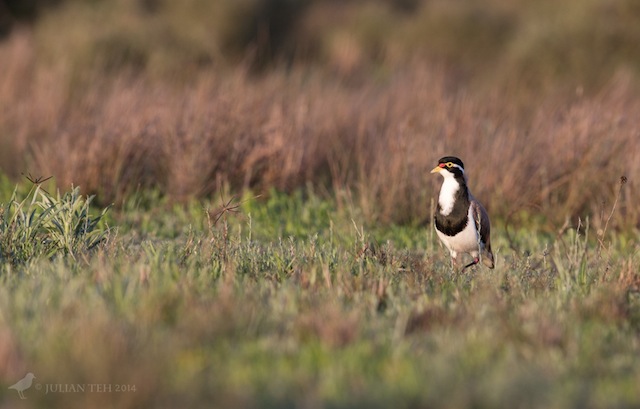
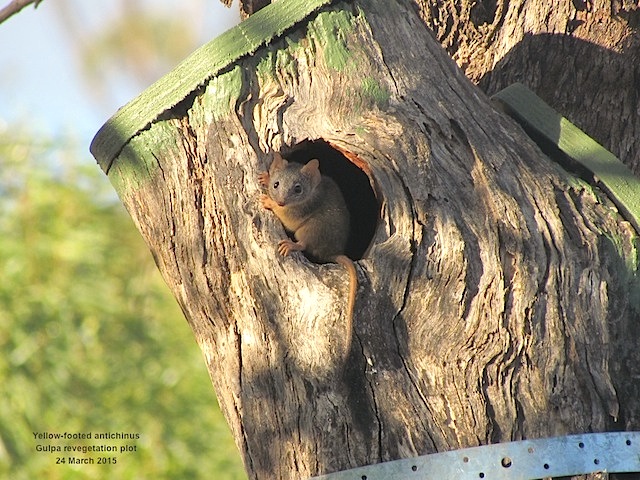
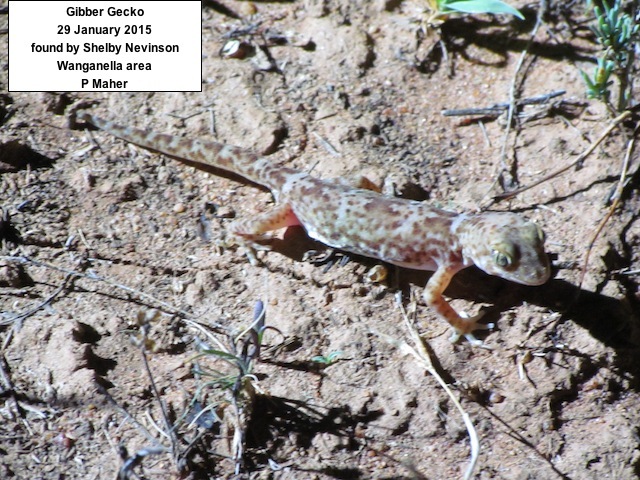
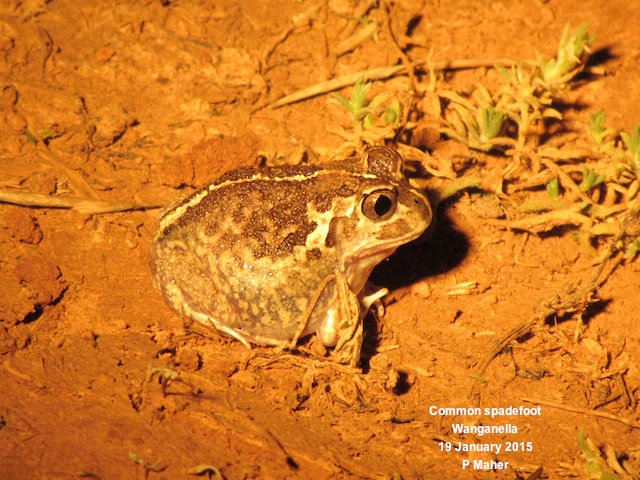
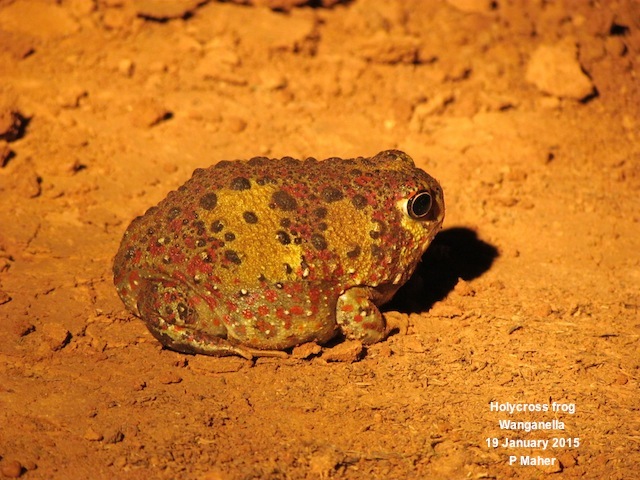
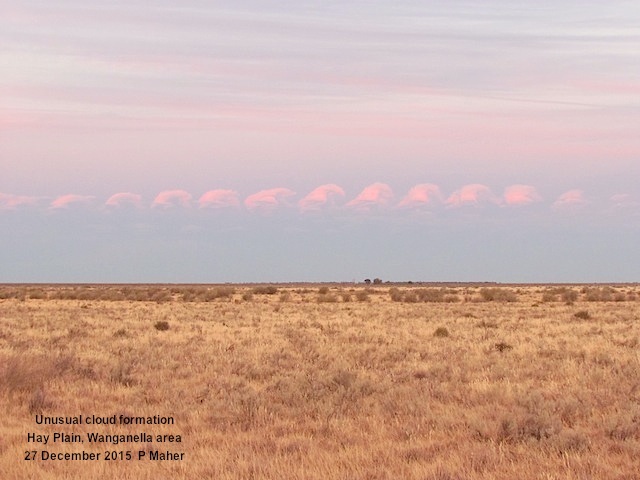
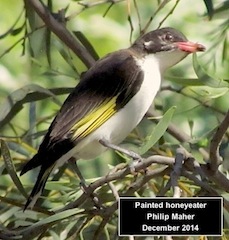
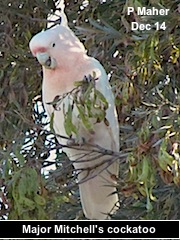 .....
.....